
How to Know When to Replace Your Water Heater (And When to Act Fast)
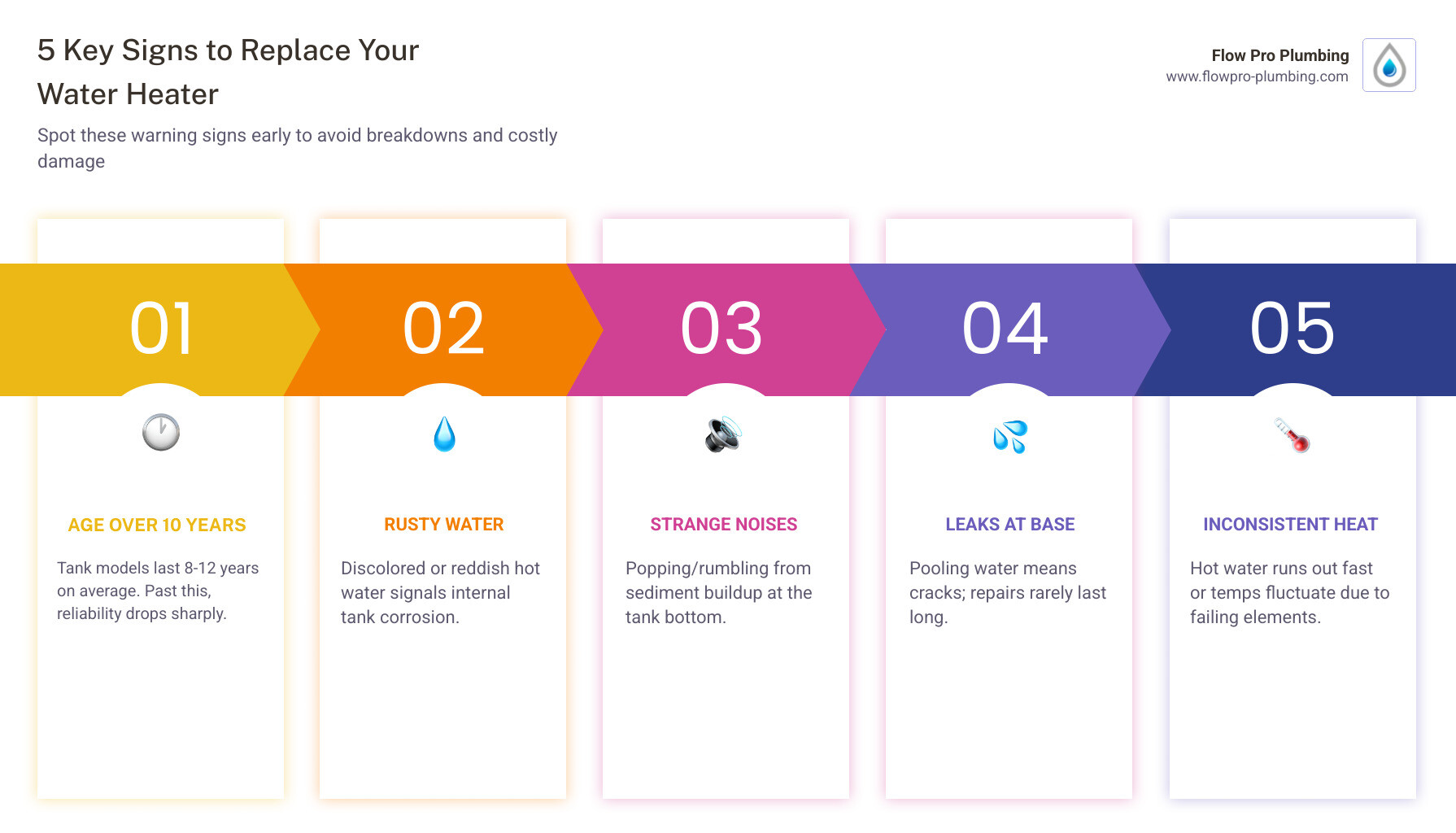
Knowing how to know when to replace your water heater can save you from a flooded basement, a cold shower at the worst possible moment, or a slow leak quietly damaging your home. Here’s a quick summary of the most common signs it’s time to replace:
- Age over 10 years – Most tank water heaters last 8 to 12 years. If yours is past that window, it’s time to start planning.
- Rusty or discolored hot water – Reddish or murky water from your hot tap points to internal tank corrosion.
- Rumbling or popping noises – These sounds usually mean sediment has built up at the bottom of the tank.
- Pooling water or leaks near the base – Moisture around the tank often signals cracks that won’t get better on their own.
- Inconsistent or insufficient hot water – If your hot water runs out faster than it used to, the tank may be failing.
- Rising energy bills without explanation – An aging heater works harder and uses more energy to do the same job.
Most homeowners don’t think much about their water heater until something goes wrong. It quietly does its job day after day, heating water for showers, dishes, laundry, and more. But like any appliance, it won’t last forever — and when it fails, it rarely happens at a convenient time. The good news is that the warning signs are usually there well before a breakdown, if you know what to look for.
I’m Jesse Delgado, owner of Flow Pro Plumbing in Brentwood, California, and I’ve spent years helping East Bay homeowners understand how to know when to replace your water heater before it becomes an emergency. In this guide, I’ll walk you through everything you need to make a confident, informed decision.
Understanding Average Water Heater Lifespans
When we talk about water heaters, the first thing we look at is the clock. Every appliance has a “biological clock” of sorts, and for water heaters, that clock is determined largely by the type of unit you have installed.
Conventional Tank Lifespan
For the majority of homes in Brentwood, Oakley, and Antioch, the standard is the conventional storage tank water heater. These units work by keeping a large volume of water hot 24/7. Because they are constantly holding water, they are subject to steady corrosion. On average, a conventional tank water heater has a typical lifespan of 8 to 12 years. If your unit is celebrating its 10th birthday, it is officially in the “red zone.” While some well-maintained units might stretch to 15 years, the risk of a catastrophic tank failure increases significantly every year after a decade.
Tankless Longevity
If you are looking for a marathon runner rather than a sprinter, tankless models are the way to go. Because they only heat water on demand and don’t store it in a large metal vat, they avoid many of the corrosion issues that plague tank models. A tankless water heater can last up to 20 years or more with proper care. If you are tired of the 10-year replacement cycle, you might want to Explore Tankless Water Heaters as a long-term solution for your home.
Gas vs. Electric Models
Does the fuel source matter? Generally, yes. Natural gas water heaters typically last between 6 and 12 years. Electric models often last slightly longer because they don’t have a burner at the bottom that creates intense thermal stress on the tank’s floor. However, both are still susceptible to the same water quality issues. Understanding the Benefits of a Tankless Water Heater can help you decide if switching fuel types or delivery methods is right for your household usage patterns.
Impact of Water Quality and Usage
In our neck of the woods—from Concord to Discovery Bay—water hardness can vary. Hard water contains minerals like calcium and magnesium that settle at the bottom of the tank. This sediment acts as an insulator, forcing the burner to work harder and eventually causing the metal to overheat and fatigue. A large household that uses hundreds of gallons of hot water a day will naturally wear out a heater faster than a single-occupant home.
How to Know When to Replace Your Water Heater: 5 Warning Signs
If you aren’t sure how old your unit is, your plumbing will usually try to tell you something is wrong. Here are the five “cries for help” your water heater might make.
1. Rusty or Discolored Water
If you turn on the hot water and it looks like tea or has a metallic smell, you have a problem. This usually indicates internal tank corrosion. To be sure, run the cold water. If the cold water is clear but the hot water is rusty, the rust is coming from inside your heater. Once the steel tank starts to rust through, there is no “patching” it—it’s time for Water Heater Repair and Installation assessment.
2. Strange Noises: Popping and Rumbling
Does your water heater sound like it’s boiling marbles? Those popping and rumbling sounds are caused by sediment buildup. As the sediment hardens into a thick crust at the bottom, pockets of water get trapped underneath it. When the burner turns on, that trapped water boils and “pops” through the sediment layer. This isn’t just annoying; it’s a sign that the bottom of your tank is being scorched, leading to cracks.
3. Persistent Leaks and Moisture
Any sign of water around the base of your heater is a major red flag. Metal expands when it heats and contracts when it cools. Over thousands of cycles, small fractures can form in the tank. If you see puddles, don’t wait. A small drip today can become a 50-gallon flood tomorrow. For residents in our service area, our Water Heater Replacement Brentwood Guide offers deeper insights into handling these leaks.
4. Inconsistent Water Temperatures
If your morning shower starts hot but turns lukewarm after five minutes, your heating elements (in electric models) or the burner assembly (in gas models) are likely failing. It could also mean that sediment has taken up so much space in the tank that there isn’t enough room for a full supply of hot water anymore.
5. Rising Energy Bills
If your gas or electric bills are creeping up but your usage hasn’t changed, your water heater might be the culprit. As units age and accumulate scale, they become incredibly inefficient. You’re essentially paying more money for less hot water.
Determining the Age of Your Unit
If you’ve lived in your home for a while, you might have forgotten exactly when that heater was installed. Luckily, every unit has a “birth certificate” in the form of a manufacturer label.
To find the age, look for the serial number on the side of the tank. It’s usually a string of letters and numbers. Most manufacturers use a code where the first letter represents the month (A for January, B for February, etc.) and the next two digits represent the year. For example, a serial number starting with “C15” likely means the unit was manufactured in March 2015.
If you can’t decode it yourself, resources like the Building Intelligence Center can help, or you can check our guide on Water Heater Maintenance Brentwood for more tips on reading your equipment. If your unit is over 10 years old, it has reached the threshold where ENERGY STAR recommends a proactive replacement. You should also consider How Long for Water Heater to Heat Up as a benchmark for performance; if it’s taking forever, age is likely the factor.
Repair vs. Replacement: Making the Right Choice
We often get asked, “Can’t you just fix it?” The answer depends on the age and the specific problem.
| Feature | Repair Benefits | Replacement Advantages |
|---|---|---|
| Cost | Lower immediate investment | Lower long-term utility bills |
| Lifespan | Extends life of a newer unit | Resets the clock for 10-20 years |
| Efficiency | Restores original efficiency | Upgrades to modern standards |
| Safety | Fixes immediate hazards | Eliminates risk of tank bursts |
If your unit is under 8 years old and has a specific broken part—like a thermocouple or a heating element—a repair is usually the smart move. You can refer to our Hot Water Heater Repair Guide for more on these common fixes. However, if the tank itself is leaking or rusted, repair is impossible. Even for modern units, you might wonder Can a Tankless Hot Water Heater Be Repaired?—the answer is yes, as they are highly modular.
How to know when to replace your water heater based on repair history
Are you on a first-name basis with your plumber? If you find yourself calling us every six months because the Water Heater Pilot Light Won’t Stay Lit or the elements keep burning out, you are throwing good money after bad. Frequent repairs are a sign of a system in total decline. At some point, the cumulative cost of service calls will outweigh the cost of a brand-new, reliable unit.
How to know when to replace your water heater for better energy efficiency
Modern water heaters are significantly more efficient than those built just a decade ago. New insulation standards and better burner designs mean less “standby heat loss.” If you switch to a Tankless Water Heater Installation, you eliminate standby loss entirely. Look for the Uniform Energy Factor (UEF) rating on new models—the higher the number, the more hot water you get for every dollar spent on energy.
Maintenance Tips to Extend Your System’s Life
We want your water heater to last as long as possible. The secret isn’t magic; it’s maintenance.
- Annual Flushing: This is the big one. Learning How to Flush a Water Heater allows you to remove the sediment before it hardens. We recommend doing this at least once a year, or more often if you live in an area with particularly hard water.
- Check the Anode Rod: Inside your tank is a “sacrificial” rod made of magnesium or aluminum. Its only job is to rust so your tank doesn’t. If this rod is completely dissolved, the rust will start attacking your tank walls.
- Test the T&P Valve: The Temperature and Pressure relief valve is a safety device. If it’s stuck, your tank could theoretically become a pressurized rocket. We check these during every Water Heater Maintenance Brentwood visit.
- Set the Right Temp: Keep your thermostat at 120°F. This is hot enough for comfort but low enough to slow down mineral buildup and prevent scalding. Knowing How Often to Drain Your Water Heater is also key to keeping these settings effective.
Frequently Asked Questions
Should I replace my water heater if it’s old but still working?
This is the “if it ain’t broke, don’t fix it” dilemma. However, with water heaters, “broke” often means a flooded house. Preemptive replacement gives you the luxury of time to research the best models and schedule an appointment at your convenience, rather than making a panicked decision on a Sunday night while mopping up your garage. Plus, you’ll start saving on energy bills immediately.
What causes the popping or rumbling noises in my tank?
As mentioned earlier, this is almost always sediment. Think of it like a layer of sand at the bottom of a pot on the stove. The heat has to struggle to get through that sand to reach the water. This causes the bottom of the tank to overheat, which weakens the steel and leads to that distinctive “kettle” sound.
Can a leaking water heater be repaired?
If the leak is coming from a loose pipe connection or a faulty valve, yes! Those are easy fixes. But if the water is dripping from the actual body of the tank, it means the metal has corroded through. In that case, the unit is a goner and must be replaced to prevent a total rupture.
Conclusion
At Flow Pro Plumbing, we take pride in being the local experts that Brentwood, Oakley, and the surrounding East Bay communities trust. We aren’t just here to sell you a new unit; we’re here to ensure your home is safe, efficient, and comfortable. Whether you need a quick repair, a routine flush, or a full system upgrade, our team brings unsurpassed workmanship to every job.
Don’t wait for a cold shower to tell you it’s time for a change. If you’re still wondering how to know when to replace your water heater, give us a call. We can perform a professional assessment of your current system and help you explore all your Water Heaters options, from traditional tanks to high-efficiency tankless models.
Ready to secure your home’s hot water for the next decade? Schedule your consultation today with the friendly pros at Flow Pro Plumbing!