

Hydro Jetting vs Snaking Which Is Better for Clogged Drains in Brentwood, CA?
Hydro jetting vs snaking which is better really depends on your specific situation — the type of clog, the condition of your pipes, and whether you’re dealing with a one-time blockage or a recurring problem. Here’s a quick answer to help you decide:
Quick Comparison: Hydro Jetting vs Snaking
| Factor | Snaking | Hydro Jetting |
|---|---|---|
| Best for | Simple, localized clogs | Recurring clogs, grease, roots, buildup |
| How it works | Breaks through or grabs the clog | Scours entire pipe wall with high-pressure water |
| Pipe safety | Safer for older or fragile pipes | Requires inspection first; not ideal for damaged pipes |
| Results last | 3–6 months | 1–4 years |
| Ideal pipe age | Any, including older systems | Pipes in good condition |
| Camera inspection needed? | Usually not | Strongly recommended |
One day your drains work fine. The next, your kitchen sink backs up and your shower drains at a crawl. For homeowners in Brentwood and across Contra Costa County, slow or blocked drains are one of the most common — and most frustrating — plumbing problems. The real question isn’t just how to fix the clog in front of you. It’s how to stop it from coming back.
That’s where the choice between snaking and hydro jetting matters most. Snaking has been a plumbing staple since the 1800s, and it still works well for the right situations. Hydro jetting is a more powerful, thorough approach that uses water pressurized up to 4,000 PSI to scour pipe walls clean — not just punch a hole through the blockage. Each method has its place, and choosing the wrong one can mean the same clog returns in a matter of weeks.
I’m Jesse Delgado, owner of Flow Pro Plumbing in Brentwood, California, and I grew up working alongside my father on plumbing jobsites — which means I’ve seen how the right drain cleaning method can make the difference between a lasting fix and a repeat service call. In this guide, I’ll walk you through everything you need to know about hydro jetting vs snaking which is better for your home’s drains, so you can make a confident, informed decision.
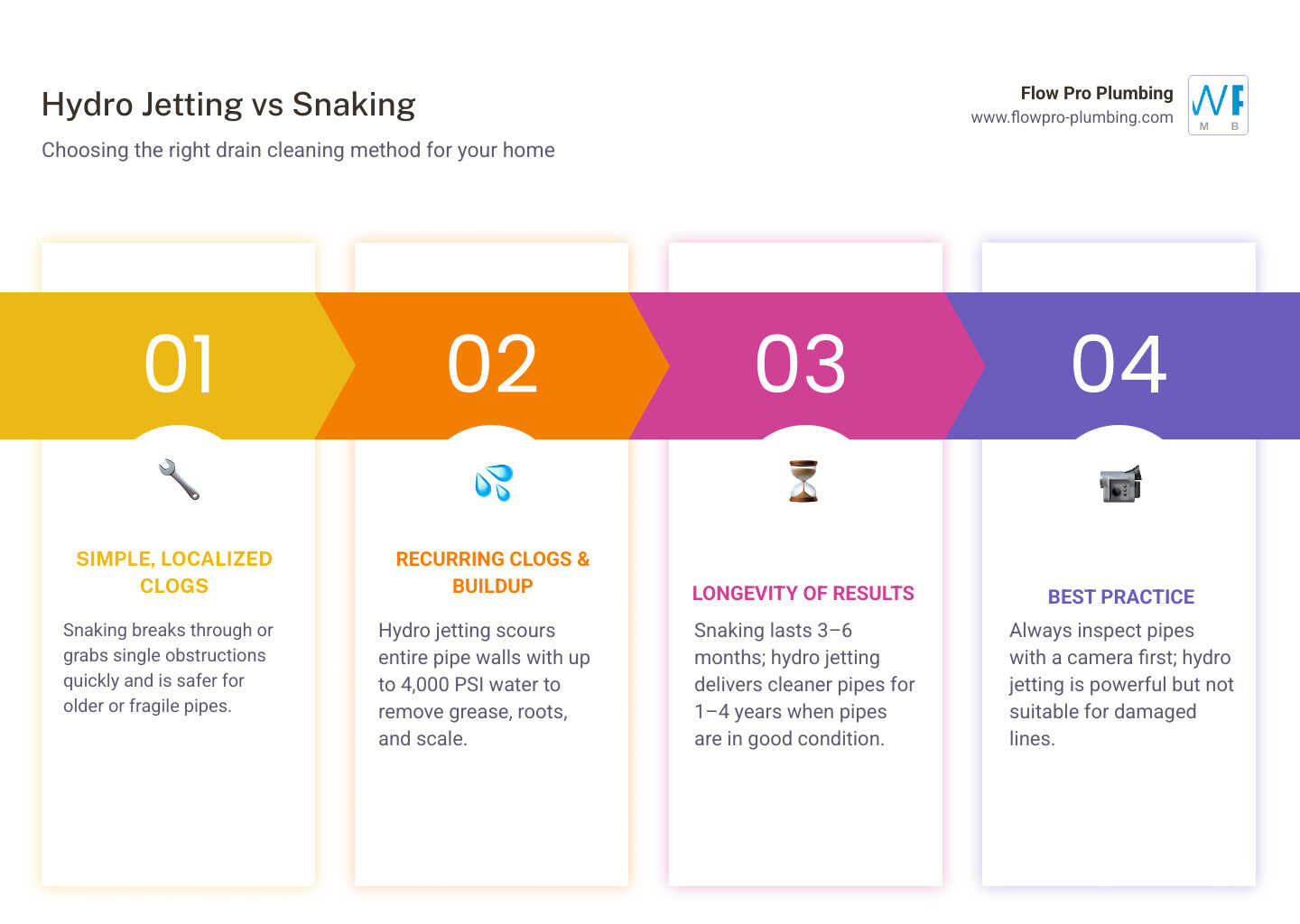
Hydro jetting vs snaking which is better word guide:
Understanding the Methods: How Snaking and Hydro Jetting Work
To make an informed decision for your home, it helps to understand what is happening inside your pipes during each procedure. While both methods are designed to clear blockages, they rely on completely different mechanical principles. One acts as a physical punch to create a pathway, while the other acts as an all-encompassing wash to restore your pipes to like-new condition.
When deciding on the right approach, homeowners often ask, What is the Best Method for Cleaning Drains? The answer lies in matching the tool to the specific plumbing issue.
What Is Drain Snaking and How Does It Work?
Drain snaking, also known as using a plumbing auger, is one of the oldest and most reliable physical methods for clearing a drain. The tool itself consists of a long, flexible steel cable with a coiled, corkscrew-shaped tip or a cutting blade at the end.
When we perform professional snaking, we feed this cable down your drain until it encounters the physical obstruction. By rotating the cable—either manually with a hand crank or with a motorized machine—the tip bores directly into the blockage.
Depending on the nature of the clog, the snake will either:
- Break the physical obstruction apart into smaller pieces so they can safely wash down the line.
- Grab onto the obstruction (such as a massive clump of hair, wet wipes, or a foreign object) so we can physically pull it back out of the drain.
This targeted, minimal-force approach is highly effective for localized clogs. If you want to understand how this is done for minor residential issues, you can read our guide on How to Use a Drain Snake on Clogged Pipes.
What Is Hydro Jetting and How Does It Work?
Hydro jetting is a modern, high-tech method that cleans your pipes rather than just clearing them. Instead of using a metal cable to punch through a clog, hydro jetting relies on high-pressure water delivered through a specialized hose and multidirectional nozzle.
During this process, we insert the hose into your plumbing system through an accessible cleanout. A specialized machine pumps water at pressures ranging from 1,500 to 4,000 PSI. The nozzle features a forward-facing jet to blast through stubborn blockages, along with multiple rear-facing jets that propel the hose forward while scouring the entire interior pipe wall.
This intense water pressure doesn’t just push debris out of the way; it completely shears off built-up grease, soap scum, mineral scale, and even invasive tree roots. To learn more about this process, explore What Does Hydro Jetting Do? and read The Ultimate Guide to How Hydro Jetting Works for Your Drains.
Hydro Jetting vs Snaking Which Is Better for Your Home’s Drains?
Now that you know how each method works, let’s look at hydro jetting vs snaking which is better for your overall home plumbing health. For a detailed side-by-side analysis, check out The Ultimate Drain Showdown: Hydro Jetting vs Snaking Comparison.
While snaking is a fantastic “first-aid” response for a sudden, simple backup, hydro jetting is the gold standard for long-term preventative maintenance and severe line blockages. Let’s compare their performance across the most common plumbing challenges.
Hydro Jetting vs Snaking Which Is Better for Recurring Clogs?
If you find yourself calling a plumber every few months for the exact same drain, you are dealing with a recurring clog. In this scenario, hydro jetting is significantly better than snaking.
When a drain snake encounters a soft clog—such as grease, soap scum, or sludge—it simply punches a small hole through the center of the mess to restore basic water flow. However, the sticky residue remains plastered to the pipe walls. This leftover film acts like a magnet, catching hair, food particles, and paper products. Within 3 to 6 months, the pipe narrows again, and the clog returns.
Hydro jetting removes 100% of this wall buildup. By blasting away the sticky biofilm, grease, and mineral scale, it restores the pipe to its original diameter. This thorough cleaning prevents new debris from catching on the pipe walls, which is why hydro jetting results last much longer. For a deeper look at timeline expectations, read How Long Does Hydro Jetting Last?
Hydro Jetting vs Snaking Which Is Better for Older Pipes?
In older homes across Contra Costa County—especially those built before 1980 in historic areas of Brentwood, Pittsburg, or Concord—the choice of drain cleaning method requires extreme caution. In this battle, snaking is often the safer, more appropriate choice.
Older homes frequently feature fragile pipe materials, such as cast iron, clay, or orangeburg pipes. Over decades, these lines can suffer from:
- Severe corrosion and thinning pipe walls
- Hairline cracks and structural weaknesses
- Shifting joints caused by soil movement
Subjecting a fragile, corroded cast iron or cracked clay pipe to 4,000 PSI of water pressure can cause catastrophic damage, leading to collapsed lines and costly excavation repairs. Snaking offers a gentler, mechanical alternative that removes immediate blockages without putting intense pressure on fragile pipe walls.
If we do use hydro jetting on older lines, we must always perform a detailed camera inspection first and adjust the pressure to a lower, safer setting.
The Role of Professional Camera Inspections
Before we perform any high-pressure drain cleaning, we always start with a professional sewer camera inspection. This step is non-negotiable for protecting your home’s plumbing system.
A sewer camera inspection involves feeding a flexible, high-resolution fiber-optic camera down your sewer lateral. This allows us to see the exact state of your pipes in real-time on a digital monitor.
This diagnostic process reveals:
- The exact location and composition of the clog (whether it is grease, hair, a foreign object, or tree roots)
- The material, age, and physical condition of your pipes
- Any hidden structural issues, such as cracks, sagging lines (bellies), offset joints, or pipe collapses
Without this visual confirmation, hydro jetting is like driving blindfolded. If we attempt to jet a pipe that is already collapsed or severely broken, we risk making the damage far worse. For more information on how this technology works, check out our guide on Sewer Camera Inspection and learn How Sewer Video Inspections Find Hidden Problems Before They Explode.
Frequently Asked Questions About Drain Cleaning
Understanding the differences between these two methods helps you make the best decision for your home. Here are answers to some of the most common questions we receive from homeowners in Brentwood, Oakley, and Antioch.
Can hydro jetting damage my home’s pipes?
When performed by a licensed, experienced professional, hydro jetting is entirely safe for your plumbing system. However, if it is done by an untrained technician or without a preliminary camera inspection, the high water pressure can damage pipes.
Specifically, pre-existing cracks can expand, corroded cast iron walls can rupture, and loose joints in clay pipes can blow apart under high pressure. That is why we always inspect the structural integrity of the line first and carefully calibrate the water pressure to match the pipe’s material and condition.
How long do the results of hydro jetting last compared to snaking?
The difference in longevity is one of the main reasons homeowners choose hydro jetting.
- Snaking typically keeps drains clear for 3 to 6 months because it only creates a temporary path through the blockage, leaving behind sticky residues that quickly attract new debris.
- Hydro jetting results routinely last 1 to 4 years because it completely scours the line clean, removing the grease and scale that cause recurring clogs.
This makes hydro jetting a highly effective form of preventative maintenance. To explore the long-term advantages further, read about the Hydro Jetting Benefits That Will Flush Your Worries Away.
Can snaking make a drain clog worse?
Yes, if used incorrectly, a drain snake can worsen a blockage. An inexperienced user or an improper DIY attempt can push the clog deeper into the plumbing system, compacting the debris into a dense, solid plug that is much harder to remove.
Additionally, forcing a metal snake through tight pipe bends can scratch or scrape the interior walls, creating rough spots where future debris can easily catch. To learn how to avoid these issues, read our article on how to Effortlessly Unclog Pipes: Master the Drain Snake Technique.
Conclusion
When it comes to hydro jetting vs snaking which is better for your home, there is no single “correct” answer—only the right tool for your specific plumbing needs. Snaking remains an excellent, cost-effective choice for simple, localized clogs and fragile older pipes. However, if you are fighting a constant battle against recurring clogs, grease buildup, mineral scale, or invasive tree roots, hydro jetting provides a complete, long-lasting solution that restores your lines to peak performance.
At Flow Pro Plumbing, we believe in providing honest, professional advice and lasting solutions. Whether you live in Brentwood, Oakley, Antioch, Discovery Bay, Pittsburg, or Concord, our team of friendly, licensed plumbers is ready to help you find the perfect fix for your drains. We combine advanced camera diagnostics with expert workmanship to ensure your home’s plumbing runs smoothly and reliably.
Don’t let slow, stubborn drains disrupt your peace of mind. Schedule professional drain services with Flow Pro Plumbing today for fast, courteous, and professional plumbing help!