

What a Sewer Video Inspection Actually Is (And Why It Matters)
A sewer video inspection is a diagnostic method where a waterproof, high-definition camera mounted on a flexible cable is fed into your home’s sewer line to visually assess the pipe’s interior in real time — without any digging. Here’s a quick breakdown:
- What it does: Sends live video from inside your pipes to a monitor above ground
- What it finds: Cracks, root intrusion, blockages, corrosion, bellied pipes, and offset joints
- Who performs it: A licensed plumber or certified sewer scope inspector
- How long it takes: Typically 30 to 60 minutes for a standard residential property
- Why it matters: It replaces costly guesswork with a clear, visual diagnosis
For decades, the only way to truly know what was happening inside a buried sewer line was to dig it up. That meant expensive excavation, torn-up yards, and plenty of uncertainty — even after the work was done. Today, a sewer camera changes all of that. It gives homeowners and plumbers a direct look at what’s happening underground, before a slow drain turns into a sewage backup or a small crack becomes a collapsed pipe.
This is especially important in the East Bay Area, where older homes, mature trees, and aging clay pipes create conditions where sewer problems can develop quietly for years before they surface.
I’m Jesse Delgado, owner of Flow Pro Plumbing in Brentwood, California, and I grew up in a family of plumbers — so understanding what is a sewer video inspection and how to use it as a diagnostic tool is something I’ve been doing for most of my career. In this guide, I’ll walk you through exactly how the process works, what it can and can’t find, and what to do when something shows up on camera.
What is a Sewer Video Inspection?
At its core, a sewer video inspection is a form of “telepresence.” Think of it like a colonoscopy for your home’s plumbing. We use a specialized, waterproof HD camera attached to a long, flexible fiber-optic cable. This cable is sturdy enough to be pushed through the twists and turns of your underground pipes but flexible enough to navigate around elbows and joints.
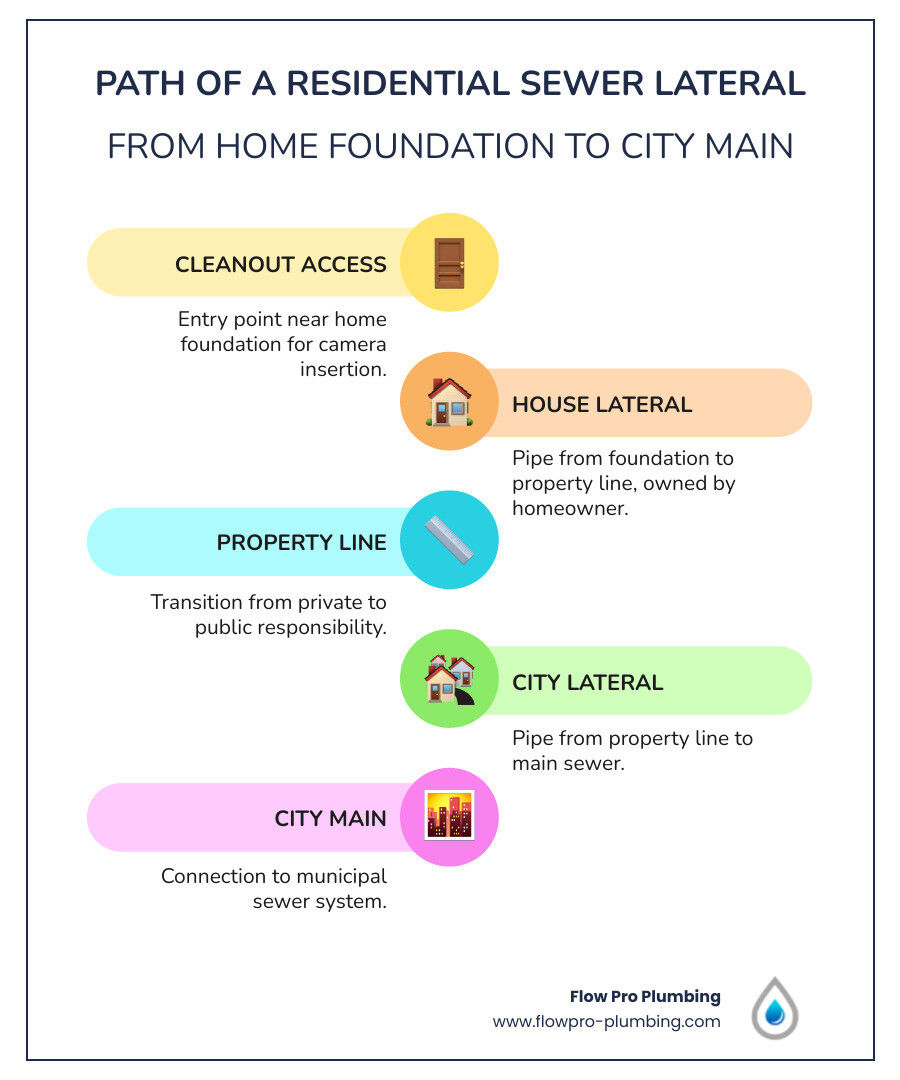
When we perform a Sewer Video Inspection, we aren’t just looking for big clogs. We are conducting a comprehensive visual assessment of the entire lateral line—the pipe that connects your home to the municipal sewer main or a septic tank. This is a non-destructive testing method, meaning we don’t have to break through your concrete slab or dig up your rose bushes just to see if there’s a problem.
The Sewer Video Inspection Role has become indispensable in modern plumbing. In the past, if a drain in Antioch or Concord kept backing up, a plumber might just “snake” the line, clear the immediate clog, and leave. But without seeing why it clogged, the problem would inevitably return. Maybe it was a cracked pipe or a “belly” in the line where waste collects. The camera takes the “maybe” out of the equation.
How a Sewer Line Inspection Camera Works
You might wonder how a tiny camera can see anything in the pitch-black environment of an underground sewer pipe. The technology is actually quite impressive.
- The Camera Head: The tip of the cable contains a high-definition camera surrounded by powerful LED lights. These lights illuminate the interior of the pipe, allowing us to see every detail, from tiny hairline cracks to massive root balls.
- The Push Rod: The camera is mounted on a semi-rigid “fish” or push rod. For residential Sewer Camera Inspection work in places like Oakley or Pittsburg, we typically use a push-rod system that can span anywhere from 40 to 150 feet.
- The Monitor: As the camera travels through the pipe, it broadcasts a live video feed to an HDTV monitor. This allows us (and you!) to see the condition of the pipe in real-time.
- Distance Tracking: The system tracks exactly how many feet of cable have been deployed. If we see a break at the 32-foot mark, we know exactly how far away it is from the access point.
- The Sonde (Radio Transmitter): This is the “secret sauce” of precision. The camera head contains a radio transmitter, often called a sonde. If we find a collapsed section of pipe, we can use a handheld locating device above ground to “find” the signal from the sonde. This tells us the exact physical location and depth of the problem. Instead of digging up your whole yard, we can pinpoint the exact two-foot section that needs repair.
By using these tools, Sewer Video Inspections Prevent Plumbing Issues from escalating. We can record the entire session to a USB drive or the cloud, giving you a digital “receipt” of your pipe’s health that you can use for insurance claims or home sale negotiations.
Common Issues and Limitations of Video Scopes
While the camera is a superhero tool, it’s important to understand what it’s looking for and what its limits are. In our service areas like Discovery Bay and Walnut Creek, we see a wide variety of pipe materials—from modern PVC to old-school cast iron and vitrified clay.
Identifying Problems with a Sewer Video Inspection
When we slide that camera into your line, we are looking for several specific “red flags”:
- Root Intrusion: This is the #1 problem in older East Bay neighborhoods. Tree roots are attracted to the moisture and nutrients inside sewer pipes. They can enter through tiny cracks or gaps in pipe joints. Once inside, they grow into massive “root balls” that act like a net, catching grease and debris. Root Intrusion Removal is often the first step in restoring flow.
- Bellied Pipes: Over time, the soil beneath a pipe can shift or settle, causing a section of the pipe to sink. This creates a “U” shape or a “belly.” Because sewer lines rely on gravity, water and waste sit in this low spot, leading to frequent clogs.
- Corrosion: Cast iron pipes, common in homes built before the 1970s, eventually rust and deteriorate. The camera can show us if the bottom of the pipe has rotted away.
- Offset Joints: In clay pipes, the sections can shift due to ground movement, leaving a gap at the joint where sewage can leak out and roots can get in.
- Pipe Material Identification: Sometimes a homeowner doesn’t even know what their pipes are made of. The camera easily identifies if you have PVC, cast iron, orangeburg (tar paper), or clay.
By catching these issues early, you can Avoid Common Sewer Problems that lead to emergency calls at 2:00 AM. If the damage is extensive, we move toward Sewer Main Line Repair to ensure the structural integrity of your system.
Limitations of Video Technology in Leak Detection
It is a common misconception that a sewer camera is a “leak detector.” While a camera is an incredible tool, it has specific limitations:
- The Internal View Constraint: The camera is inside the pipe. It can see a crack, but it can’t always tell if that crack goes all the way through the pipe wall.
- Buildup Interference: If a pipe is coated in grease, sludge, or “scale” (mineral buildup), a crack or pinhole leak might be hidden behind that layer of grime.
- External Issues: A camera cannot see what is happening outside the pipe. It won’t show us soil erosion or “voids” caused by leaking water unless the pipe has already started to collapse into that void.
- Pinhole Leaks: Very small leaks might not be visible on a standard video feed. To officially certify a line is “leak-free,” we often need to perform a pressure test or a static water test in addition to the video scope.
Understanding these boundaries is part of the Essential Sewer Repair Services we provide. We won’t tell you a line is perfect just because the camera didn’t see a giant hole; we look at the whole picture.
When to Schedule and What to Expect During the Process
Knowing when to call for a scope can save you thousands of dollars in the long run. If you are buying a home in Bethel Island or Clayton, you should consider a sewer scope as part of your “must-have” due diligence.
Sewer Scope vs. Standard Home Inspection
Many first-time homebuyers are surprised to learn that a standard home inspection does not cover the underground sewer line. Most home inspectors follow standards that exclude anything underground or hidden behind walls.
| Feature | Standard Home Inspection | Sewer Scope Inspection |
|---|---|---|
| Focus | Roof, HVAC, Electrical, Structure | Underground Sewer Lateral Line |
| Tools | Flashlight, Moisture Meter, Eyes | HD Waterproof Camera, Sonde |
| Scope | Visible Plumbing only | Interior of Private Sewer Line |
| Goal | General Safety & Function | Identify Roots, Cracks, & Collapses |
If you are looking at a home built before 1984, you are in a “high-risk” zone for clay pipe problems. Clay was the standard for decades, but it is prone to cracking and root intrusion. A quick 30 to 60-minute inspection can tell you if you’re buying a dream home or a plumbing nightmare.
For current homeowners, Preventing Sewer Blockages starts with knowing the state of your pipes. If you have large trees near your sewer line or you’ve noticed slow drains across multiple bathrooms, it’s time for a look. Keeping Up With Sewer System Services In Your Home is the best way to protect your property value. Whether you need Sewer Service Concord CA or an inspection in Pleasant Hill, being proactive is key.
Benefits and Next Steps for Homeowners
Once the inspection is complete, you’ll have a clear path forward. At Flow Pro Plumbing, we don’t just show you the problem; we provide the solution.
The biggest benefit of a sewer video inspection is accurate diagnosis. Instead of guessing where a blockage is, we know exactly what it is and where it is. This prevents “exploratory digging,” which is just a fancy way of saying “digging up your yard until we find something.”
If the camera reveals a problem, we have several Sewer Pipe Repair Methods at our disposal. One of the most popular is trenchless repair. There are huge Benefits Of Trenchless Sewer Repair, including:
- Saving your landscaping and driveway.
- Faster completion times.
- Durable, seamless pipes that roots can’t penetrate.
If you are in our backyard, we specialize in Sewer Line Repair Brentwood CA, using the latest technology to fix your pipes with minimal disruption to your life. After any repair, we perform a follow-up video inspection to verify that the work was done perfectly and your line is clear.
Frequently Asked Questions
Frequently Asked Questions About What is a Sewer Video Inspection
What exactly is a sewer video inspection? It is a diagnostic procedure using a high-resolution, waterproof camera on a flexible cable to view the inside of your sewer pipes. It allows us to see the “unseen” without digging up your property.
Is the technology waterproof? Yes. These cameras are specifically designed to work in wet, harsh environments. They can even be used while water is running to help us identify the flow and see where water might be “pooling” in a bellied pipe.
Can I see the footage? Absolutely. We provide our clients with a clear, real-time explanation of what we are seeing, and we can provide digital copies of the recording for your records.
What happens if the inspection reveals a broken pipe?
If we find a break, the next step depends on the severity. For minor cracks, we might recommend a localized repair. However, if the pipe is old and failing in multiple spots, Trenchless Sewer Line Replacement Discovery Bay CA (or in our other service areas) is often the best long-term solution. This involves pulling a brand-new pipe through the old one, effectively “bursting” the old pipe and replacing it without a massive trench.
Can a sewer camera find a leak under a concrete slab?
A camera can find the likely source of a leak, such as a large crack or a separated joint under the slab. It can also show signs of moisture or mud entering the pipe. However, if you suspect a “slab leak,” we may use the camera in conjunction with secondary testing (like electronic leak detection or pressure testing) to be 100% certain. This is part of our Broken Sewer Pipe Repair process to ensure we handle the job right the first time.
Conclusion
In plumbing, knowledge is power. Understanding what is a sewer video inspection is the first step toward taking control of your home’s most critical (and most hidden) system. Whether you are a homebuyer looking for peace of mind or a homeowner in Knightsen or Bay Point dealing with a stubborn drain, a video scope is the most cost-effective, non-invasive way to get answers.
Don’t wait for a small crack to become a catastrophic backup. Proactive maintenance today protects your property value and your sanity tomorrow.
Schedule your professional Sewer Video Inspection today with the experts at Flow Pro Plumbing. We’re here to give you a clear view of what’s happening underground and the expert solutions to keep your home running smoothly.