
Signs of a Hidden Water Leak in Your Home You Should Never Ignore
The signs of a hidden water leak in your home can show up in ways you might not immediately connect to plumbing — a musty smell in a dry room, a water bill that keeps climbing, or paint that starts bubbling for no obvious reason. Here’s a quick look at the most common warning signs:
- Unexplained spike in your water bill — usage goes up but your habits haven’t changed
- Musty or earthy odors — especially in rooms that should be dry
- Mold or mildew growth — on walls, ceilings, or in corners
- Water stains or discoloration — yellow or brown patches on ceilings and walls
- Peeling paint or bubbling wallpaper — moisture trapped behind surfaces
- Warped, soft, or spongy floors — water saturating the subfloor
- Low water pressure — flow being diverted by a crack or leak in the line
- Sounds of running water when nothing is on — dripping, hissing, or rushing behind walls
- Foundation cracks — persistent moisture weakening structural integrity
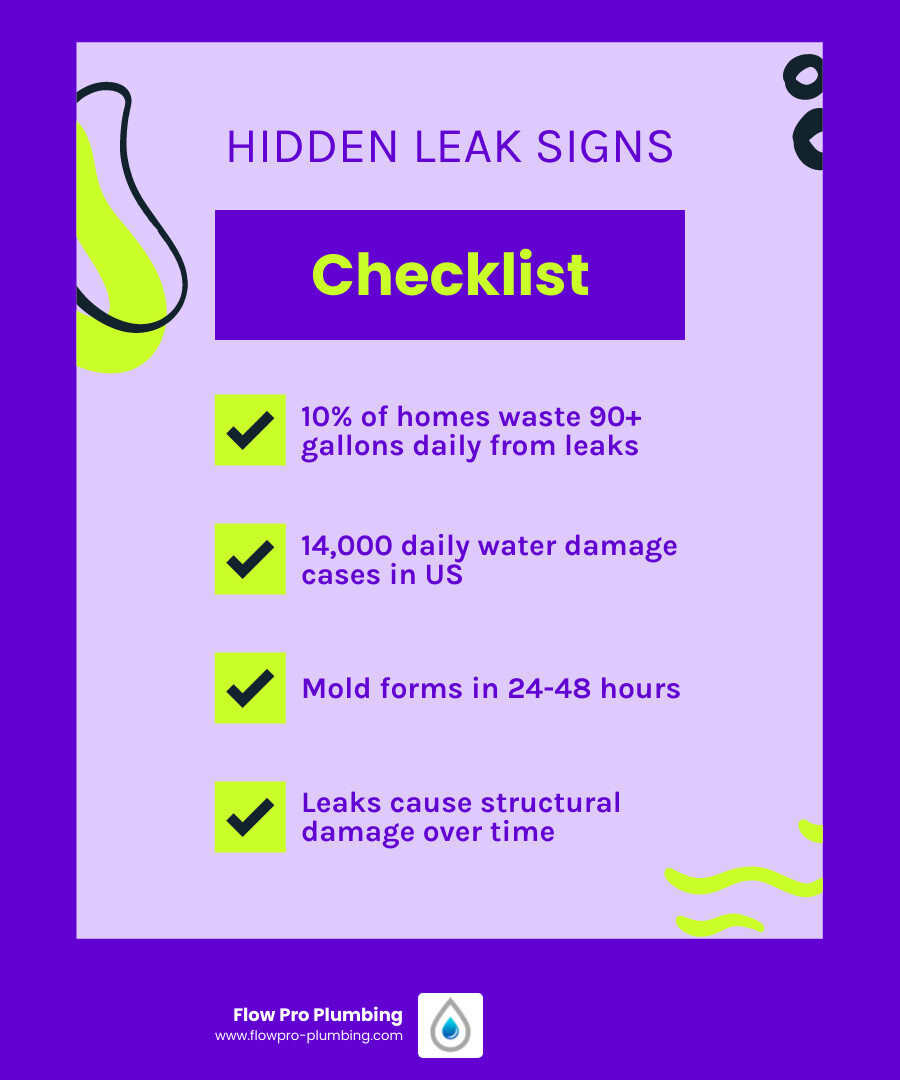
These leaks often go unnoticed for weeks or months. By the time visible damage appears, the problem has usually been growing quietly behind walls, under floors, or beneath your home’s foundation. According to the EPA, 10% of U.S. households waste 90 gallons or more per day from leaks — and nearly 14,000 Americans deal with water damage in their homes every single day. Mold can begin forming within just 24 to 48 hours of a leak starting, which means the window to act is short.
I’m Jesse Delgado, owner of Flow Pro Plumbing in Brentwood, California, and with over a decade of licensed plumbing experience I’ve seen how the signs of a hidden water leak in your home can go from a minor nuisance to a major structural problem almost overnight. I’ll walk you through exactly what to look for, how to test for leaks yourself, and when it’s time to call in a professional.
7 Common Signs of a Hidden Water Leak in Your Home
Identifying a leak early is the difference between a quick pipe repair and a full-scale home renovation. Many homeowners in Brentwood and Antioch assume that if they don’t see a puddle, there isn’t a problem. However, the most destructive leaks are the ones that stay out of sight.
One of the first red flags is a sudden, unexplained spike in your water bill. If your daily routine hasn’t changed—no extra houseguests, no new pool filling—but your bill is climbing, water is escaping somewhere. Even a pinhole leak can waste hundreds of gallons over a month.
Another major indicator is the presence of musty or earthy odors. If a room smells like a damp basement despite being cleaned regularly, there is likely moisture trapped behind the drywall. This environment is the perfect breeding ground for mold and mildew. If you see dark spots appearing on your walls or ceilings, you need to act fast. Understanding Common Pipe Leak Causes and How to Avoid Them can help you realize that age and corrosion often play a role in these silent failures.
Visual changes to your home’s surfaces are also telling. Look for:
- Peeling paint: Moisture causes paint to lose its adhesion to the wall.
- Bubbling wallpaper: Water vapor builds up behind the paper, creating visible pockets.
- Warped flooring: If your hardwood starts “cupping” or your laminate feels spongy, water is likely saturating the subfloor.
Low Water Pressure as a Sign of a Hidden Water Leak in Your Home
Have you noticed your morning shower feels more like a light drizzle? While a Leaky Faucet Fix might solve a localized drip, a sudden drop in pressure throughout the house often points to a larger issue.
When a pipe cracks or a joint fails, the water flow is diverted. Instead of all that pressure heading to your showerhead, some of it is being pushed out into your walls or foundation. If the pressure drop is consistent and affects multiple fixtures, it’s a strong sign that the supply line is compromised.
Auditory Signs of a Hidden Water Leak in Your Home
Sometimes your ears will find a leak before your eyes do. In the quiet of the night, listen for unusual sounds behind your walls. You might hear a faint hissing sound, which often indicates a high-pressure leak from a small hole. Other times, it sounds like constant dripping or even a rushing sound similar to a toilet filling, even when no water is being used.
If you hear these noises, knowing What to Do If a Pipe is Leaking is vital. These sounds can also be caused by air pockets or bubbling in the pipes, which occurs when a crack allows air to enter the system, creating a “knocking” or “gurgling” effect.
How to Perform DIY Leak Detection Tests
Before you start tearing through drywall, there are a few simple tests you can perform to confirm your suspicions. These DIY methods are non-invasive and can provide peace of mind or the evidence you need to call a plumber.
| Test Type | What it Detects | Difficulty | Time Required |
|---|---|---|---|
| Water Meter Test | Whole-home leaks (main line, hidden pipes) | Easy | 20 – 60 Minutes |
| Toilet Dye Test | Silent toilet leaks (flapper or fill valve) | Very Easy | 30 Minutes |
| Visual Inspection | Visible drips, stains, and appliance issues | Easy | 15 Minutes |
While performing these checks, don’t forget the basics. Learning How to Stop a Faucet from Dripping can save you from a minor headache, but these larger tests focus on the leaks you can’t see.
The Water Meter Test
The water meter is your best friend when it comes to leak detection. To start, turn off every faucet, shower, and water-using appliance (like the dishwasher and laundry) in your home. Ensure no one flushes a toilet during the test.
Locate your water meter—usually found in a concrete box near the street or sidewalk. Check the “leak indicator,” which is often a small rotating triangle or silver disk. If that dial is moving while all your water is off, you have a leak. If you don’t see a leak indicator, record the current meter reading, wait 20 minutes (without using any water), and check it again. Any change in the numbers confirms a leak. If you’re in the East Bay, our team specializing in Leak Detection Antioch CA can help pinpoint exactly where that water is going.
The Toilet Dye Test
Toilets are the most common source of “silent” leaks. A faulty flapper valve can allow thousands of gallons to leak from the tank into the bowl and down the drain without making a sound.
To test this, remove the lid of your toilet tank and drop in a few drops of food coloring or a dye tablet. Do not flush. Wait about 30 minutes. If the color appears in the toilet bowl, you have a leak. This is a much simpler issue than Why is my Toilet Leaking at the Base?, but both require immediate attention to prevent water waste.
Structural Risks and Health Hazards of Undetected Leaks
Ignoring the signs of a hidden water leak in your home isn’t just a financial risk; it’s a health and safety risk. Water is incredibly destructive to the materials that hold your house together.
Within 24 to 48 hours of a leak starting, mold can begin to colonize. Mold spores thrive in the dark, damp spaces behind walls and under floors. For families in Walnut Creek or Concord, this can lead to serious respiratory issues, allergies, and asthma flare-ups.
Beyond health, the structural damage is profound:
- Wood Rot: Support beams and floor joists can soften and fail when exposed to constant moisture.
- Foundation Issues: Water seeping under your home can cause soil expansion or erosion. How Serious is a Slab Leak? Very. It can lead to cracks in your foundation and even tilt your home’s structure.
- Pest Infestations: Termites, cockroaches, and silverfish are attracted to damp wood and high-humidity environments.
- Electrical Hazards: Water and electricity are a deadly mix. Leaks that reach outlets or wiring behind walls can cause short circuits or fires.
If you suspect a leak in your walls, our Leak Detection Martinez CA experts can help identify these hazards before they become catastrophic.
When to Call a Professional for Advanced Leak Detection
While DIY tests are great for confirmation, they rarely tell you exactly where the leak is. This is where professional technology comes in. At Flow Pro Plumbing, we use non-invasive tools to find leaks without causing unnecessary damage to your home.
We utilize several high-tech methods, including:
- Infrared Cameras: These allow us to see temperature variations behind walls. Since water is usually a different temperature than the surrounding material, the leak shows up clearly on the screen.
- Acoustic Sensors: These high-sensitivity microphones allow us to hear the specific frequency of water escaping a pipe deep underground or behind masonry.
- Thermal Imaging: Similar to infrared, this helps map out moisture patterns in ceilings and floors.
- Moisture Meters: These probes can detect the exact percentage of moisture in drywall or wood to see how far the damage has spread.
Using Electronic Leak Detection is the most efficient way to handle a suspected leak. Whether you need Walnut Creek CA Leak Detection or help in Pleasant Hill, professional tools save you time and money by preventing “exploratory” demolition of your walls.
Frequently Asked Questions about Hidden Water Leaks
Where are the most common locations for hidden leaks?
Hidden leaks typically occur in areas where pipes are stressed or joints are old. Common spots include:
- Behind Walls: Often near bathrooms or kitchens where supply lines run.
- Under Slabs: Concrete foundations can hide “slab leaks” for months.
- Attic Spaces: Leaks from HVAC condensation lines or roof-related plumbing.
- Crawl Spaces: Damp soil in a crawl space is a major red flag.
If you are dealing with a Leaking Pipe in Brentwood CA or a Leaking Pipe in Discovery Bay CA, these are the first places we look.
Can a small leak really waste that much water?
Yes! A leak the size of a pinhead can waste nearly 10,000 gallons of water a year. That’s enough to fill a small backyard pool. On average, 10% of homes have leaks that waste 90 gallons or more every single day. For a detailed look at the impact, check out Spotting the Drip: A Guide to Leaking Pipe Detection in Antioch CA or our Leaking Pipe Byron CA Ultimate Guide.
What should I do immediately if I suspect a leak?
- Shut off the water: Turn off your main water valve to stop the flow.
- Protect electronics: Unplug devices near the suspected leak area.
- Document the damage: Take photos for your insurance company.
- Call a pro: Contact a licensed plumber for an inspection.
If you are in Oakley, our team for Leak Detection Oakley CA and Water Leak Repair Oakley CA can be on-site quickly to mitigate the damage.
Conclusion
Detecting the signs of a hidden water leak in your home early is the best way to protect your property and your family’s health. From sudden bill increases to the faint sound of water in the walls, your home is usually trying to tell you something is wrong. Don’t wait for a ceiling to collapse or mold to take over your basement.
At Flow Pro Plumbing, we take pride in being a reliable plumbing partner for homeowners in Brentwood, Oakley, Antioch, and throughout the East Bay. Our experienced, friendly team is known for unsurpassed workmanship and a reputation built on trust. If you suspect a leak, let us provide the Leak Repair Brentwood CA or Leak Repair Oakley you need to get things back to normal.
Contact us today to schedule a professional leak detection service and keep your home safe, dry, and efficient!