

Why the Temperature You Set Your Water Heater Matters More Than You Think
What temperature should I set my water heater? For most households, the answer is 120°F (49°C) — the setting recommended by both the U.S. Department of Energy and the Consumer Product Safety Commission as the best balance of safety, health, and energy savings.
Here’s a quick reference based on your situation:
| Household Situation | Recommended Setting |
|---|---|
| Most households (default) | 120°F |
| Homes with young children or elderly | 120°F or lower |
| Immune-compromised individuals | 140°F with a mixing valve |
| High hot water demand (large family) | 130–140°F |
| Dishwasher without a booster heater | 130–140°F |
| Vacation / extended absence | ~50°F (pilot/vacation mode) |
That single dial on your water heater quietly affects three things every day: whether someone in your home gets burned, whether harmful bacteria can grow in your tank, and how much you pay on your utility bill each month. Hot water heating accounts for roughly 14–18% of the average home’s energy costs, and simply dialing down from 140°F to 120°F can cut that portion of your bill by 4–22% annually. At the same time, setting it too low opens the door to bacterial growth like Legionella, while setting it too high puts your family — especially kids and older adults — at real risk of scalding.
Most water heaters ship from the factory set at 140°F. That’s higher than most families need, and higher than most safety agencies recommend. Yet many homeowners never touch that setting, either because they don’t know they can or because they’re not sure what the right number is.
That’s exactly what this guide is here to help you figure out.
I’m Jesse Delgado, owner of Flow Pro Plumbing in Brentwood, California, and I’ve been helping East Bay homeowners navigate questions like what temperature should I set my water heater for over a decade — from routine thermostat adjustments to full water heater replacements. Growing up in a family of plumbers and holding a C-36 plumbing license, I’ve seen how a simple temperature setting can make a real difference in both household safety and monthly costs.
What Temperature Should I Set My Water Heater for Safety and Savings?
When we visit homes in Brentwood or Oakley, we often find water heaters cranked up to their maximum settings. While a steaming hot shower feels great after a long day, setting the temperature too high is often unnecessary and potentially dangerous. The Department of Energy (DOE) and the Consumer Product Safety Commission (CPSC) both agree that 120°F is the “sweet spot.”
By adhering to this 120°F standard, you are primarily focusing on scalding prevention. Many homeowners don’t realize that Don’t Get Burned by Choosing the Wrong Water Heater starts with the setting, not just the unit itself.
Beyond safety, your wallet will thank you. Setting your Water Heaters to 120°F can save you anywhere from 4% to 22% on your utility bills. This is largely due to a reduction in “standby heat loss” — the energy wasted when the heater works to keep water hot while nobody is using it. For the average household, this simple adjustment can result in savings of over $400 annually as of April 2026.
Why 120°F is the standard for what temperature should i set my water heater
The primary reason for the 120°F recommendation is the window of safety it provides against burns. Water temperature and burn times have a terrifyingly direct relationship:
- 150°F: Causes third-degree burns in just 2 seconds.
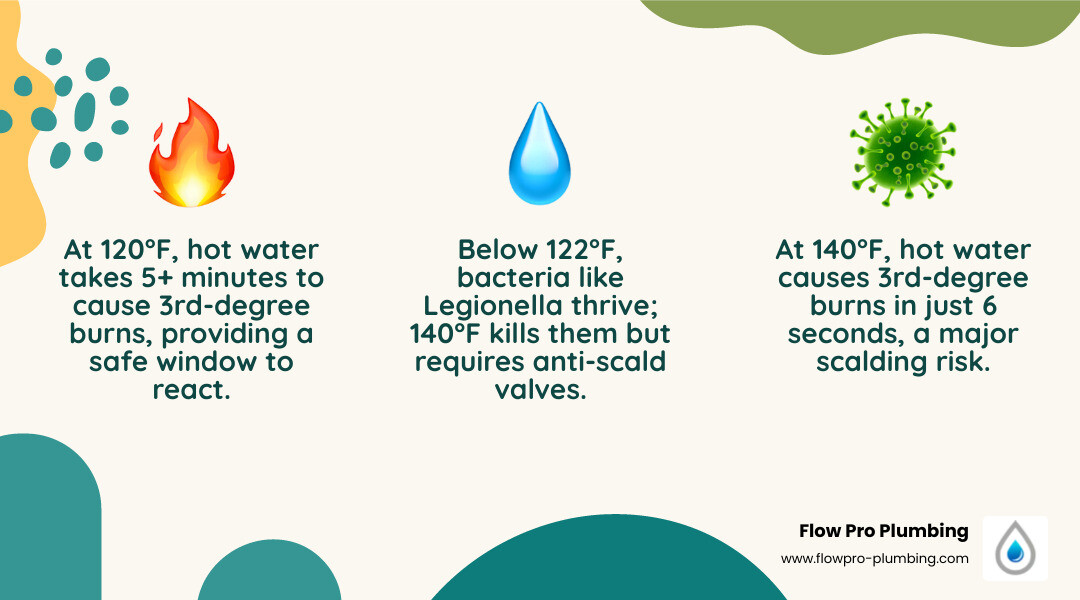
- 140°F: Causes third-degree burns in 6 seconds.
- 130°F: Causes third-degree burns in about 30 seconds.
- 120°F: Takes a full 5 minutes of exposure to cause a serious burn.
That 5-minute window is critical for child safety and elderly protection. Children and seniors often have thinner skin and slower reaction times; a 6-second window at 140°F is simply not enough time to escape a scalding stream. By keeping the setting at 120°F, you create a fail-safe environment. Furthermore, the EPA recommends this setting for Energy Star standards, ensuring your Water Heater Repair and Installation is as eco-friendly as possible.
Adjusting for appliances when deciding what temperature should i set my water heater
A common concern we hear is: “Will my dishes get clean at 120°F?” In the past, 140°F was often required to activate dishwasher detergents and kill bacteria on plates. However, most modern dishwashers manufactured by April 2026 come equipped with internal booster heaters. These units take the 120°F water from your pipes and heat it further inside the machine to reach sanitization cycles.
If you have an older dishwasher without a booster, you might need a slightly higher setting to ensure proper detergent activation. However, for most households, the Benefits of a Tankless Water Heater or a modern tank system mean you can keep the main thermostat lower without sacrificing cleanliness.
Balancing Health Risks: Bacteria vs. Scalding
While 120°F is great for energy savings and scald prevention, we have to talk about the “bacteria factor.” Harmful pathogens, specifically Legionella (which causes Legionnaires’ disease) and Mycobacterium avium (NTM), can thrive in stagnant, warm water.
| Temperature | Impact on Health & Safety |
|---|---|
| Below 120°F | Danger Zone: Bacteria like Legionella can proliferate. |
| 120°F | Safe for most; inhibits most bacterial growth; 5-min burn time. |
| 122°F | OSHA’s recommended minimum to prevent Legionella. |
| 130°F | Effective at killing NTM; 30-second burn time. |
| 140°F | Standard for killing most pathogens; 6-second burn time. |
OSHA guidelines actually recommend a minimum of 122°F to prevent harmful bacteria growth in the tank’s biofilm. For immune-compromised households or those with chronic respiratory conditions, experts often suggest a setting of 140°F to ensure these pathogens are completely neutralized.
The Solution: Mixing Valves. If you need to kill bacteria but have small children at home, we recommend installing a thermostatic mixing valve. This allows you to keep the water in the tank at 140°F (killing bacteria) while mixing it with cold water at the outlet to deliver a safe 120°F to your faucets.
Household Factors That Change the Ideal Setting

Every home in the East Bay is different. What works for a single professional in Walnut Creek might not work for a family of seven in Discovery Bay. Here are the factors we consider when helping you find your “Goldilocks” temperature:
- High Demand: If you have back-to-back showers every morning, a higher setting (130°F) might be necessary to ensure the last person doesn’t end up with a freezing surprise.
- Climate and Groundwater: During the winter months in places like Antioch or Pittsburg, the incoming groundwater is much colder. This means your heater has to work harder. You might find you need to nudge the dial up 5 degrees in January to maintain the same comfort level you had in July.
- Pipe Insulation: If your water heater is in the garage and your master bath is on the other side of the house, you lose heat as the water travels through the pipes. Insulating your pipes can help, but sometimes a higher base temperature is the only way to get a hot shower.
- System Type: If you are considering a Tankless Water Heater Installation, you have more flexibility. Since there is no tank for bacteria to grow in, 120°F is almost always the perfect permanent setting.
How to Safely Adjust and Maintain Your Water Heater
Ready to change your settings? Safety is paramount. Always turn off the power or gas before making adjustments.
- Gas Water Heaters: These usually have a dial on the gas valve near the bottom. It may be labeled with numbers, or it might just have “Hot,” “A,” “B,” and “C.” Typically, “Hot” is 120°F, while each letter adds about 10 degrees.
- Electric Water Heaters: These are trickier. You must turn off the breaker first. You’ll need to unscrew two access panels (top and bottom) and move the insulation to find the thermostats. Use a flathead screwdriver to adjust both to the same temperature.
- Tankless Models: Most have a simple digital LED display where you can use arrows to set the exact degree.
Once adjusted, wait at least three hours for the tank to reach the new temperature. Test it by running the hot water at the faucet farthest from the heater for three minutes, then use a cooking thermometer to check the temperature in a glass.
Maintenance is the other half of the equation. Knowing How to Flush a Water Heater is vital because sediment buildup acts as an insulator, making your thermostat “lie” to you. We recommend you learn How Often to Drain Your Water Heater (usually once a year) to keep temperatures consistent. Don’t forget to have a pro inspect your anode rod every 3-5 years to prevent the tank from rusting out from the inside.
Troubleshooting Common Temperature Issues
If you’ve set your dial to 120°F but the water feels lukewarm or wildly inconsistent, you might have an underlying issue.
- Mineral Buildup: If you hear popping or rumbling sounds, that’s sediment. It traps heat at the bottom of the tank, which can damage the unit and lead to fluctuating temperatures.
- Pilot Light Issues: For gas units, if the Water Heater Pilot Light Won’t Stay Lit, you’ll obviously have no hot water. This often points to a faulty thermocouple.
- Slow Recovery: If you’re asking How Long for Water Heater to Heat Up and the answer is “forever,” you might have a failing heating element (in electric models) or a burner assembly issue (in gas models).
- Thermostat Calibration: Sometimes the internal sensors simply wear out. If your thermometer test shows 140°F but the dial is set to 120°F, it’s time for a professional inspection.
Frequently Asked Questions about Water Heater Settings
Is 140°F too hot for a residential water heater?
For most homes, yes. While it’s great for killing bacteria, the 6-second burn time is a major liability if you have children or seniors. It also causes significantly more wear and tear on your tank’s valves and seals due to the increased internal pressure.
How do I check my water heater’s actual output?
Go to the faucet farthest from the heater. Run the hot water for at least 3 minutes to ensure you’re getting water straight from the tank. Fill a cup and immediately test it with a digital cooking thermometer. For the most accurate reading, do this first thing in the morning before anyone has showered.
Does a lower temperature setting save money in 2026?
Absolutely. With energy costs in the East Bay continuing to fluctuate, reducing your water heating demand is one of the easiest ways to lower your overhead. Every 10°F reduction can cut your water heating costs by 3–5%. Over the course of a year, that adds up to significant savings for Brentwood families.
Conclusion
Finding the right answer to what temperature should I set my water heater doesn’t have to be a guessing game. For the vast majority of our neighbors in Brentwood, Antioch, and Walnut Creek, 120°F provides the perfect balance of safety, comfort, and cost-effectiveness.
However, your home is unique. Whether you need to install anti-scald valves for a growing family, flush out years of sediment buildup, or upgrade to a high-efficiency tankless system, we are here to help. At Flow Pro Plumbing, our friendly, experienced team is dedicated to ensuring your home’s plumbing is safe and efficient.
Don’t leave your family’s safety or your monthly budget to chance. Schedule your water heater service today and let us help you find your “Goldilocks” zone.