

Why Knowing How to Choose the Right Water Heater Can Save You Time, Money, and Cold Showers
Knowing how to choose the right water heater is one of the most practical things you can do as a homeowner — and it matters more than most people realize. Water heating accounts for roughly 18% of your home’s total energy use. Pick the wrong unit and you’re either running out of hot water at the worst moments or paying far more than you should every single month.
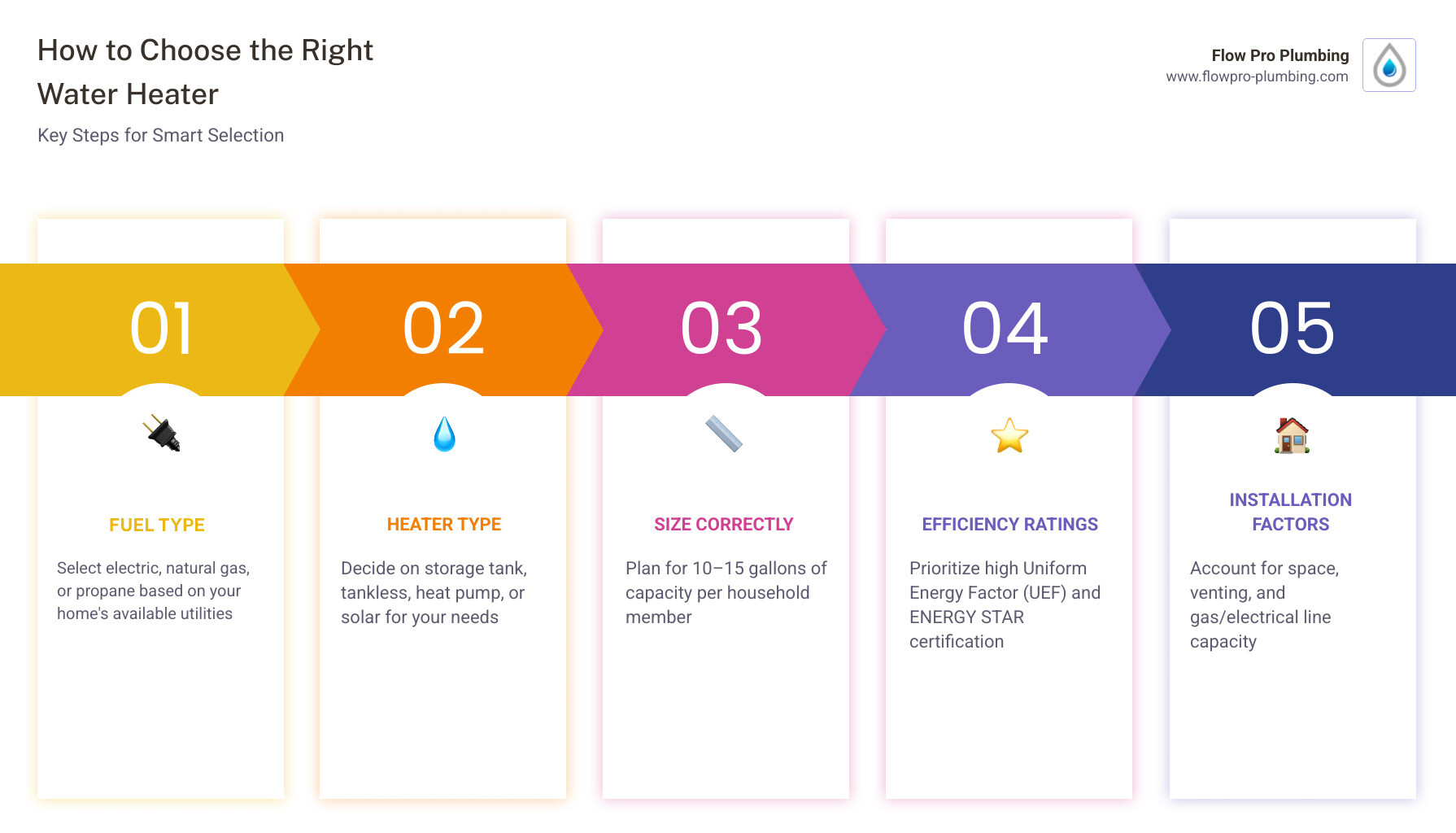
Here’s a quick overview of the key steps to choose the right water heater:
- Identify your fuel type — electric, natural gas, or propane — based on what’s available in your home
- Choose your water heater type — storage tank, tankless, heat pump, or solar
- Size it correctly — plan for roughly 10–15 gallons of capacity per person in your household
- Check efficiency ratings — look for the Uniform Energy Factor (UEF) and ENERGY STAR certification
- Consider installation requirements — space, venting, and electrical or gas line capacity
- Factor in long-term costs — not just the purchase price, but annual operating costs and maintenance
- Look for rebates and incentives — federal tax credits and local utility programs can offset upfront costs
Most homeowners don’t think about their water heater until something goes wrong — a leak, a cold shower, or worse, a flood. But making a smart, informed choice before that happens can protect your home and your budget for years to come.
I’m Jesse Delgado, owner of Flow Pro Plumbing in Brentwood, California, and I’ve spent years helping East Bay homeowners navigate exactly these kinds of decisions, including how to choose the right water heater for their specific home, family size, and budget. In this guide, I’ll walk you through everything you need to know so you can make a confident, well-informed choice.
Comparing Different Water Heater Types
When you start looking into Water Heaters, the variety of options can feel a bit overwhelming. Gone are the days when your only choice was a big white metal cylinder in the garage. Today, technology has advanced to offer systems that fit almost any lifestyle, from massive households with high demand to small condos where space is at a premium.
The most common type remains the storage tank water heater. These units keep a ready reservoir of hot water (usually 30 to 80 gallons) available at all times. They are reliable and generally have a lower upfront cost, but they do suffer from “standby heat loss,” which means they use energy to keep that water hot even when you aren’t using it.
On the other end of the spectrum, we have tankless water heaters, often called “on-demand” systems. Instead of storing water, they use high-powered burners or electric coils to heat water instantly as it flows through the unit. If you want to Explore Tankless Water Heaters, you’ll find they are incredibly efficient because they only consume energy when you turn on a tap.
For homeowners looking for the ultimate in efficiency, heat pump (hybrid) water heaters are a game-changer. Rather than generating heat directly, they move heat from the surrounding air into the water. We also see condensing gas water heaters, which capture hot exhaust gases that would normally be wasted and use them to preheat the water. Finally, solar water heaters use the abundant California sunshine to provide hot water, though they usually require a backup gas or electric system for cloudy days.
| Feature | Storage Tank | Tankless |
|---|---|---|
| Upfront Cost | Lower | Higher |
| Lifespan | 10–15 Years | 20+ Years |
| Space Required | Large Floor Space | Small Wall-Mount |
| Hot Water Supply | Limited to Tank Size | Continuous |
| Energy Efficiency | Standard | High |
Understanding the Benefits of a Tankless Water Heater versus a traditional tank is often the first step in narrowing down your search.
Advantages of On-Demand Systems
If you’ve ever been the last person in your family to shower in the morning, you know the pain of the “cold water surprise.” This is where tankless systems shine. Because they heat water as it moves, they provide a virtually endless supply of hot water. You can run the dishwasher, the washing machine, and take a shower simultaneously without the fear of running out.
Beyond the luxury of continuous hot water, there are major Reasons Why You Should Upgrade to a Tankless Water Heater. They are significantly smaller than tank models, often mounted on a wall, which frees up valuable square footage in your garage or closet. Furthermore, they tend to last nearly twice as long as traditional tanks—often reaching 20 years or more with proper maintenance.
High-Efficiency Heat Pump Technology
Heat pump water heaters are essentially “fridges in reverse.” While a refrigerator pulls heat out of a box and dumps it into the room, a heat pump water heater pulls heat from the surrounding air and dumps it into your water tank.
These units are incredibly efficient—often 3 to 4 times more efficient than standard electric tank models. In fact, some advanced models are rated at 5X the efficiency of standard gas units. Because they pull heat from the air, they also act as a dehumidifier, which can be a nice bonus in a damp utility room. They do require a bit more vertical clearance and a certain amount of “buffer air” (usually about 1,000 cubic feet) to operate effectively, but for the energy-conscious homeowner in Brentwood or Oakley, they are a top-tier choice.
How to Choose the Right Water Heater for Your Home
Choosing a water heater isn’t just about picking a model off a website; it’s about matching the technology to your home’s infrastructure. The first thing we look at is your fuel type.
Most homes in our service area, from Pittsburg to Walnut Creek, are set up for either natural gas or electricity. Natural gas units generally cost more upfront but are cheaper to operate over time and have a faster “recovery rate” (how quickly they can heat a new batch of water). Electric units are simpler to install and don’t require venting, but they can be more expensive to run unless you opt for a high-efficiency heat pump model.
Tankless Water Heater Installation also requires specific considerations. For example, a gas tankless unit needs a larger gas line than a standard tank and specialized venting to handle the high-powered burners. If you’re switching from gas to electric, or vice versa, you’ll need to account for the cost of running new lines or upgrading your electrical panel.
Capacity Factors: How to Choose the Right Water Heater Size
One of the most common mistakes we see is homeowners buying a unit that is either too small (leading to cold showers) or too large (wasting energy). A good rule of thumb is to have 10–15 gallons of tank capacity per occupant.
For a family of four, a 50-gallon gas tank is usually sufficient. However, if you have an electric tank, you might need to go up to 80 gallons to ensure you have enough hot water during peak times, as electric elements take longer to heat. You should also consider how many “hot water events” happen at once. If everyone showers at 7:00 AM while the laundry is running, you need a unit with a high First-Hour Rating (FHR). This rating tells you how many gallons of hot water the heater can supply in its first hour of operation when starting with a full tank.
If you find yourself wondering How Long for Water Heater to Heat Up, it might be a sign that your current unit is undersized for your household’s growing needs.
Performance Metrics and Flow Rates
For tankless systems, we don’t look at gallons; we look at Gallons Per Minute (GPM). To find your magic number, add up the flow rates of the fixtures you expect to use at the same time. A typical shower head uses about 2.0 GPM, while a kitchen faucet uses about 1.5 GPM. If you want to be able to shower while the kitchen sink is running, you need a unit that can handle at least 3.5 GPM.
That ground water temperature plays a role here. In colder months, your water heater has to work harder to raise the temperature of the incoming water, which can slightly lower the effective GPM. Gas tankless models can often provide up to 11 GPM, making them ideal for larger homes with multiple bathrooms.
Efficiency Ratings and Maintenance Requirements
When comparing models, you’ll see a yellow EnergyGuide label. The most important number on this label is the Uniform Energy Factor (UEF). This is the modern standard for measuring efficiency; the higher the number, the more efficient the unit.
Choosing an ENERGY STAR certified model is a smart move. These units meet strict efficiency guidelines set by the U.S. Environmental Protection Agency. While they might cost a bit more initially, the long-term savings on your utility bills—and the potential for rebates—often make them the most cost-effective choice in the long run. Proper Water Heater Repair and Installation ensures these efficiency ratings are actually realized in your daily use.
Smart Features and Advanced Technology
We live in the age of the “smart home,” and water heaters have joined the party. Many modern units come with Wi-Fi connectivity, allowing you to adjust the temperature from your phone or set a “vacation mode” to save energy while you’re away.
One of the most valuable features is leak detection with automatic shut-off. If the unit senses water where it shouldn’t be, it can shut off the water supply and send an alert to your smartphone. This single feature can save you thousands of dollars in potential water damage. Some models also offer energy tracking, so you can see exactly how much you’re spending on hot water each day.
Maintenance Tips: How to Choose the Right Water Heater for Longevity
No matter which type you choose, maintenance is the key to getting your money’s worth. For tank models, the biggest enemy is sediment buildup. Over time, minerals in our local water can settle at the bottom of the tank, creating a layer of “crust” that makes the heater work harder and eventually corrodes the tank.
Knowing How Often to Drain Your Water Heater is essential. We generally recommend a full flush at least once a year. You should also check your anode rod every 2 to 3 years. This is a sacrificial metal rod that “attracts” corrosion so the tank doesn’t have to. When the rod is gone, the tank is next.
If you’re a DIY enthusiast, learning How to Flush a Water Heater can extend the life of your unit by years. For tankless models, maintenance usually involves “descaling” to remove mineral deposits from the heating coils, which is equally important for maintaining that high efficiency.
Frequently Asked Questions about Water Heaters
When should I replace my current water heater?
Most traditional tank water heaters last between 10 and 15 years. If your unit is in that age range, it’s time to start shopping before it fails. Clear signs that your Water Heater Needs Repair or replacement include:
- Rusty water: This often indicates the inside of the tank is corroding.
- Unusual noises: Rumbling or popping sounds are usually caused by hardened sediment at the bottom of the tank.
- Frequent leaks: Even small puddles around the base can be a precursor to a total tank failure.
- Inconsistent temperatures: If your showers are getting shorter or the water isn’t as hot as it used to be.
Why won’t my water heater pilot light stay lit?
This is a common frustration for owners of gas water heaters. Often, the culprit is a failing thermocouple, which is a safety device that senses the pilot flame. If it’s dirty or broken, it will shut off the gas flow. Other causes include a clogged pilot tube, a faulty gas valve, or even a draft in the room. If your Water Heater Pilot Light Won’t Stay Lit, it’s best to have a professional take a look to ensure there isn’t a dangerous gas supply issue.
Are there rebates available for high-efficiency models?
Yes! Because water heating is such a large part of energy consumption, there are often significant incentives to go green. Federal tax credits can cover a portion of the cost for heat pump water heaters. Additionally, local utility providers in the East Bay area frequently offer rebates for switching to high-efficiency ENERGY STAR models. These incentives can significantly lower the “net cost” of a premium, high-efficiency system.
Conclusion
At Flow Pro Plumbing, we know that choosing a new water heater is a major investment in your home’s comfort and efficiency. Whether you’re in Brentwood, Antioch, Walnut Creek, or any of our surrounding communities, we are here to ensure you don’t get “burned” by a hasty decision.
From expert sizing to professional installation and long-term maintenance, our team is dedicated to providing the reliable service and unsurpassed workmanship our neighbors have come to expect. We can help you weigh the pros and cons of tank versus tankless, calculate the perfect capacity for your family, and ensure your new system is installed safely and to code.
Don’t wait for a flood or a freezing shower to take action. Schedule your professional water heater consultation with Flow Pro Plumbing today and let us help you find the perfect hot water solution for your home.