

The Warning Signs Are Already There — You Just Need to Know Where to Look
How to detect a water leak behind walls is something every homeowner should know before a small drip becomes a major disaster. Here’s a quick overview of the most reliable methods:
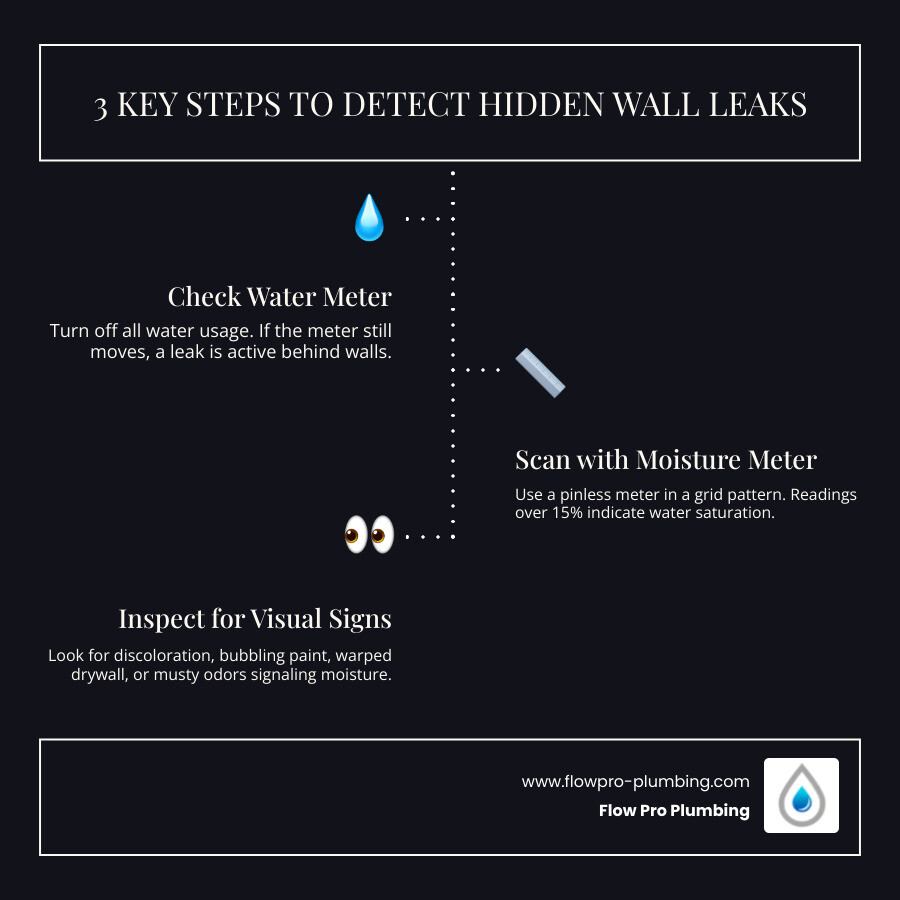
- Check your water meter — Turn off all water in the home. If the meter dial still moves, water is escaping somewhere.
- Look for visual clues — Discoloration, bubbling paint, warped drywall, or sagging ceilings are common giveaways.
- Use your senses — A persistent musty or earthy smell often means hidden moisture, even before you see any damage.
- Try the touch test — Press lightly on suspect wall areas. Soft or spongy drywall points to water saturation behind the surface.
- Use a pinless moisture meter — Run it across the wall in a grid pattern. Readings above 15% typically signal a problem.
- Listen carefully — Hissing, dripping, or running water sounds when all fixtures are off are a strong indicator of a hidden leak.
- Call a licensed plumber — If DIY methods confirm or suggest a leak, professional tools like thermal imaging and acoustic detection can pinpoint it without tearing open your walls.
Here’s the uncomfortable truth: hidden water leaks are one of the sneakiest problems a home can have. Water can seep silently behind your drywall for weeks — or even months — before you ever notice a stain, a smell, or a spike on your water bill. According to the EPA, household leaks across the U.S. waste as much as 1 trillion gallons of water every year. That’s equivalent to the annual water use of more than 11 million homes. Much of that waste comes from slow, hidden leaks that go undetected for far too long.
The damage compounds quickly. Mold can begin growing within just 24 to 48 hours of moisture exposure. Once water saturates drywall, insulation, and wood framing, the damage becomes much more extensive than what early detection would have prevented. For homeowners in Brentwood and across the East Bay, catching a leak early isn’t just smart — it protects your home, your health, and your property.
I’m Jesse Delgado, owner of Flow Pro Plumbing and a licensed plumber with over a decade of experience helping Brentwood homeowners understand how to detect a water leak behind walls before the damage gets out of hand. Growing up alongside my father in the trade, I’ve seen how often silent leaks are the most destructive ones — and this guide will walk you through exactly what to look for.
Early Warning Signs: The “Silent Thieves” in Your Walls
In our experience serving neighbors from Oakley to Concord, we’ve found that leaks are rarely “sudden.” They are usually long-term “silent thieves” that slowly rob your home of its structural integrity. If you are trying to figure out how to detect a water leak behind walls, you have to start by paying attention to the subtle changes in your home’s environment.
Visual Clues: When Walls Start to “Talk”
Your walls will eventually show signs of distress, but you have to know what those marks mean. One of the most common Water Damage Signs You Should Never Ignore is a change in the texture of your paint or wallpaper.
- Bubbling and Peeling: When water trapped behind drywall begins to evaporate, the moisture pushes the paint or wallpaper away from the surface. This creates small bubbles or causes the edges of wallpaper to curl.
- Discoloration: Look for “halos” or yellow-to-brown stains. If you see a spot on the ceiling or wall that seems to be growing or has a defined, darker edge, that is an active leak.
- Warping and Sagging: Drywall is made of gypsum, which is highly absorbent. As it takes on water, it loses its rigidity and becomes heavy. This leads to sagging in ceilings or “bowing” in walls.
- Physical Cracks: While some settling is normal in California homes, sudden or expanding cracks in the drywall can be caused by the softening of the wall’s internal structure due to water.
Sensory Clues: Trust Your Nose and Ears
Sometimes your eyes can be deceived, but your other senses are harder to fool.
- The “Musty” Smell: If you walk into a room — especially a bathroom, kitchen, or laundry room — and notice an earthy, damp cardboard smell that won’t go away after cleaning, you likely have hidden mold. Mold thrives in the dark, moist cavities behind your walls.
- Unusual Sounds: In the quiet hours of the night, listen closely near your walls. Do you hear a faint hissing, a rhythmic dripping, or the sound of rushing water when no one is using a faucet? These are classic signs of a pressurized supply line leak.
- Temperature Spikes: If you notice a specific “hot spot” on a wall or floor, it could indicate a leak in a hot water line. Conversely, a cold, damp patch often signifies a cold water line or drain leak.
The Water Meter Test: Your First Line of Defense
If you suspect something is wrong but don’t see a puddle, the water meter is the most reliable tool in your DIY arsenal. It is the “polygraph test” for your plumbing system.
Step-by-Step: How to Use Your Meter to Confirm a Leak
We often tell our clients in Antioch and Pittsburg to perform this simple test before we even arrive. It helps confirm whether the issue is a plumbing leak or something else, like roof intrusion or condensation.
- Turn Off Everything: Ensure all faucets, showers, dishwashers, and washing machines are off. Don’t forget to disable automatic ice makers and irrigation systems.
- Locate Your Meter: In most of our service areas like Brentwood and Oakley, your meter is usually located in a concrete box near the sidewalk or curb.
- Check the Leak Indicator: Many modern meters have a small “leak dial” or a digital indicator (sometimes a small triangle or star) that spins when even a tiny amount of water moves through the system. If it’s moving while everything is off, you have a leak.
- The Two-Hour Test: If the indicator isn’t moving, take a manual reading of the numbers on the meter. Leave the water off for exactly two hours. Check the meter again. If the numbers have changed, you have a slow, “stealth” leak.
Pro Tip: A household of four using more than 12,000 gallons per month during cooler seasons is a sure-fire sign of serious leaks. If your bill is rising but your habits haven’t changed, the water is going somewhere — likely into your walls or foundation.
DIY Detection Tools: Finding Leaks Without the Sledgehammer
You don’t need to be a pro to use some of the non-invasive technology available today. Knowing how to detect a water leak behind walls can be much easier with a few affordable gadgets.
Moisture Meters and Infrared Thermometers
- Pinless Moisture Meters: These are fantastic for homeowners. You simply press the device against the drywall, and it uses electromagnetic signals to detect moisture up to 3/4 of an inch deep. A reading between 5% and 12% is usually normal; anything above 15% is a major red flag.
- Infrared Thermometers: While not as advanced as a professional thermal camera, a handheld infrared thermometer can help you find “cold spots” on a wall. Since evaporating water cools the surface, a significantly cooler patch on a wall often points to the heart of a leak.
The Aluminum Foil Test: Condensation vs. Leak
Sometimes, homeowners in humid areas like Discovery Bay or Bethel Island mistake condensation for a leak. Here is a trick we recommend: Tape a square of aluminum foil tightly to the damp spot on your wall. Leave it for 24 hours.
- If the outside of the foil is wet, you have a condensation problem (high humidity).
- If the inside (the side touching the wall) is wet, moisture is migrating through the wall from a leak.

Common Causes of Hidden Wall Leaks
Understanding why leaks happen can help you stay ahead of them. In our years of providing Leak Detection in Brentwood, CA, we’ve seen a few recurring culprits.
Pipe Corrosion and Aging Systems
Many homes in the East Bay built several decades ago still rely on galvanized steel or older copper piping. Over time, these materials succumb to Common Pipe Leak Causes and How to Avoid Them.
- Galvanized Steel: These pipes corrode from the inside out. By the time you see a leak on the outside, the pipe is likely thin and brittle throughout.
- Copper Pinhole Leaks: Hard water or chemical imbalances can cause tiny “pinhole” leaks in copper lines. These are especially dangerous because they release very small amounts of water over a long period, causing massive mold growth before they are discovered.
High Water Pressure and Foundation Shifts
- High Pressure: If your home’s water pressure is set too high (above 80 PSI), it puts constant stress on the joints and valves behind your walls. Eventually, a fitting will loosen or a pipe will hairline-fracture.
- Foundation Shifts: California is known for its shifting soil. As a house settles or moves during seismic activity, the rigid pipes behind your walls can be pulled or pinched, leading to cracks.
Supply Leaks vs. Drain Leaks: What’s the Difference?
When we perform Leak Detection in Concord, CA, one of the first things we determine is whether we are dealing with a supply line or a drain line.
- Supply Line Leaks: These are under constant pressure. They leak 24/7, regardless of whether you are using water. These usually cause more immediate and severe damage, and they will always show up on a water meter test.
- Drain Leaks: These only leak when a specific fixture is used (like a shower or a sink). They are often harder to find because the damage might only appear “damp” occasionally. They typically won’t move your water meter, making them the “ghosts” of the plumbing world.
Professional Leak Detection: Advanced Technology at Work
While DIY methods are great for confirmation, pinpointing the exact location of a leak requires specialized equipment. This is where Electronic Leak Detection comes in. At Flow Pro Plumbing, we use non-invasive methods to ensure we don’t have to tear down your whole wall just to find a one-inch crack.
Thermal Imaging (Infrared Cameras)
This is one of our favorite tools. A thermal camera doesn’t “see” water; it sees heat. Because wet drywall is cooler than dry drywall (due to evaporative cooling), the camera shows the leak as a dark blue or purple bloom against the yellow and orange of the dry wall. This allows us to see exactly where the water is traveling without making a single hole.
Acoustic Leak Detection and Borescopes
- Acoustic Sensors: We use high-powered microphones to “listen” through the wall. Pressurized leaks create a specific frequency — a hiss or a whoosh. By moving the sensor along the wall, we can find the exact spot where the sound is loudest.
- Borescopes: If we need visual confirmation, we can drill a tiny, 1/4-inch hole (often behind a baseboard where it won’t be seen) and insert a flexible camera. This lets us look inside the wall cavity to see the pipe directly.
Immediate Steps: What to Do If You Suspect a Leak
If you’ve followed the steps on how to detect a water leak behind walls and you’re certain there’s an issue, you need to act fast.
- Shut Off the Water: If it’s a major leak, turn off the main water valve to your home immediately. This stops the “feeding” of the leak and prevents further structural saturation.
- Turn Off Electricity: If the leak is near outlets, light switches, or your breaker panel, shut off the power to those zones. Water and electricity are a deadly combination.
- Document Everything: Take photos and videos of the damage, the meter readings, and any DIY tests you performed. This is vital for insurance claims.
- Dry the Area: Use fans and dehumidifiers to pull moisture out of the air. This can help slow down the onset of mold while you wait for a professional.
- Call Flow Pro Plumbing: For residents in Brentwood, Antioch, or Oakley, getting a professional on-site quickly can help prevent extensive restoration and structural damage. Learn more about What to Do If a Pipe is Leaking.
The Risks of Waiting: Mold, Value, and Safety
Ignoring a hidden leak is a gamble you will eventually lose.
- Mold Growth: As mentioned, mold starts in 24-48 hours. Beyond the smell, certain types of mold can cause respiratory issues and allergic reactions.
- Structural Damage: Water softens the wood studs that hold up your home. Over time, this can lead to “rot,” which requires complex structural repairs.
- Home Value: Mold and unremediated water damage can decrease a home’s value and appeal if not handled by a professional. When it comes time to sell your home in Clayton or Walnut Creek, a history of hidden leaks will be a major red flag during inspections.
Prevention and Maintenance: Keeping Your Walls Dry
The best way to handle a leak is to prevent it from ever happening.
- Annual Inspections: Having a professional plumber check your home once a year can help you How to Spot Plumbing Problems Early and Save Your Sanity.
- Monitor Water Pressure: Install a pressure gauge on an outdoor house bib. If your pressure is over 80 PSI, call us to install a pressure-reducing valve.
- Replace Old Hoses: Replace rubber washing machine and dishwasher hoses every 5 years with braided stainless steel versions.
- Upgrade Shut-off Valves: Installing localized shut-off valves for toilets and sinks is an efficient way to manage repairs without losing water to the whole house.
Conclusion: Peace of Mind in Brentwood
Knowing how to detect a water leak behind walls is about being a proactive guardian of your home. Whether you are in Brentwood, Oakley, or Antioch, staying vigilant and using the tools at your disposal — like your water meter and your own senses — can save you from a plumbing nightmare.
At Flow Pro Plumbing, we take pride in being the East Bay’s trusted experts for Leak Detection in Antioch, CA and Leak Detection in Walnut Creek, CA. We understand the local architecture, the common pipe issues in our neighborhoods, and the urgency that comes with a hidden leak.
If you suspect a leak is living a “secret life” behind your drywall, don’t wait for the ceiling to sag. Schedule your service today for expert plumbing help. We are here to provide fast, clean, and courteous service to keep your home dry and your family safe.
Schedule your Leak Detection and Repair in Brentwood, CA today!