
Why Your Home Has Low Water Pressure (And What to Do About It)
What causes low water pressure at home is one of the most common plumbing questions homeowners ask — and the answer is rarely just one thing. Here are the most frequent culprits:
- Partially closed shutoff valves — the main valve or water meter valve isn’t fully open
- Failing pressure regulator (PRV) — the valve that controls incoming pressure has worn out
- Mineral buildup in pipes or fixtures — calcium and sediment narrow the flow path over time
- Hidden plumbing leaks — water escaping through cracks or pinhole leaks reduces pressure throughout the system
- Corroded or aging pipes — galvanized steel pipes can corrode from the inside after about 20 years
- Municipal supply issues — city-side problems, peak demand, or new regulations can reduce pressure at the source
- Shared water lines — pressure drops when neighbors draw from the same supply line simultaneously
- Clogged aerators or showerheads — mineral deposits restrict flow at individual fixtures
- Water heater sediment — buildup inside the tank affects hot water pressure specifically
Low water pressure can make everyday tasks genuinely frustrating — whether you’re rinsing shampoo under a weak shower stream or waiting too long for a pot to fill at the kitchen sink. The good news is that most causes are diagnosable and fixable once you know where to look. Some are simple DIY fixes. Others point to deeper issues inside your plumbing system that need a professional eye.
I’m Jesse Delgado, owner of Flow Pro Plumbing in Brentwood, California — I grew up in a family of plumbers and have spent over a decade diagnosing exactly what causes low water pressure at home across hundreds of East Bay residences. In this guide, I’ll walk you through every major cause, how to identify it, and what to do next.
Understanding Your Home’s Water Pressure
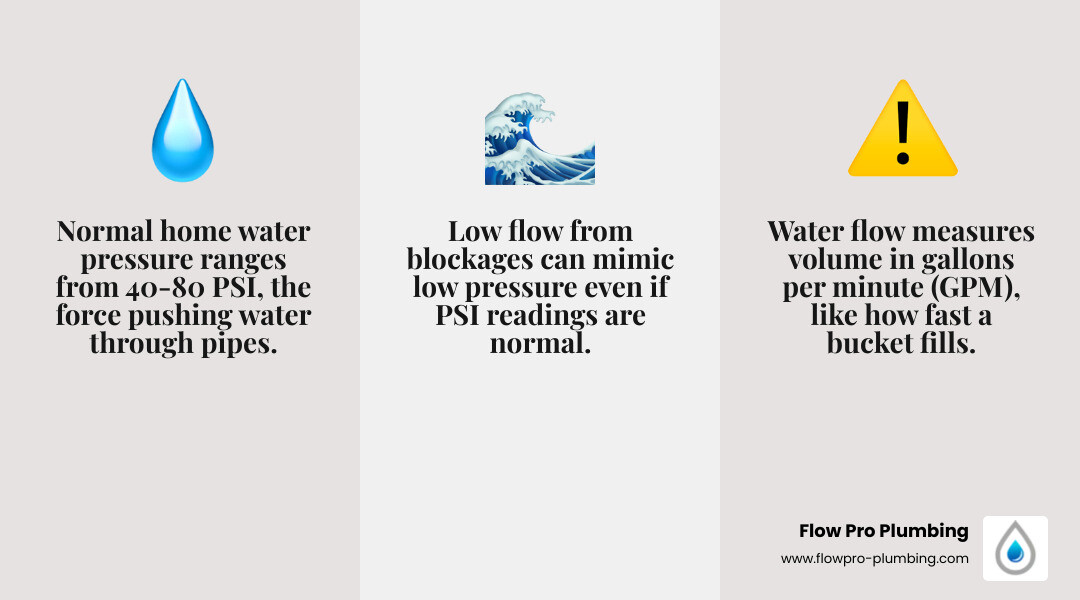
Before we dive into the “why,” we need to understand the “what.” In the plumbing world, we distinguish between water pressure and water flow. Water pressure is the force that pushes water through your pipes, measured in pounds per square inch (PSI). Water flow is the actual volume of water coming out of the tap, measured in gallons per minute (GPM).
Think of it like a garden hose: the pressure is how hard the water hits the wall, while the flow is how much water fills a bucket in ten seconds. Often, when people ask Why Is My Water Pressure So Low?, they are actually experiencing a flow restriction caused by a blockage, even if the static pressure in the pipes is technically fine.
What is Normal Water Pressure?
For most residential homes in areas like Brentwood or Antioch, a “normal” pressure range is between 40 and 80 PSI. Anything below 40 PSI is generally considered low, while anything above 80 PSI can actually damage your fixtures and cause “water hammer” (that loud banging sound in the walls). The average home usually sits comfortably around 45 to 60 PSI.
How to Measure It
You don’t have to guess. You can buy a simple water pressure gauge at a local hardware store. To get a reading:
- Ensure all faucets and water-using appliances (like the dishwasher or laundry) are turned off.
- Attach the gauge to an outside hose spigot (the one closest to the main water line entry is best).
- Open the tap fully and read the dial.
Your home’s elevation plays a huge role here. If you live at the top of a hill in Clayton or Walnut Creek, your pressure might naturally be lower than a neighbor’s at the bottom of the hill because the city’s water tanks rely on gravity to create that force.
What Causes Low Water Pressure at Home?
When the pressure drops across the entire house, we usually look at the “gatekeepers” of your water supply. If the problem isn’t just in the kitchen or just in the master bath, one of these major components is likely to blame.
The Main Shutoff Valve
This is the valve that controls the water coming into your home. If you’ve recently had plumbing work done, someone might have turned it off and failed to open it back up all the way. Even a valve that is 90% open can cause a noticeable drop in pressure when multiple fixtures are running. Ensure the handle is turned fully counter-clockwise (for wheel handles) or is parallel to the pipe (for lever handles).
The Water Meter Valve
Similar to your main shutoff, there is a valve at the water meter itself (usually located in a box near the street). This valve belongs to the water utility, but it can sometimes be left partially closed after a meter reading or city repair.
Municipal Supply Issues
Sometimes, the problem isn’t inside your walls at all. Water Pressure Suddenly Low can be the result of a water main break in your neighborhood or a hydrant being used nearby. If you notice a sudden drop, check with your neighbors. If they’re experiencing it too, it’s time to call the local water department.
What Causes Low Water Pressure at Home During Peak Hours
If your shower feels like a “raging river” at 10:00 PM but turns into a “gentle creek” at 7:00 AM, you’re likely dealing with peak demand issues.
- Morning Routines: Between 6:00 AM and 8:00 AM, everyone on your block is showering and getting ready. This high demand can strain the local supply.
- Shared Pipelines: In some older developments or multi-unit properties, homes may share a single service line from the main. If your neighbor is watering their lawn while you’re trying to bathe, your pressure will suffer.
- Seasonal Peaks: During hot California summers, municipal water usage spikes due to irrigation. Some cities even implement staggered supply regulations to manage the load.
Faulty Pressure Regulators and Valves
Many homes in the East Bay are equipped with a Pressure Reducing Valve (PRV). This is a bell-shaped brass fixture, usually located near your main shutoff valve. Its job is to slow down high-pressure city water so it doesn’t blow out your pipes.
When a PRV fails, it usually goes one of two ways: it either lets the pressure soar dangerously high, or the internal diaphragm gets stuck, causing a massive drop in pressure. If you notice your pressure is fine for a split second when you turn on the tap but then immediately dies down to a trickle, a failing PRV is a prime suspect.
Localized Issues: Why Only One Faucet is Trickling
If the kitchen sink is fine but the guest shower is weak, the problem is “localized.” This is actually good news because it means you probably don’t need to repipe your entire house.
What Causes Low Water Pressure at Home in Specific Fixtures
The most common culprit for a single weak fixture is mineral buildup. Our water contains dissolved minerals like calcium and magnesium. Over years of use, these minerals solidify into “scale.”
- Aerators: The little screen at the tip of your faucet is designed to catch debris. It doesn’t take much sediment to clog those tiny holes.
- Showerheads: If the water is spraying in odd directions or barely coming out, the internal filter or the spray nozzles are likely clogged with calcium.
- The Vinegar Fix: You can often solve this by unscrewing the aerator or showerhead and soaking it in a bowl of white vinegar overnight. This dissolves the mineral deposits and restores the flow. For showerheads that won’t come off, you can tie a bag of vinegar around the neck with a rubber band.
For tips on choosing hardware that handles these issues better, check out our guide on the Best Shower Head Low Water Pressure.
Hot Water Pressure Problems
If your cold water pressure is great but the hot water is weak, the issue is narrowed down to your water heater.
- Sediment in the Tank: Over time, minerals settle at the bottom of your water heater tank. This “sludge” can block the outlet pipe, restricting hot water flow to the rest of the house.
- Shutoff Valve: Check the cold water inlet valve on top of the heater. If it’s partially closed, your hot water pressure will be poor.
- Acidic Water: In some areas, the chemistry of the water can accelerate the degradation of your heater’s internal components. Understanding How Acidic Water Affects Plumbing can help you decide if you need a water filtration or neutralizing system.
Hidden Plumbing Culprits: Leaks and Corrosion
Sometimes the cause of low pressure is more sinister—and potentially more expensive if left unaddressed.
Pipe Material and Aging
If your home was built before the mid-1980s, you might have galvanized steel pipes. While they were the industry standard for decades, they have a major flaw: they rust from the inside out.
- Internal Scaling: As rust builds up inside the pipe, the “opening” for water to travel through gets smaller and smaller. A pipe that started with a 1-inch diameter might only have a 1/4-inch opening left after 30 years.
- Red Water: If your water looks rusty or orange for the first few seconds after you turn it on, your pipes are likely corroding.
- Lifespan: Galvanized pipes usually last about 20 to 50 years. If you’re hitting that mark and experiencing Low Water Pressure Brentwood CA, it might be time to discuss repiping with copper or PEX.
Detecting Hidden Leaks
A leak is essentially a “thief” stealing your water pressure before it reaches your faucet. If a pipe in your slab or crawlspace has a major crack, the water will take the path of least resistance (out the crack) rather than going up to your shower.
- The Water Meter Test: Turn off every single faucet and appliance in your house. Go out to your water meter and look at the “leak indicator” (usually a small triangular dial or a digital display). If it’s moving while everything is off, you have a leak.
- Visual Clues: Look for damp spots in the yard, soggy drywall, or a musty smell in the basement.
- Sounds: If the house is quiet and you can hear the faint sound of running water or hissing behind a wall, call a plumber immediately.
Troubleshooting and Professional Solutions
Before you panic and assume you need a $10,000 repipe, there are several steps you can take to narrow down the problem.
DIY Troubleshooting Steps
- The “Neighbor Check”: Ask the people next door if their pressure is low. If it is, the problem is likely with the city or a shared main.
- Test Multiple Fixtures: Check the hot and cold water at every sink. If it’s only the hot water, it’s the heater. If it’s only one sink, it’s the aerator.
- Inspect the Valves: Ensure your main shutoff and the valves under your sinks are fully open.
- Clean the Aerators: It’s a five-minute job that fixes 50% of localized pressure issues.
When to Call a Professional
Some issues require tools and expertise that the average homeowner doesn’t have.
- Installing a Booster Pump: If your home is at a high elevation and the city simply can’t provide more than 30 PSI, we can install a water pressure booster. This system uses an electric pump and a pressure tank to “kick” the water up to a comfortable 50 or 60 PSI.
- PRV Replacement: Adjusting or replacing a pressure regulator is a delicate job. If you over-tighten it, you could burst a pipe elsewhere in the house.
- Pipe Relining or Repiping: If your pipes are corroded or full of roots, we can often use fiber-optic cameras to find the exact spot of the blockage and determine if a full repipe is necessary or if a simpler repair will do.
Frequently Asked Questions about Water Pressure
What is considered a normal water pressure range for a house?
A healthy range for a residential home is 40 to 80 PSI. Most homeowners find that 50 to 60 PSI provides the perfect balance of a strong shower without putting undue stress on the plumbing joints and appliances.
How can I tell if the pressure issue is my house or the city?
The easiest way is to check your “static pressure” with a gauge on an outdoor spigot and compare it to your neighbors’ experience. If your gauge reads 60 PSI but the water barely trickles out of your kitchen faucet, the problem is a restriction (clog or pipe corrosion) inside your home. If the gauge itself reads 25 PSI and your neighbors are also complaining, it’s a city-side issue.
Can a clogged water filter cause low pressure?
Absolutely. If you have a whole-house water filtration system or a Point-of-Entry (POE) filter, it needs to be changed every 3 to 6 months. As the filter traps sediment and minerals, it becomes harder for water to pass through, leading to a significant drop in pressure throughout the house.
Conclusion
Understanding what causes low water pressure at home is the first step toward reclaiming your morning shower. Whether it’s as simple as soaking a showerhead in vinegar or as complex as replacing an aging pressure regulator, you don’t have to live with a weak flow.
At Flow Pro Plumbing, we’ve built our reputation on being the friendly, expert team that Brentwood families trust. We don’t just “fix” things; we diagnose the root cause to ensure your plumbing system runs efficiently for years to come. If you’ve tried the DIY steps and you’re still underwhelmed by your water flow, we’re here to help.
Don’t let a hidden leak or a failing valve ruin your home’s comfort. Schedule a professional inspection for low water pressure in Brentwood, CA with Flow Pro Plumbing today, and let’s get your water moving again.