

Is PEX or Copper Better for Repiping Your Home?
A pex vs copper pipe for repiping comparison comes down to a few key factors: cost, durability, installation ease, and your home’s specific conditions. Here’s a quick breakdown to help you decide at a glance:
| Factor | PEX | Copper |
|---|---|---|
| Lifespan | 30-50 years | 50-70 years |
| Flexibility | Highly flexible | Rigid |
| Corrosion Resistance | Excellent | Good (poor in acidic water) |
| Installation Speed | 1-3 days | 3-5 days |
| Freeze Resistance | Expands without bursting | Can crack or burst |
| UV/Outdoor Use | Not suitable | Suitable |
| Recyclability | Not recyclable | 100% recyclable |
| Antimicrobial Properties | No | Yes |
| Max Temperature | 180°F | 400°F |
Bottom line: PEX is the more affordable and easier-to-install choice, especially for older homes or areas with hard water. Copper offers a longer lifespan and is better suited for high-heat applications and outdoor use. Neither is universally “better” — the right pick depends on your home, your water quality, and your long-term goals.
If your home’s plumbing is aging and you’re weighing your options, you’re not alone. Repiping is one of the most significant investments a homeowner can make, and the material you choose will affect your water quality, your wallet, and your peace of mind for decades to come. Both PEX and copper have been used reliably in residential plumbing for years — but they behave very differently depending on your home’s age, your local water chemistry, and where you live. Understanding those differences is what makes the right choice clear.
I’m Jesse Delgado, owner of Flow Pro Plumbing in Brentwood, California, and a licensed plumber with over a decade of hands-on experience helping East Bay homeowners navigate decisions like this pex vs copper pipe for repiping comparison every day. Growing up in a family of plumbers and working across residential, new construction, and commercial settings has given me a practical, real-world perspective on what actually works in the field — and I’m here to share that with you.
Understanding the Materials: PEX vs Copper Pipe for Repiping Comparison
When we talk about Repiping, we are essentially choosing between two very different philosophies of manufacturing.
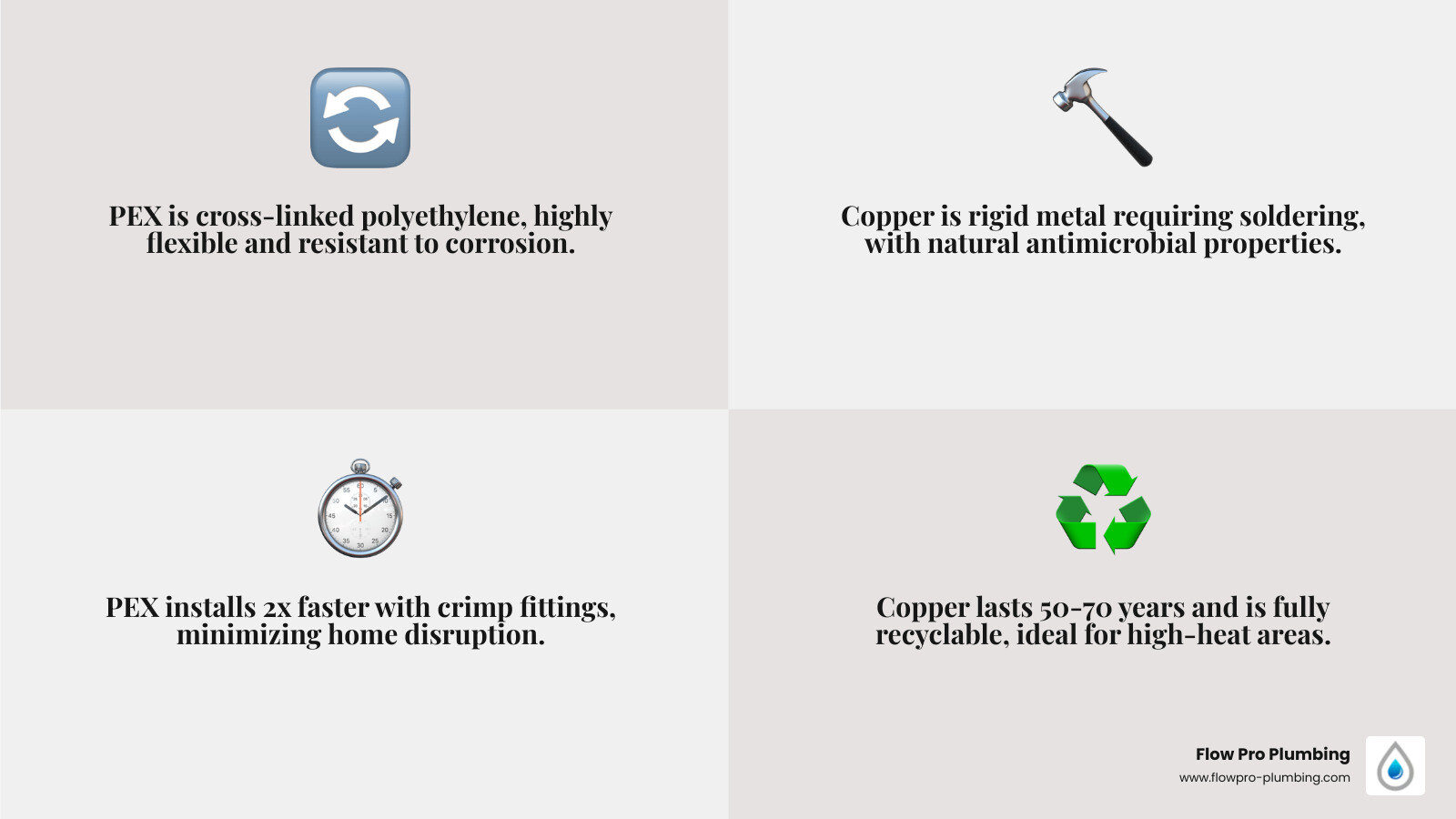
Copper is the “old guard” of the plumbing world. It is a rigid metal pipe that has been the industry standard since the 1960s. It’s manufactured from naturally occurring ore, making it a “noble” metal in the plumbing world. Copper is prized for its antimicrobial properties—it naturally inhibits the growth of bacteria—and its incredible strength. However, because it is rigid, every corner or turn in your home requires a separate fitting that must be soldered (sweated) together using a torch.
PEX, or cross-linked polyethylene, is the modern challenger. It’s a high-density plastic tubing that was introduced to North America in the 1980s. The “cross-linking” refers to a chemical or physical process that bridges the molecular chains of the polyethylene, making it much tougher and more heat-resistant than standard plastic.
The most significant difference in a pex vs copper pipe for repiping comparison is flexibility. PEX is like a long, high-tech garden hose. It can be snaked through walls and around corners in a single continuous run. This is a game-changer for Repiping in Brentwood CA: The Ultimate Guide to Modern Plumbing, as it often allows us to update your system with far fewer holes in your drywall.
The Pros and Cons of Modern Plumbing Materials
Choosing the right material requires weighing the specific benefits of each against their known vulnerabilities. In our experience serving areas from Oakley to Walnut Creek, we see how local conditions impact these materials differently.
PEX: The Flexible Powerhouse
- Pros: PEX is immune to corrosion and mineral scale buildup. In areas with hard water, this is a massive advantage. It also expands up to eight times its size, meaning it can “dance with the cold” and resist bursting if water freezes inside. Furthermore, PEX systems often use a central manifold—a “circuit breaker” for your water—where every fixture has its own dedicated line and shut-off valve.
- Cons: PEX is sensitive to UV light. It cannot be used outdoors or in areas where it will be exposed to direct sunlight, as the rays will break down the plastic. It is also vulnerable to rodents, who may occasionally chew on the tubing, and it cannot be recycled at the end of its life.
Copper: The Rigid Standard
- Pros: Copper is a time-tested material that can last 70 years or more. It is fire-resistant, rodent-proof, and 100% recyclable. For those concerned about Emergency Repiping in Concord CA: Fast, Reliable 24/7 Service, copper is often the go-to for exposed areas or high-heat zones near water heaters because it can withstand temperatures up to 400°F.
- Cons: Copper is susceptible to “pinhole leaks” if your water is particularly acidic or has a high chlorine content. It is also more labor-intensive to install and can be prone to “water hammer”—that loud banging sound you hear when a faucet is turned off quickly.
Performance and Durability in a PEX vs Copper Pipe for Repiping Comparison
When looking at the long-term, copper generally wins the lifespan race, lasting 50 to 70 years compared to PEX’s 30 to 50 years. However, this “win” comes with a caveat: water chemistry.
In a Pittsburg CA Home Repiping project, we have to consider the local water. If the water is acidic (low pH), it can eat away at the inside of copper pipes, leading to oxidation and leaks long before the 50-year mark. PEX, being plastic, is completely unaffected by acidic water or the mineral “scale” that can clog up older metal pipes. This makes PEX a very reliable performer in Smooth Flows: The Ultimate Guide to Repiping in Concord CA, where water conditions might fluctuate.
Installation Efficiency and Home Disruption
If you want to minimize the time your water is turned off and the number of holes in your walls, PEX is the clear winner. Because PEX is flexible, we can often “fish” it through the same holes as your old pipes. A PEX repipe typically takes 1 to 3 days.
Copper installation is much more invasive. Every joint must be measured, cut, and soldered with a torch. This requires more “open heart surgery” on your walls to give the plumber room to work safely with fire. A copper repipe usually takes 3 to 5 days and involves significantly more labor. For homeowners needing Brentwood’s Urgent Call: When You Need Same-Day Repiping, the speed of PEX is often the deciding factor.
Water Quality, Safety, and Environmental Impact
| Feature | PEX | Copper |
|---|---|---|
| Water Taste | Neutral (some report plastic scent initially) | Can be metallic if pipes are corroding |
| Health | BPA-free; potential leaching (minimized by filtration) | Natural antimicrobial; potential metal leaching |
| Eco-Friendly | Lower energy to produce; non-recyclable | High energy to mine; 100% recyclable |
| Noise | Very quiet; dampens water hammer | Can be noisy; prone to vibration |
| Efficiency | Excellent heat retention; naturally insulated | Higher heat loss; requires external insulation |
From a health perspective, copper is often favored because it is naturally antimicrobial, meaning it helps kill bacteria inside the lines. However, if copper pipes corrode, they can leach metals into your drinking water, causing a metallic taste.
PEX is generally considered very safe and meets all U.S. standards, though some homeowners worry about chemical leaching from plastics. In California, it’s often recommended to use a water filtration system with PEX to ensure the highest purity.
Environmentally, the pex vs copper pipe for repiping comparison is a toss-up. PEX takes less energy to manufacture and transport (it’s lighter), but copper is a sustainable material that can be melted down and reused forever. If you are looking for a Licensed & Loved: Finding the Best Repiping Company in Brentwood CA, we can help you weigh these eco-factors based on your personal values.
Choosing the Right Material for Your Home’s Needs
How do you decide? It often comes down to the “personality” of your home and your budget. If you live in an older home in Discovery Bay or Bethel Island with tight crawlspaces and complex layouts, PEX’s flexibility is a lifesaver. It allows us to navigate around the quirks of older construction without tearing your house apart.
If you are looking for Smart Savings: How to Get Affordable Repiping in Concord CA, PEX is usually the way to go. The material itself is less expensive than copper, and the labor savings are substantial because it installs so much faster.
When to Prioritize PEX vs Copper Pipe for Repiping Comparison Factors
- Choose PEX if: You are on a budget, you want a quiet plumbing system, you live in an area prone to freezing (like the colder nights in Clayton or Pleasant Hill), or you want to minimize the disruption to your home during the project. It’s also the better choice for homes with acidic water that would otherwise destroy copper.
- Choose Copper if: You want the longest possible lifespan, you are repiping an outdoor area, you want to add “resale value” to a high-end home, or you are running lines in a high-heat area (like right next to a boiler).
For many residents looking for Smart Spending: Don’t Miss These Repiping Deals in Antioch, a “hybrid” approach is also possible—using copper for the main incoming line and PEX for the distribution throughout the house.
Frequently Asked Questions about Repiping
Which pipe material lasts longer in a PEX vs copper pipe for repiping comparison?
Copper is the longevity king, with a lifespan of 50 to 70 years. PEX is no slouch, however, lasting 30 to 50 years. In many cases, PEX may actually outlast copper if the local water is highly acidic or contains minerals that cause copper to fail prematurely.
Is PEX safe for drinking water and does it affect taste?
Yes, PEX is code-approved and certified safe for drinking water. While some people notice a slight “plastic” smell for the first few days after installation, this quickly fades. Unlike older copper, PEX will never give your water a “penny-like” metallic taste.
Can PEX and copper be used together in the same plumbing system?
Absolutely! We do this all the time. Using special transition fittings, we can connect new PEX lines to existing copper sections. This is very common during remodels or partial repipes where only a portion of the home’s plumbing needs replacing.
Conclusion
At Flow Pro Plumbing, we know that there is no “one-size-fits-all” answer to the pex vs copper pipe for repiping comparison. Whether you are in Antioch, Pittsburg, or Walnut Creek, the best choice depends on your home’s unique plumbing “DNA.”
Copper offers a legacy of durability and recyclability, while PEX provides modern flexibility, freeze resistance, and cost-effectiveness. Our team of experienced, friendly specialists is here to provide an expert consultation to help you choose the material that fits your goals and your budget.
If you are ready to say goodbye to low water pressure, discolored water, or frequent leaks, we are here to help. From Repiping Antioch CA to whole-home upgrades in Brentwood, we pride ourselves on unsurpassed workmanship and a reputation you can trust.
Schedule your professional repiping service today and let us help you build a plumbing system that lasts for generations.