
Is Whole House Water Filtration Worth It? Here’s What Most Homeowners Get Wrong
Is whole house water filtration worth it for your home? Here’s a quick answer before we dive deeper:
It depends on your situation, but for most homeowners — yes.
| Scenario | Worth It? |
|---|---|
| You rely on well water | Almost always yes |
| You have hard water or mineral buildup | Yes |
| You have health concerns or sensitive skin | Yes |
| You only want better-tasting drinking water | A point-of-use filter may be enough |
| You’re renting | Probably not |
| Your water tests clean with no odor or taste issues | Maybe not necessary |
Here’s the thing: about 36% of homeowners have noticed an unusual taste or odor coming from their tap. And while that alone might send you searching for a solution, the real question isn’t just about how your water tastes — it’s about what’s happening to your pipes, your appliances, your skin, and your health every single day.
You don’t just drink your water. You shower in it, cook with it, run it through your dishwasher and washing machine, and heat it in your water heater. That means whatever’s in your water is touching nearly every system in your home — not just your glass at dinner.
A whole house water filtration system treats all the water entering your home at the main line, before it ever reaches a faucet or appliance. That’s a very different level of protection compared to a pitcher filter on your counter. But it also comes with a higher upfront cost and ongoing maintenance — so it’s worth thinking through carefully before you commit.
I’m Jesse Delgado, owner of Flow Pro Plumbing in Brentwood, California, and after years of helping East Bay homeowners navigate water quality concerns and plumbing decisions, I’ve seen when a whole house system genuinely transforms a home — and when a simpler solution does the job just fine. In this guide, I’ll walk you through everything you need to know to decide if whole house water filtration is worth it for your specific situation.
Understanding Whole House Water Filtration Systems
When we talk about water filtration, most people immediately think of that plastic pitcher sitting in the fridge or the little attachment clipped onto the kitchen faucet. Those are known as “Point-of-Use” (POU) filters. They are great for a glass of water, but they don’t do a thing for your shower, your laundry, or your dishwasher.
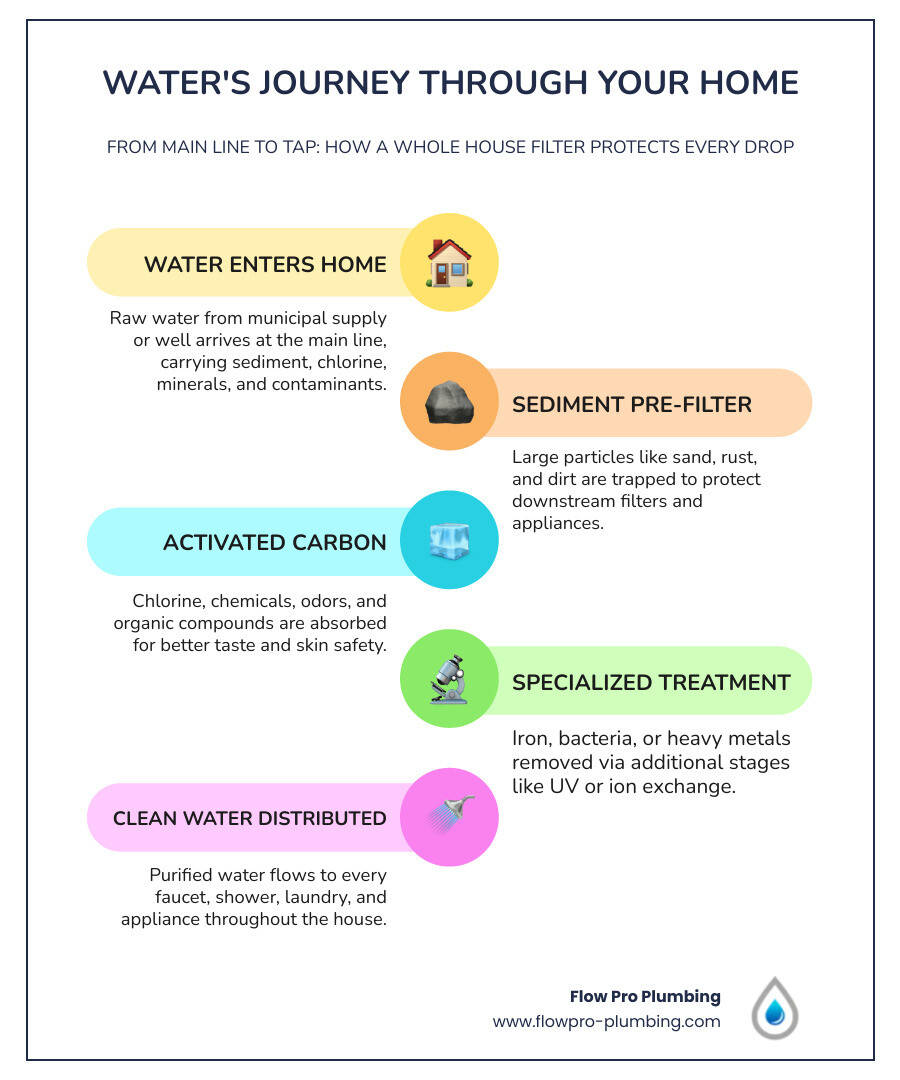
A whole house water filtration system is different. It is a “Point-of-Entry” (POE) system. This means it is installed right where the main water line enters your home. Every single drop of water that flows through your pipes—whether it’s going to the master bath, the garden hose, or the ice maker—passes through this system first.
The Different Technologies at Work
Not all whole house systems are created equal. Depending on what we find in your water, we might recommend a single-stage filter or a complex multi-stage setup. Here are the most common types:
- Sediment Filters: Think of this as the “bouncer” at the door. It catches physical particles like dirt, sand, rust, and silt. It’s essential for protecting the more delicate filters down the line.
- Activated Carbon: This is the workhorse of home filtration. Carbon filters are incredible at removing chlorine, chloramines, and volatile organic compounds (VOCs). If your water smells like a swimming pool, this is the solution.
- Reverse Osmosis (RO): While often used as a POU system under the sink, some advanced whole-home RO systems exist. They use a semi-permeable membrane to remove up to 99% of dissolved solids, including lead, arsenic, and fluoride. However, they can be “overkill” for some homes and do produce wastewater.
- UV Sterilization: This doesn’t “filter” particles; it uses ultraviolet light to scramble the DNA of living organisms. It is 99.9% effective at killing bacteria, viruses, and parasites like Cryptosporidium.
Is Whole House Water Filtration Worth It?
To determine if is whole house water filtration worth it, we have to look past the initial setup and consider the long-term ripple effects on your home. For many of our neighbors in Brentwood and Oakley, the “worth” comes from three main areas: health, home protection, and lifestyle.
Protecting Your “Plumbing Arteries” and Appliances
Unfiltered water is often like “liquid sandpaper” on your plumbing. Sediment and minerals can cause scale buildup in your pipes, leading to restricted flow and eventual corrosion.
Your appliances feel the brunt of this, too. Hard water and chemical contaminants can reduce the efficiency of a water heater by up to 48%. By installing a whole-home system, you can extend the lifespan of major appliances—like your washing machine and dishwasher—by 15% to 20%. In many cases, the system pays for itself within 5 to 7 years just through reduced appliance repairs and replacements.
The “Shower Effect” on Skin and Hair
Have you ever felt itchy or noticed your skin feels “tight” after a shower? That’s often the chlorine talking. Chlorine is great for killing germs in city pipes, but it strips the natural oils from your skin and hair.
Furthermore, when you take a hot shower, chlorine and other VOCs can evaporate into the steam. This means you aren’t just touching these chemicals; you’re inhaling them. A whole-home system ensures that the water you bathe in is just as clean as the water you drink, which can provide significant relief for family members with eczema or sensitive skin.
If you’re still on the fence, check out our deeper dive into is home water filtration worth it for more specific examples of home transformations.
Is whole house water filtration worth it for well water?
About 50% of the U.S. population relies on groundwater, and if you’re on a private well in the outlying areas of Contra Costa County, a filtration system isn’t just a “nice to have”—it’s often a necessity.
Groundwater is much more likely to contain pollutants like pesticides, nitrates from local agriculture, and heavy minerals like iron and sulfur (the source of that “rotten egg” smell). Since well water isn’t treated by a municipal plant, you are your own “water treatment manager.” A system that includes UV sterilization is particularly vital here to protect against bacterial outbreaks that can occur after heavy rains or flooding. You can learn more about how these systems contribute to a healthy home in our guide on water filtration systems contribution.
Is whole house water filtration worth it for city water?
Even if your water comes from a treated city source in Pittsburg or Concord, it isn’t necessarily “pure.” Municipalities do a great job of meeting federal standards, but those standards allow for certain levels of chlorine, fluoride, and even “forever chemicals” like PFAS.
Additionally, city water has to travel through miles of aging infrastructure before it hits your tap. Along the way, it can pick up sediment, microplastics, or even lead from old pipes. A whole house system acts as your home’s final gatekeeper, removing over 90% of chlorine and other residuals that the city leaves behind. For a complete breakdown of the top options, see our article on the best water filtration system.
Key Factors When Choosing Your System
Choosing a system isn’t a one-size-fits-all process. If you buy a system that’s too small, your water pressure will tank. If you buy one that’s too complex, you’ll be spending money on maintenance you don’t need.
The “Big Three” Specs to Watch
- Flow Rate (GPM): This is measured in Gallons Per Minute. You need to know how much water your household uses at peak times (like when the shower, dishwasher, and laundry are all running). Most homes need at least 5 to 10 GPM. If you have a larger home with 4+ bathrooms, you might need a system rated for 12 to 20 GPM to avoid a drop in pressure.
- Filter Capacity: This tells you how many gallons the filter can treat before it needs to be replaced. Some carbon tanks are rated for 1,000,000 gallons (lasting up to 10 years!), while smaller cartridge-based systems might need a swap every 6 to 12 months.
- NSF Certification: Look for the NSF seal. Standard 42 covers taste and odor (chlorine), while Standard 53 covers health-related contaminants like lead and VOCs. Standard 58 is specific to Reverse Osmosis systems.
Comparison of Common Filtration Types
| Filter Type | Best For… | Removes | Maintenance |
|---|---|---|---|
| Activated Carbon | City Water | Chlorine, bad tastes, odors, VOCs | Low (Replace every 1-3 years) |
| Reverse Osmosis | Total Purification | Lead, fluoride, arsenic, nitrates | High (Membrane swaps + wastewater) |
| UV Sterilization | Well Water | Bacteria, viruses, parasites | Medium (Annual bulb change) |
| Sediment Filter | All Homes | Sand, dirt, rust, silt | Easy (Clean/swap every 3-6 months) |
Comparing Whole House Systems to Point-of-Use Alternatives
We often get asked: “Can’t I just put a filter on every sink?” Technically, yes, but it’s rarely the most efficient way to go.
A pitcher filter or a faucet mount is a great entry point. They are inexpensive and require zero plumbing skills to install. However, they have very low capacities. If you have a family of four, you’ll be changing those tiny filters constantly.
An under-sink RO system is a fantastic choice for high-quality drinking water, but it still leaves your shower and your appliances unprotected. If you find yourself wanting “bottled water quality” at every tap, or if you’re tired of seeing white crusty scales on your showerhead, the whole house system is the only way to achieve that.
For many homeowners, the “Goldilocks” solution is a hybrid approach: a whole house carbon/sediment system to protect the entire home and skin, paired with a small RO unit under the kitchen sink for the absolute purest drinking water and ice.
Frequently Asked Questions
Will a whole house filter reduce my water pressure?
This is the most common fear we hear. If a system is sized correctly for your home’s GPM requirements, you shouldn’t notice a drop in pressure. However, if you notice the pressure dipping over time, it’s usually a sign that your sediment pre-filter is doing its job and is full of gunk. A quick filter swap usually brings the pressure right back up.
Do these systems increase my monthly water bill?
Most whole house systems (carbon and sediment) have zero impact on your water bill because they don’t “waste” water; they just clean it as it passes through. The exception is Reverse Osmosis. RO systems can take almost two gallons of water to create one gallon of filtered water, which can roughly double the water usage for that specific line. However, whole-home RO is rare; most people stick to carbon-based POE systems.
How often do filters need to be replaced?
It depends on your water quality. In areas like Brentwood or Oakley with higher sediment, you might swap a pre-filter every 3 to 6 months. The main filtration media (like the carbon tank) often lasts 3 to 5 years, or even up to a decade in some high-end models. UV bulbs generally need to be replaced once a year to ensure they stay at the correct intensity to kill bacteria.
Conclusion: Making the Right Choice for Your Home
So, is whole house water filtration worth it? If you’re looking to protect your home’s infrastructure, improve your family’s skin and hair health, and enjoy clean water from every single tap, the answer is a resounding yes. While the upfront investment is higher than a simple pitcher, the long-term savings in appliance longevity and the daily improvement in water quality are hard to beat.
At Flow Pro Plumbing, we’ve spent years serving our neighbors in Brentwood, Oakley, Antioch, and throughout the East Bay. We know the local water profiles, and we know exactly what it takes to keep your plumbing running smoothly. We don’t believe in “one-size-fits-all” sales pitches; we believe in testing your water and finding the specific solution that fits your home and your budget.
If you’re ready to stop being “salty” about your water quality and want to see what a home water filtration system can do for you, give us a call. We’d love to help you find the perfect system for your peace of mind.