

Why Choosing the Best Water Filter System Matters for Your Home
The best water filter system for most homes depends on your water source, the contaminants present, and how much of your home you want protected. Here is a quick breakdown to help you decide:
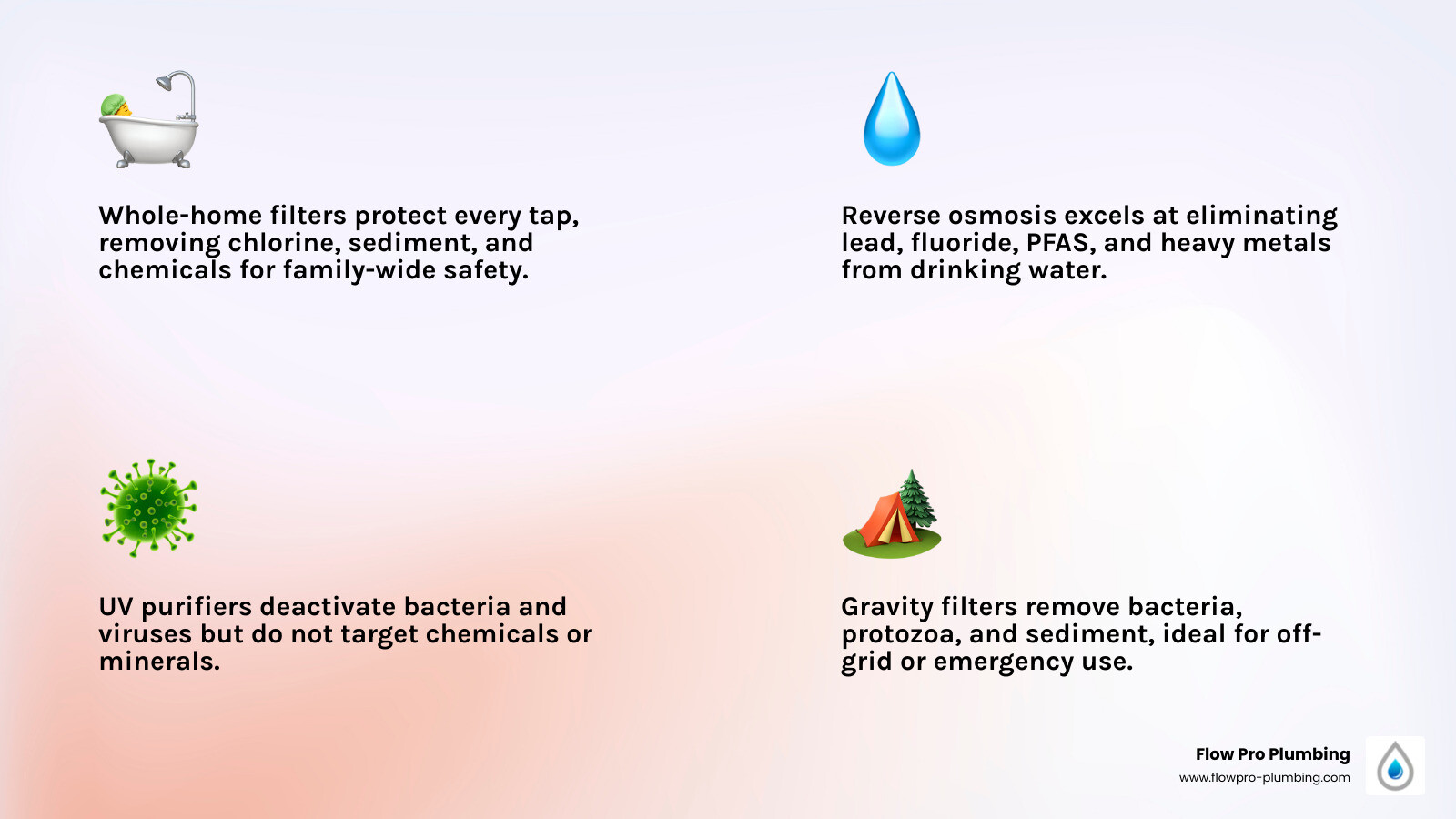
| Filter Type | Best For | Removes |
|---|---|---|
| Whole-home filter | Families, all taps | Chlorine, sediment, chemicals |
| Reverse osmosis (RO) | Drinking/cooking water | Lead, fluoride, PFAS, heavy metals |
| Countertop/pitcher | Renters, small households | Chlorine, some heavy metals |
| UV purifier | Bacteria and virus removal | Pathogens (not chemicals) |
| Gravity filter | Off-grid, emergencies | Bacteria, protozoa, sediment |
Most people do not realize that common pitcher and fridge filters mainly improve taste — they do not remove germs or serious contaminants like lead or PFAS. If you want true protection, you need to match the filter to what is actually in your water.
Clean water is not just about taste. Harmful contaminants like bacteria, heavy metals, and chemicals often have no smell, color, or flavor — so you cannot rely on your senses alone to judge whether your water is safe.
Whether you are on city water or a private well, the right filtration system can protect your family’s health, extend the life of your plumbing and appliances, and give you genuine peace of mind at every tap.
I’m Jesse Delgado, owner of Flow Pro Plumbing in Brentwood, California, with over a decade of licensed plumbing experience helping East Bay homeowners find the best water filter system for their specific needs. In this guide, I’ll walk you through everything you need to know — from filter types and certifications to maintenance and installation — so you can make a confident, informed decision.
Understanding the Best Water Filter System for Your Home
When we talk about finding the best water filter system, we first have to clarify what we are trying to achieve. In water treatment, there is a fundamental difference between a “filter” and a “purifier.” A standard water filter generally uses a physical barrier or chemical process to reduce impurities like chlorine or sediment. A water purifier, however, is designed to remove or deactivate biological threats like bacteria and viruses.

The effectiveness of any system is largely dictated by its “pore size.” This is measured in microns. To give you an idea of the scale, a human hair is about 70 microns wide.
- Absolute Pore Size: This refers to a filter that has a consistent, guaranteed pore size. For example, a filter with an absolute pore size of 1 micron or smaller is required to remove parasites like Giardia and Cryptosporidium.
- Nominal Pore Size: This is more of an average. It means the filter can stop most particles of that size, but some might still sneak through.
When you ask, Is Tap Water Safe to Drink?, the answer often depends on your local infrastructure. In areas like Brentwood and Antioch, municipal water is treated to meet federal standards, but that doesn’t account for what happens in the pipes between the treatment plant and your faucet.
Identifying Contaminants and Water Testing
Before you can choose the best water filter system, you have to know what you’re fighting. Contaminants generally fall into a few categories:
- Biological: Bacteria (like E. coli), viruses (like Norovirus), and protozoa (like Cryptosporidium).
- Chemicals: Chlorine, fluoride, pesticides, and “forever chemicals” like PFAS.
- Heavy Metals: Lead, arsenic, and mercury.
- Particulates: Sand, silt, and rust.
Testing is the only way to be sure. If you are on a public water system in Pittsburg or Concord, you can check your annual water quality report. However, if you have a private well in Discovery Bay or Byron, the CDC recommends testing your water at least once a year. Testing is vital because harmful germs and chemicals often don’t change the taste, smell, or appearance of your water.
If you’re noticing strange stains or odors, our team can help you navigate the various Water Filtration Systems available to address those specific issues.
Comparing Residential Filtration Technologies
Choosing between different technologies can feel like a science project, but it’s easier when you see them side-by-side.
| Feature | Reverse Osmosis (RO) | Whole-Home Filtration |
|---|---|---|
| Installation Point | Under-sink (Point-of-Use) | Main water line (Point-of-Entry) |
| Contaminant Removal | 99% of lead, fluoride, arsenic, TDS | Chlorine, sediment, pesticides, VOCs |
| Water Efficiency | Produces wastewater | No water wasted |
| Flow Rate | Slower (fills a tank or special faucet) | High (same as your normal tap) |
| Maintenance | Change filters every 6–12 months | Main media lasts 6–10 years |
Activated Carbon is the most common technology, found in everything from pitchers to whole-home units. It works through adsorption, where contaminants stick to the surface of the carbon. It’s excellent for making water taste better by removing chlorine.
Ion Exchange is typically used in water softeners to swap “hard” minerals like calcium for sodium. If you’re struggling with white crusty buildup on your faucets, you might be interested in Having a Water Softener or the many Benefits of a Water Softener.
UV Sterilization is the “silver bullet” for bacteria and viruses. It doesn’t remove chemicals, but it scrambles the DNA of pathogens so they can’t reproduce. This is a common add-on for a Home Water Filtration System in rural areas.
Why Whole-Home Units are the Best Water Filter System for Families
For families in Oakley or Knightsen, a whole-home system is often the most practical choice. These systems are installed where the water enters your house, meaning every drop—from the shower to the washing machine—is filtered.
We often recommend systems featuring ActivFlo technology. This is a four-stage filtration process that maximizes the time water spends in contact with the filter media. This ensures more contaminants are removed without causing a drop in water pressure. High-quality whole-home units offer flow rates between 9 and 20 Gallons Per Minute (GPM), which is plenty for homes with multiple bathrooms.
Beyond health, these systems provide a significant Water Filtration Systems Contribution to your home’s longevity. By removing sediment and chemicals, you protect your plumbing from corrosion and prevent your appliances from wearing out prematurely.
Key Factors in Selecting a Filtration Solution
When shopping for the best water filter system, don’t just take the manufacturer’s word for it. Look for NSF/ANSI certifications. These are the gold standard for independent testing:
- Standard 42: Covers aesthetic effects (taste and odor, usually chlorine).
- Standard 53: Covers health effects (lead, VOCs, and cysts).
- Standard 58: Specifically for Reverse Osmosis systems.
- Standard 401: Covers “emerging contaminants” like pharmaceuticals and detergents.
Pore size is also a major factor. If you want to remove bacteria like Salmonella or E. coli, you need an absolute pore size of 0.3 micron or smaller. For viruses, you typically need nanofiltration or reverse osmosis, as viruses are far too small for standard mechanical filters.
Finding The Best Water Filtration System means balancing these certifications with your home’s specific flow rate needs. A filter that is too “tight” might provide incredibly pure water but leave you with a frustratingly slow shower.
Maintenance and Performance for the Best Water Filter System
Even the best water filter system will fail if it isn’t maintained. Filters are like sponges—eventually, they get full.
- Sediment Pre-filters: These should be changed every 6–9 months. They catch the “big stuff” like sand and rust, protecting the primary internal filters.
- Carbon Cartridges: Usually replaced every 6–12 months depending on usage.
- RO Membranes: These can last 2–3 years if the pre-filters are maintained.
Regular maintenance is the secret to system longevity. If you let a filter go too long, it can actually start releasing trapped contaminants back into your water or become a breeding ground for bacteria. If you’ve ever wondered, Is Home Water Filtration Worth It?, the answer is a resounding yes—provided you keep up with the simple task of swapping cartridges.
Special Considerations for Health and Water Sources
Certain populations need to be extra cautious. If someone in your home has a weakened immune system, they are at a much higher risk for infections from pathogens like Cryptosporidium. In these cases, a system certified to NSF Standard 53 or 58 for cyst reduction is a non-negotiable requirement.
Water source also matters. If you have “turbid” water (water that looks cloudy), your filters will clog much faster. You’ll need a heavy-duty sediment pre-filter or a self-cleaning system like the MSR Guardian (for outdoor use) or a robust residential backwashing filter.
Well water users in areas like Bethel Island or Clayton also have to watch out for pH levels. Acidic water can eat away at your copper pipes, leading to pinhole leaks. Understanding How Acidic Water Affects Plumbing is a key part of choosing a system that might need to include a neutralizing stage to balance the water’s chemistry.
Frequently Asked Questions about Home Filtration
Do water filters remove beneficial minerals like fluoride?
It depends on the technology. Activated carbon filters generally do not remove fluoride. However, Reverse Osmosis and certain specialized alumina filters will remove it. While fluoride is added to many municipal systems to help prevent tooth decay, some homeowners prefer to remove it. If you choose an RO system but want minerals back, look for a model with a “remineralization” stage that adds calcium and magnesium back into the water.
What is the difference between a 1-micron and 0.3-micron filter?
A 1-micron absolute filter is small enough to catch larger parasites like Giardia. A 0.3-micron filter is significantly tighter and can catch most bacteria. For reference, the LifeStraw Peak Squeeze uses a 0.2-micron filter, while the MSR Guardian Purifier goes all the way down to 0.02 microns to stop even tiny viruses.
How often should I test my home’s water quality?
For most homes in Contra Costa County on city water, testing every 2–3 years is usually sufficient unless you notice a change in taste or color. For well water, you should test annually for bacteria and nitrates. If you decide to install a new system, we recommend testing before and after to verify the system is doing its job.
Conclusion
Finding the best water filter system shouldn’t be a guessing game. Whether you’re in Brentwood, Oakley, or Discovery Bay, your water quality has a direct impact on your family’s health and your home’s plumbing. From simple under-sink RO units to heavy-duty whole-home systems that protect every tap, there is a solution for every need.
At Flow Pro Plumbing, we take pride in being more than just installers; we are your neighbors. We’ve built our reputation across Antioch, Pittsburg, and Concord by providing fast, clean, and courteous service. Our licensed plumbers are experts in local water conditions and can help you navigate everything from Installing Water Softeners to maintaining complex filtration arrays.
We believe in clear communication and building long-term relationships with our customers. You won’t find any technical jargon or high-pressure sales here—just honest advice and unsurpassed workmanship.
Are you ready to enjoy the peace of mind that comes with crystal clear, healthy water? Schedule your water filtration service today and let us help you make your home’s water the best it can be.