

How Often Should Sewer Lines Be Inspected — and Why It Matters More Than You Think
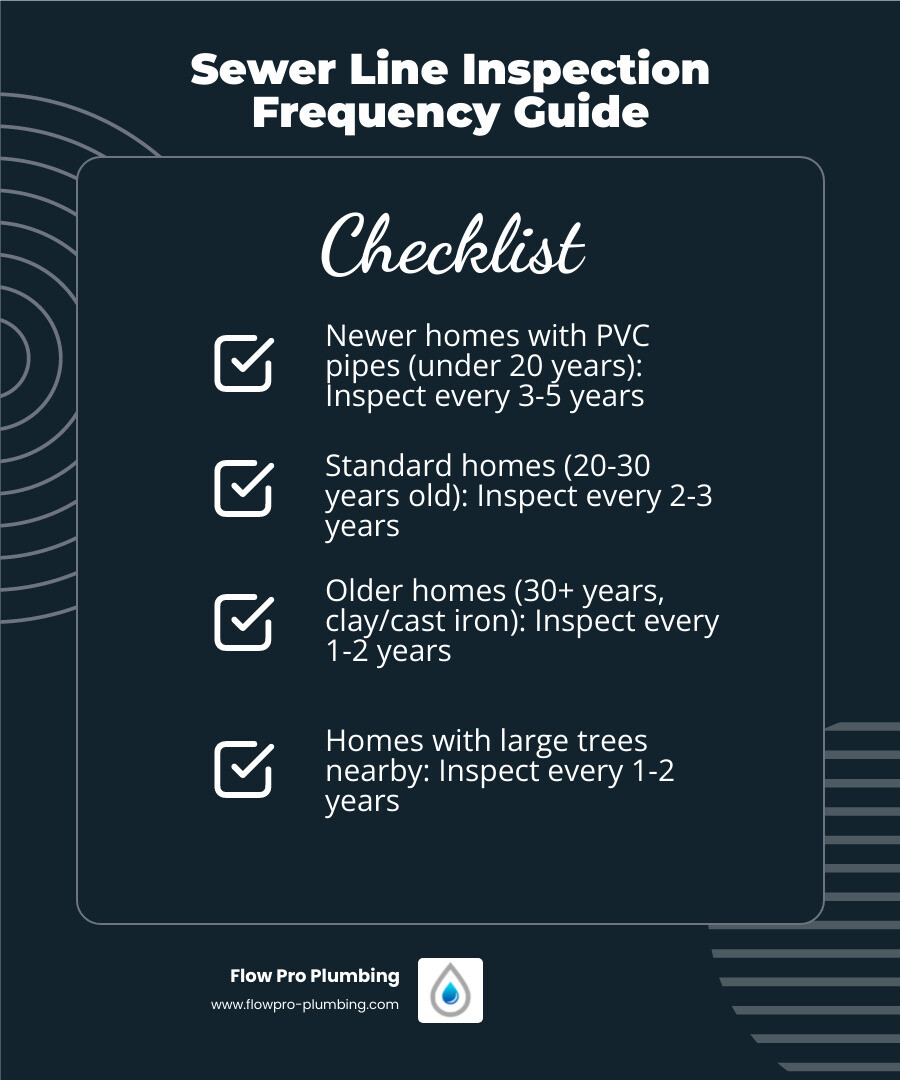
How often should sewer lines be inspected depends on your home’s age, pipe material, and surrounding environment — but here’s a quick reference to get you oriented:
| Home Type | Recommended Inspection Frequency |
|---|---|
| Newer home with PVC pipe (under 20 years) | Every 3-5 years |
| Standard home (20-30 years old) | Every 2-3 years |
| Older home (30+ years, clay or cast iron) | Every 1-2 years |
| Any home with large trees nearby | Every 1-2 years |
| Home over 10 years old (aggressive schedule) | Every 6-12 months |
| Before buying any home | Once, immediately |
Most homeowners don’t think about their sewer line until something goes wrong — and by then, the damage is often already done. Your sewer line quietly moves wastewater away from your home every single day, running underground through your yard and connecting to the municipal main. It’s one of the hardest-working parts of your entire plumbing system, and one of the most overlooked.
The problem is that sewer line issues rarely announce themselves early. Tree roots, pipe corrosion, grease buildup, and cracks can develop slowly over months or years before you ever notice a slow drain or a bad smell. And when a failure does happen — a backup at two in the morning, sewage in the basement, or a sinkhole forming in the yard — the resulting damage can be severe. A proactive inspection, by contrast, is a simple preventive measure that can catch problems before they escalate.
In this guide, we’ll walk you through exactly how to determine the right inspection schedule for your home, the warning signs you shouldn’t ignore, and how modern camera technology makes the whole process fast and non-invasive.
I’m Jesse Delgado, owner of Flow Pro Plumbing in Brentwood, California, and a licensed plumber with over a decade of experience helping East Bay homeowners understand how often should sewer lines be inspected — and what to do when we find something. Growing up around plumbing and spending years in the field, I’ve seen how a simple, routine inspection can save homeowners from stressful emergencies.
Determining How Often Should Sewer Lines Be Inspected for Your Home
When we talk to our neighbors in Brentwood or Discovery Bay, the most common question is: “Do I really need to do this if everything is flushing fine?” The answer lies in the age and material of your pipes. In May 2026, we are seeing a wide variety of infrastructure across Contra Costa County.
If your home was built recently, you likely have PVC (polyvinyl chloride) piping. These pipes are smooth, durable, and resistant to the corrosion that plagued older materials. For these modern systems, a baseline of every 3 to 5 years is typically sufficient. However, if you live in one of the more established neighborhoods in Pittsburg or Antioch, your home might still rely on vitrified clay or cast iron pipes. These materials are much more prone to cracking, “scaling” (internal rust buildup), and joint offsets. For these older systems, we recommend an inspection every 1 to 2 years.
Soil conditions also play a huge role. Our local climate can cause the ground to shift, especially during the transition from dry summers to wet winters. This movement can put immense pressure on buried lines, leading to “bellies” (dips in the pipe) or full-scale breaks. Some experts even suggest that once a sewer system hits the 10-year mark, you should consider moving to a more aggressive 6-to-12-month checkup to ensure Sewer Video Inspections Prevent Plumbing Issues from turning into midnight disasters.
How often should sewer lines be inspected if you have large trees?
Trees are the natural enemy of a healthy sewer line. In beautiful, leafy areas like Oakley, large trees and shrubs are a staple of local landscaping. Unfortunately, tree roots are moisture-seeking missiles. They can sense the condensation on the outside of a sewer pipe or a tiny pinhole leak at a joint. Once they find a way in, they grow rapidly, creating a “root ball” that acts as a net, catching grease, hair, and toilet paper.
If you have mature trees within 15 to 20 feet of your sewer line, you need to be more vigilant. We recommend annual inspections for these properties. Catching a root intrusion early allows us to clear it before the roots expand enough to actually shatter the pipe. Utilizing Preventing Sewer Blockages strategies, like routine camera checks, ensures your yard stays beautiful without your plumbing suffering beneath the surface.
How often should sewer lines be inspected for new homeowners in Oakley?
If you are currently in the process of buying a home in Oakley or Discovery Bay, a sewer scope is non-negotiable. Standard home inspections often stop at the drains inside the house. They don’t look at the “side sewer”—the private line that connects the house to the city main.
Getting a Sewer Camera Inspection before you close escrow provides a “baseline health” report. It ensures you aren’t inheriting a major repair job the week after you move in. Many real estate contracts in our area now include these inspections as a standard due-diligence item because hidden defects like construction debris in a new build or a collapsed line in an older resale can be deal-breakers.
Critical Warning Signs That You Need an Immediate Inspection

Sometimes, you can’t wait for your scheduled 3-year checkup. Your plumbing system has a way of “whispering” to you before it starts “shouting.” If you notice any of the following, call us for an immediate look:
- Gurgling Noises: If your toilet bubbles when you run the bathroom sink, or you hear a “glug-glug” sound from the floor drain after a shower, air is trapped in the line by a blockage.
- Foul Odors: You should never smell raw sewage inside or immediately outside your home. A persistent “rotten egg” smell usually indicates a crack or a backup in the main line.
- Lush, Green Patches: Is one specific spot in your lawn looking much greener and growing faster than the rest? Sewage acts as a potent fertilizer. If you have a leak, the grass above it will be the first to know.
- Multiple Clogs: One clogged sink is a local problem. If your kitchen sink, bathtub, and toilet are all backing up at the same time, the problem is deep in the main sewer line.
- Rodent or Pest Activity: Rats and cockroaches are attracted to the moisture and waste in sewer lines. If you have a sudden influx of pests and can’t find the entry point, it might be a broken sewer pipe.
- Soggy Yard Spots or Sinkholes: In areas like Antioch, unexplained wet spots in the yard—even when it hasn’t rained—are a major red flag for a leaking pipe that is saturating the soil.
Ignoring these signs can lead to foundation moisture issues or even mold growth inside the home. It’s always better to Avoid Common Sewer Problems by investigating these symptoms the moment they appear.
The Role of Advanced Video Technology in Modern Inspections
The days of “guess and dig” are over. At Flow Pro Plumbing, we use state-of-the-art Sewer Video Inspection Role technology to see exactly what’s happening underground.
The process involves feeding a high-definition, waterproof camera attached to a flexible metal cord through your home’s “cleanout” (an access point in your yard or near the foundation). As the camera travels through the pipe—sometimes up to 300 feet—it sends a real-time video feed to a monitor.
This technology allows us to:
- Pinpoint Accuracy: We use a “sonde” (a locating beacon) on the camera head. If we find a break, we can walk over the yard with a receiver and mark the exact spot and depth where the repair is needed.
- Identify the Material: We can confirm if you have clay, cast iron, Orangeburg, or PVC, which dictates how we approach repairs.
- Find Hidden Issues: We can see corrosion, “bellies” in the line, or cracks that haven’t caused a full backup yet.
- Non-Invasive Diagnostics: There is no need to tear up your driveway just to see what’s wrong.
If we do find a problem, we often discuss the Benefits of Trenchless Sewer Repair, which allows us to fix or replace pipes without digging massive trenches through your beautiful landscaping.
Preventive Maintenance to Extend the Life of Your Sewer System
You don’t have to just wait for your pipes to fail. There are several proactive steps you can take to extend the time between major inspections and keep your system running smoothly:
- Grease Management: Never pour fats, oils, or grease down the drain. They solidify as they cool, creating “fatbergs” that narrow the diameter of your sewer line.
- Flushing Habits: Only flush human waste and toilet paper. Even “flushable” wipes don’t actually break down and are a leading cause of blockages in Pittsburg homes.
- Hydro Jetting: Think of this as a “deep clean” for your pipes. We use high-pressure water to scour the inside of the lines, removing grease buildup and small tree roots. This is often part of a comprehensive Sewer Line Repair Guide for long-term maintenance.
- Root Barriers: If you’re planting new trees, consider installing physical root barriers to direct growth away from your plumbing.
- Starchy Food Disposal: Avoid putting pasta, rice, and potato peels down the garbage disposal, as they create a thick paste that can easily clog a sewer line.
By combining regular inspections with Essential Sewer Repair Services and smart daily habits, you can keep your home’s wastewater system healthy for decades.
Frequently Asked Questions About Sewer Maintenance
What is the difference between a sewer inspection and a cleaning?
An inspection is a diagnostic tool. We use a camera to see what is happening. A cleaning is the solution. If the camera shows a lot of grease or debris, we then use tools like a motorized auger or a hydro jetter to clear the line. You usually want the inspection first so you aren’t cleaning blindly.
Do new construction homes in Concord need a sewer scope?
Surprisingly, yes. We often find construction debris (like 2x4s or chunks of concrete) that fell into the lines during the build. We also see “pipe bellies” caused by soil shifting after the heavy machinery leaves the site, or even simple installation errors where the pipe wasn’t sloped correctly.
How long does a professional sewer inspection typically take?
For a standard residential property in our service area, a professional inspection usually takes between 45 and 90 minutes. This includes setting up, running the camera through the full length of the line to the city main, and reviewing the footage with you to explain any findings.
Conclusion
Understanding how often should sewer lines be inspected is the first step in protecting your home from one of the messiest and most serious plumbing problems imaginable. Whether you are in Brentwood, Oakley, Antioch, or Concord, being proactive is always better than being reactive.
At Flow Pro Plumbing, we pride ourselves on providing fast, clean, and courteous service. Our licensed plumbers are locally owned and committed to building long-term relationships with our neighbors throughout Contra Costa County. We won’t just tell you there’s a problem; we’ll show it to you on the screen and walk you through the most efficient, reliable way to fix it.
Don’t wait for a 2:00 AM emergency to find out what’s happening under your lawn. Schedule your professional sewer line inspection today and give yourself the peace of mind that comes with a healthy home.