

Understanding Hard Water Problems Common in Contra Costa County
Hard water problems common in Contra Costa County affect thousands of East Bay homeowners every day — showing up as white crusty buildup on faucets, spots on dishes, dry skin after showering, and appliances that wear out years too soon.
Here is a quick look at the most common hard water problems in the region:
- Scale buildup on faucets, showerheads, and pipes from dissolved calcium and magnesium minerals
- Reduced water heater efficiency — hard water scale forces heaters to work harder and fail earlier
- Spotty dishes and glassware even after a full dishwasher cycle
- Stiff laundry and dingy whites because soap can’t lather or rinse properly in hard water
- Dry, itchy skin and dull hair after bathing
- Soap scum on tubs, tiles, and shower doors that won’t scrub off easily
- Shortened appliance lifespan for washing machines, dishwashers, and water heaters
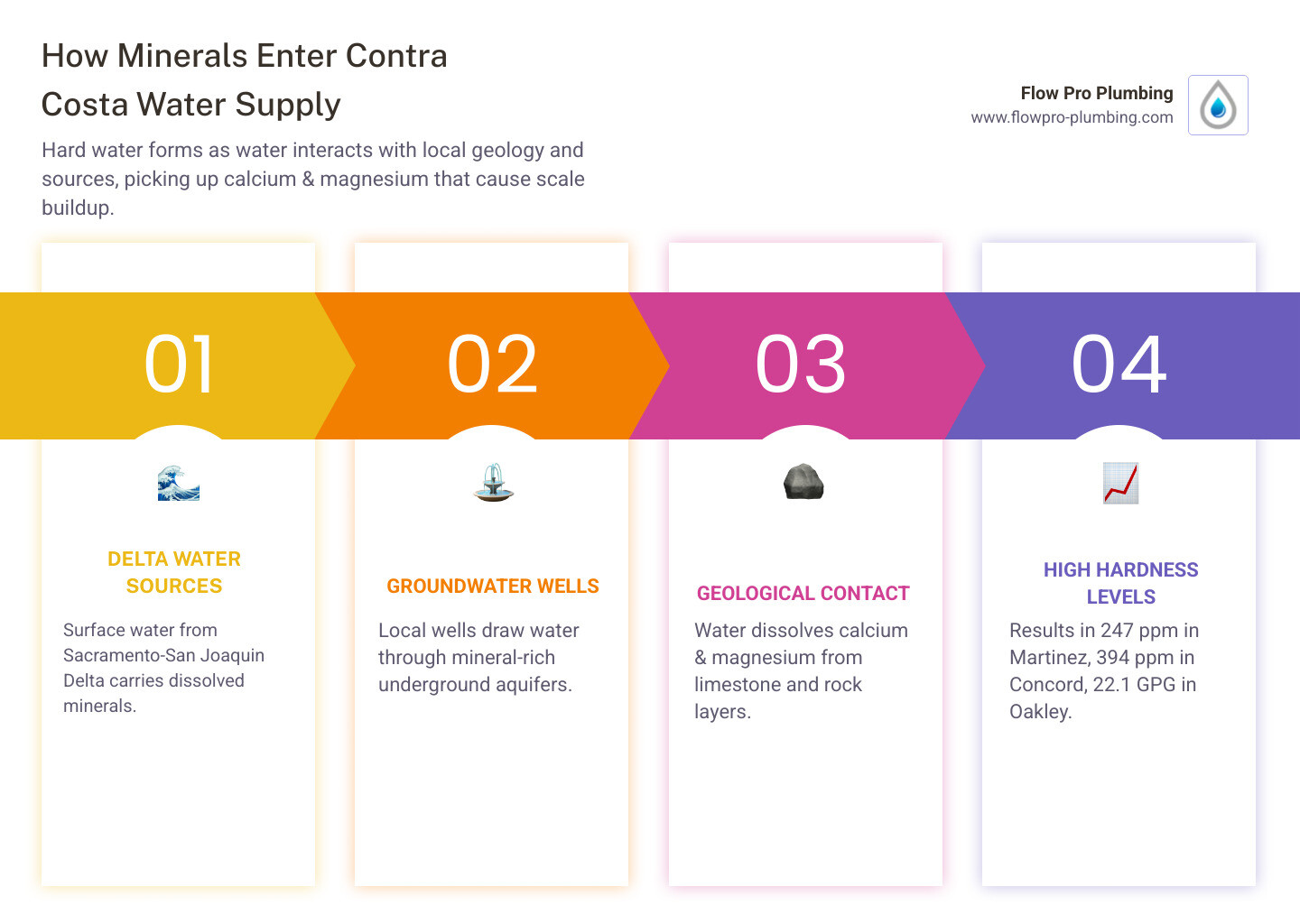
Water hardness varies across the county. Martinez measures around 247 parts per million (ppm) in Total Dissolved Solids, while Concord reaches 394 ppm and Oakley sits at a very hard 22.1 grains per gallon. These numbers reflect how much calcium and magnesium has dissolved into the water as it moves through local geology and Delta water sources — and the higher those numbers climb, the more damage your home absorbs over time.
I’m Jesse Delgado, owner of Flow Pro Plumbing in Brentwood, California, and after years of servicing homes across the East Bay, I’ve seen how hard water problems common in Contra Costa County quietly drain homeowners of time, money, and comfort. In this guide, I’ll walk you through exactly what’s happening in your water, what it’s doing to your home, and what actually works to fix it.
The Impact on Your Home’s Infrastructure
When we talk about hard water problems common in Contra Costa County, we aren’t just talking about an aesthetic nuisance. We are talking about a physical assault on your home’s plumbing infrastructure. Hard water contains high concentrations of dissolved minerals, primarily calcium and magnesium. As this water flows through your pipes and sits in your appliances, these minerals “precipitate” out of the liquid, forming a rock-hard crust known as scale.
This scale acts like cholesterol in an artery. It narrows the diameter of your pipes, which eventually reduces water pressure. Even worse, it forms an insulating layer inside any appliance that heats water. Research shows that even a thin layer of scale can lead to a 29% efficiency loss in your home’s water heating capabilities. Essentially, you are paying to heat a layer of rock before you ever start heating the water itself.
Beyond the hidden pipes, you can see the damage on your fixtures. If you’ve ever wondered why your chrome faucets look dull or why there’s a white ring around your drain that won’t go away, that’s the calcium making itself at home. You can learn more about how to remove calcium from your faucet to keep things looking sharp, but cleaning the outside doesn’t fix the buildup happening inside.
It is also important to understand the chemistry of your water. While hardness is our main focus, the pH balance matters too. We’ve seen many cases where how acidic water affects plumbing can exacerbate the wear and tear on copper pipes already struggling with mineral deposits.
| Appliance | Lifespan with Hard Water | Lifespan with Treated Water |
|---|---|---|
| Water Heater | 6–8 Years | 12–15 Years |
| Dishwasher | 5–7 Years | 10–12 Years |
| Washing Machine | 6–8 Years | 11–14 Years |
| Faucets/Fixtures | 3–5 Years | 10+ Years |
Hard Water Problems Common in Contra Costa County and Your Water Heater
The water heater is the “ground zero” for hard water damage. Because heat accelerates the formation of scale, your water heater becomes a magnet for mineral deposits. In cities like Antioch and Pittsburg, we frequently see water heaters that should have lasted 15 years failing in just six or seven.
As the minerals settle at the bottom of the tank, they create a thick layer of sediment. This causes several issues:
- The “Popcorn” Noise: If you hear banging or popping sounds coming from your closet or garage, that’s steam bubbles struggling to escape through the layer of sediment at the bottom of the tank.
- Energy Waste: Because the burner has to heat through inches of rock, performance drops and the system works harder than it should.
- Premature Failure: The constant overheating of the tank bottom weakens the steel, eventually leading to a leak or a total tank failure.
When we are installing water softeners for our neighbors, one of the primary goals is to protect this expensive piece of equipment. Without treatment, you are essentially replacing your water heater more often than necessary.
Detergent and Cleaning Efficiency
Have you noticed that no matter how much soap you use, you can’t get a good lather in the shower? Or that your clothes feel “crunchy” when they come out of the dryer? This is one of the most frustrating hard water problems common in Contra Costa County.
Hard water minerals chemically react with soap and detergent to form “soap curd” or scum. Instead of the soap dissolving and cleaning your clothes or skin, it turns into a sticky film that clings to everything. Studies show that households with hard water must use up to 35% more detergent to achieve the same level of cleanliness as those with soft water.
For a family in Concord or Pleasant Hill, that extra soap adds up in everyday cleaning routines. You end up using more laundry detergent, dish soap, and shampoo, only to deal with dingy whites and stiff towels. Furthermore, that soap scum builds up on your shower doors and tiles, requiring harsh chemical cleaners and hours of scrubbing to remove. Understanding water-filtration-systems-contribution to your home’s cleanliness is the first step toward reclaiming your weekends from scrubbing lime scale.
Health, Skin, and Contaminant Interactions
The effects of hard water aren’t limited to your plumbing; they also affect your family’s physical well-being. The same minerals that clog your pipes also clog your pores. When you bathe in hard water, the soap scum we mentioned earlier doesn’t just stay on the shower walls—it stays on your skin.
This film can trap bacteria and strip away natural oils, leading to dry, itchy skin and “dull” hair. For residents in Discovery Bay or Clayton with sensitive skin or conditions like eczema, hard water can be a major trigger for flare-ups. In fact, many families find that their children’s skin issues clear up significantly once a water treatment system is installed.
But there is a deeper concern. Our skin is our largest organ, and research indicates that during a 10-minute shower, your body can absorb up to 64% of the contaminants present in the water. In Contra Costa County, our water often contains disinfection byproducts like Total Trihalomethanes (TTHMs) and Haloacetic Acids (HAA5). These chemicals form when chlorine reacts with organic matter in our Delta-sourced water.
When you combine hard water minerals with these chemical contaminants, you get a “double whammy.” The hard water weakens the skin’s barrier, potentially making it even easier for chemicals like Chromium-6 or nitrates to be absorbed. This is why many residents ask, “is home water filtration worth it?” When you consider the long-term health of your family and the comfort of your skin, the answer is usually a resounding yes.
Choosing the Right Treatment for Your East Bay Home
If you’re ready to stop the cycle of scale and damage, you need to choose the right “weapon” for the job. There isn’t a one-size-fits-all solution, especially with the diverse water chemistry we see from Bay Point to Bethel Island.
When we evaluate a home, we look at three main types of systems:
- Water Softeners (Ion Exchange): These are the gold standard for removing hardness. They physically swap the calcium and magnesium ions for sodium or potassium ions.
- Salt-Free Conditioners: These don’t remove the minerals; instead, they change the chemical structure of the minerals so they don’t stick to your pipes. These are great for preventing scale but don’t provide the “slippery” feeling of soft water or the soap-saving benefits.
- Reverse Osmosis (RO): This is typically a point-of-use system (like under your kitchen sink) that removes almost everything—minerals, chemicals, and heavy metals—providing bottled-water quality right from the tap.
One of the biggest benefits of a water softener is the immediate change in water quality. However, you have to make sure the system is the right size for your home. If the system is too small, it will run out of soft water during heavy use; if it’s too large, you’re wasting salt and water. Knowing how to size a water softener is something we specialize in to ensure your home in Knightsen or Byron is perfectly covered.
Solving Hard Water Problems Common in Contra Costa County with Softeners
For the “very hard” water found in Oakley and Concord, a traditional ion-exchange softener is usually the most effective choice. These systems use a tank filled with resin beads. As hard water passes through, the beads grab the calcium and magnesium and hold onto them.
Eventually, the beads get “full” and need to be cleaned. This is called the regeneration cycle, where the system flushes the beads with a brine solution. For our local water conditions, we highly recommend using 10% crosslink resin. It’s a more durable grade of resin that stands up much better to the chlorine and chloramines used by the Contra Costa Water District, ensuring your system lasts much longer.
There are many benefits of water softeners beyond just saving your pipes. You’ll notice cleaner dishes, softer skin, and you’ll spend much less time cleaning. If you’ve never lived with one, having a water softener is often described by our customers as a “life-changing” home improvement.
Advanced Filtration for Chemical Contaminants
While softening handles the minerals, it doesn’t always address the chemicals. As we noted, the EWG (Environmental Working Group) often points out that “legal” water isn’t always “healthy” water. Disinfection byproducts like TTHMs are common in our local supply.
To handle these, we often recommend a “dual-stage” approach:
- Activated Carbon: A whole-home carbon filter can strip away the chlorine taste and smell, as well as many organic chemicals.
- Alkalizing Reverse Osmosis: For the water you actually drink and cook with, an RO system is the ultimate protection. It removes Chromium-6, nitrates, and lead. We prefer alkalizing RO systems because they add back a tiny amount of healthy minerals at the end, so the water doesn’t taste “flat” and maintains a healthy pH balance.
Finding the best water filtration system depends entirely on what is in your specific water. A home in Walnut Creek might have different needs than a home in Pittsburg based on which treatment plant serves them.
Frequently Asked Questions about East Bay Water
Is Contra Costa water safe to drink?
The water in Brentwood and surrounding areas is in compliance with EPA federal standards. Even so, many homeowners prefer additional treatment for peace of mind, especially when they want to reduce substances such as disinfection byproducts in their household water. A professionally selected treatment system can provide an added layer of protection for drinking, cooking, bathing, and everyday use.
How do I know if I have hard water?
If you live in Contra Costa County, you almost certainly have hard water. However, the “symptoms” include:
- White, chalky spots on glassware.
- A “film” on your hands after washing with soap.
- Difficulty getting a good lather.
- Crusty buildup on showerheads.
- Dry, itchy skin. The best way to know for sure is a professional water test, which can tell you exactly how many “grains” of hardness you are dealing with.
What maintenance do softeners need?
Modern softeners are very reliable, but they aren’t “set it and forget it.” The most important task is knowing how to add salt to water softener brine tanks. Without salt, the system cannot regenerate and will stop softening your water.
You should also have the resin cleaned periodically and check for “salt bridges”—a hard crust that forms in the salt tank and prevents the brine from reaching the water. When properly maintained, you might find yourself decoding the lifespan of water softeners and realizing they can easily serve your home for 15 years or more.
Conclusion
Living with hard water problems common in Contra Costa County is a frustrating reality for many of us in the East Bay. From the scale that damages water heaters to the minerals that irritate skin, these issues can take a toll on your home and daily comfort over time.
At Flow Pro Plumbing, we are proud to be a part of the Brentwood community, serving our neighbors in Oakley, Antioch, Discovery Bay, and throughout the region. We don’t just fix leaks; we help families improve their quality of life by providing clean, soft, and safe water. Whether you are dealing with a failing water heater or you’re tired of the white spots on your dishes, we have the expertise to design a solution that fits your home.
Don’t let hard water minerals take over your home’s infrastructure. If you’re ready to see the difference that treated water can make, reach out to us for a Professional Water Softener Installation in Contra Costa County. We’ll help you take control of your water so you can get back to enjoying your home.