
How to Decide Between Water Heater Repair and Replacement (Quick Answer)
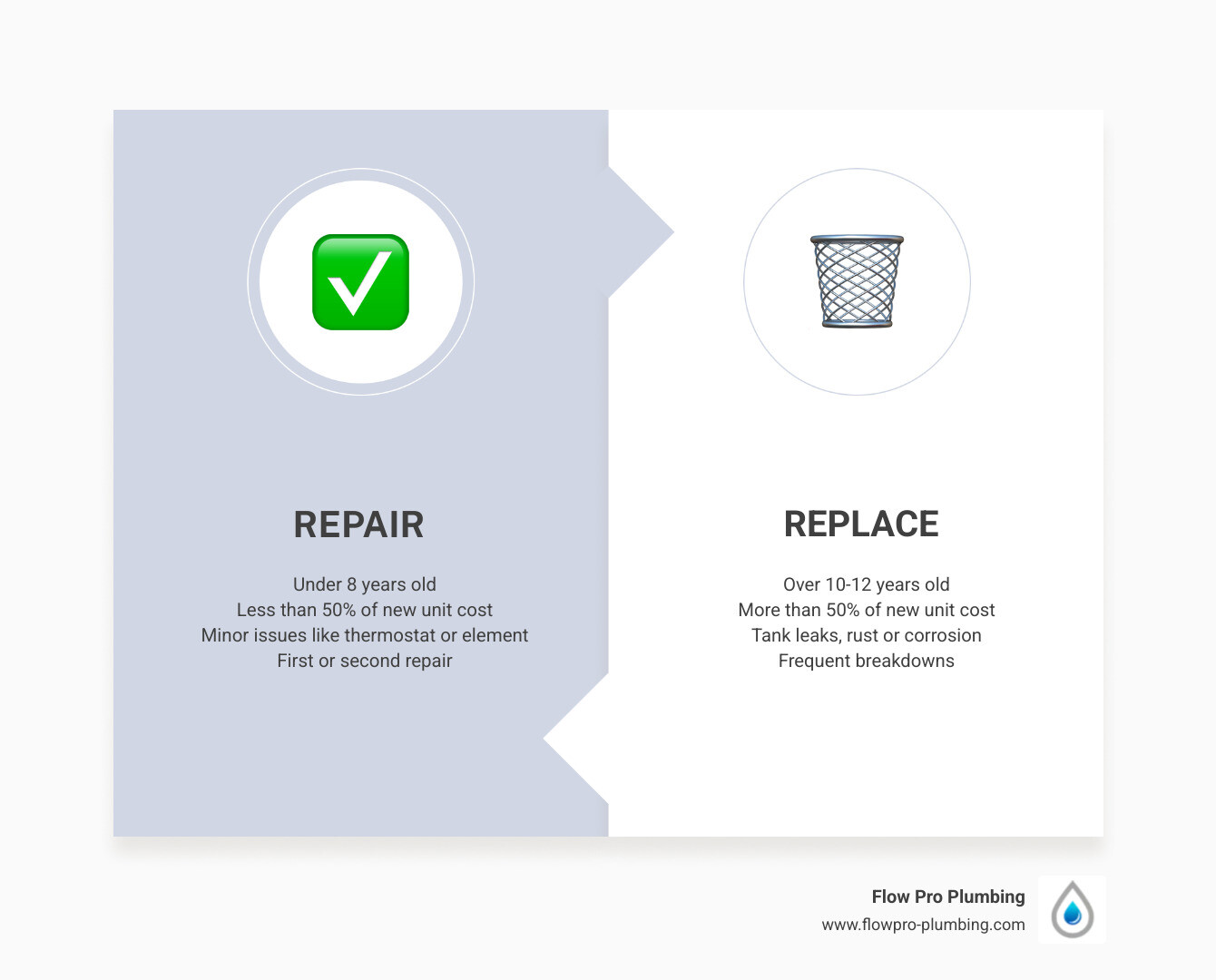
Knowing how to decide between water heater repair and replacement comes down to four key factors:
| Factor | Repair | Replace |
|---|---|---|
| Age | Under 8 years old | Over 10-12 years old |
| Condition | Minor issues (thermostat, element, valve) | Tank leaks, rust, or corrosion |
| Repair history | First or second repair | Frequent breakdowns |
| Performance | Consistent hot water with a specific issue | Ongoing reliability problems |
The short version: If your water heater is relatively young and the issue is minor, repair is usually the smarter call. If it’s over a decade old, leaking from the tank, showing rust, or constantly breaking down, replacement is often the better long-term solution.
Most of us don’t think about our water heater until the moment it fails — usually mid-shower, or right before guests arrive. It’s one of those appliances that quietly does its job every single day, and when something goes wrong, the question hits fast: do I fix this thing or just replace it?
That decision isn’t always obvious. A repair may solve the problem quickly, but on an aging unit, it could be one of several issues that appear over time. On the other hand, replacing a water heater that only needs a new thermostat would be unnecessary. The right answer depends on your specific situation — and that’s exactly what this guide walks you through.
I’m Jesse Delgado, owner of Flow Pro Plumbing in Brentwood, California, and I’ve spent years helping East Bay homeowners navigate how to decide between water heater repair and replacement — drawing on a lifetime in the trade that started working alongside my father on residential and commercial jobsites. In this guide, I’ll share the same honest framework we use when assessing water heaters for our customers, so you can make a confident, informed decision.
Understanding Lifespan: How Long Do Water Heaters Last?
The first step in how to decide between water heater repair and replacement is knowing where your unit stands in its expected life cycle. Like any hardworking appliance, Water Heaters have a finite number of years they can effectively serve your home before the internal components simply wear out.
Traditional Tank Lifespan
For a standard tank-style water heater, the industry average is typically 8 to 12 years. Some units may stretch to 15 years with meticulous maintenance, but once you cross the 10-year mark, you are essentially living on “borrowed time.” The constant heating and cooling of water, combined with the chemical reactions occurring inside the steel tank, eventually lead to structural fatigue.
Tankless Longevity
If you have invested in a Tankless Water Heater Brentwood CA, you can expect a significantly longer service life. These units often last 15 to 20 years, and sometimes even longer. Because they don’t store a large volume of water that sits and corrodes a tank 24/7, their primary components tend to hold up better over time.
Decoding the Age of Your Unit
Not sure how old your unit is? You can usually find the manufacturing date by decoding the serial number on the manufacturer’s label. Typically, the first letter represents the month (A for January, B for February, etc.), and the next two digits represent the year. For example, a serial number starting with “D21” likely means the unit was manufactured in April 2021.
Factors Affecting Longevity
Several variables can shorten or extend these timelines:
- Water Quality: Hard water (common in parts of the East Bay) leads to scale buildup, which acts as an insulator between the burner and the water, forcing the unit to work harder.
- Usage Patterns: A large household that runs the dishwasher, laundry, and multiple showers simultaneously puts more “miles” on a heater than a single-occupant home.
- Maintenance History: Units that are flushed annually and have their anode rods replaced every few years almost always outlast neglected ones.
- Installation Quality: Proper venting and correct sizing are crucial for preventing premature failure.
Key Factors in How to Decide Between Water Heater Repair and Replacement
When we arrive at a home in Antioch or Oakley to evaluate a failing unit, we look at the full condition of the system rather than just the immediate symptom. Here is the framework we use to help homeowners navigate how to decide between water heater repair and replacement.
Overall Severity of the Issue
A minor component failure is very different from a major tank problem. If the issue involves a thermostat, heating element, relief valve, or another replaceable part, repair may be the right choice. If the tank itself is compromised, replacement is usually the safer and more reliable solution.
The Age Threshold
Even if a repair seems reasonable, we have to consider the unit’s age. If a tank is 11 years old and needs a significant repair, it may only be a matter of time before another issue appears. We generally suggest that once a tank passes 10 years, replacement becomes the more practical long-term strategy.
Frequency of Breakdowns
Has your water heater required professional attention more than once in the last two years? Frequent breakdowns are a sign that the system is reaching the end of its reliable life. A Water Heater Repair and Installation expert can help you determine if these are isolated incidents or a pattern of systemic failure.
Warranty Status
Always check your warranty before making a move. If your unit is still under a manufacturer’s warranty, parts coverage may make a repair more worthwhile. Most standard tanks come with a 6-year warranty, though some premium models offer 10 or 12 years.
Comparison Table: Repair vs. Replace
| Indicator | Lean Toward Repair | Lean Toward Replacement |
|---|---|---|
| Unit Age | 0-8 Years | 10+ Years |
| Water Appearance | Clear | Rusty or Discolored |
| Tank Integrity | Dry exterior | Moisture or pooling at base |
| Noise Level | Quiet | Banging, popping, or rumbling |
| Efficiency | Stable performance | Declining performance |
| Issue Type | Minor component problem | Major tank or corrosion issue |
When to Choose Water Heater Repair
Not every cold shower requires a brand-new appliance. In many cases, especially with units under eight years old, a targeted repair can restore your hot water for a fraction of the cost of a new installation.
Faulty Thermostats
If your water is suddenly scalding hot or consistently lukewarm, the thermostat might be the culprit. On electric models, there are often two thermostats. Replacing these is a straightforward task for a professional providing Hot Water Repair Antioch CA services.
Heating Elements
In electric water heaters, the heating elements can burn out over time, especially if sediment has built up around them. If you have some hot water but it runs out very quickly, one of your elements has likely failed. This is a very common and repairable issue for those seeking Water Heater Repair Oakley CA.
Pressure Relief Valves
The Temperature and Pressure (T&P) relief valve is a critical safety component. If it is dripping, it might just be stuck or have a bit of debris in it. Sometimes the valve itself fails and needs replacement. This is a vital repair that should never be ignored, as this valve prevents the tank from becoming dangerously over-pressurized.
Sediment Buildup and Flushing
Do you hear a banging or popping sound coming from your tank? That is the sound of steam bubbles escaping through a layer of hardened sediment at the bottom of the tank. While it sounds scary, it can often be resolved by a professional flush. Knowing How Often to Drain Your Water Heater (usually once a year) can prevent this sediment from damaging the tank lining.
Minor Valve Leaks
If you see water dripping from a pipe connection or a shut-off valve above the heater, that is a plumbing repair, not a water heater failure. These leaks can usually be fixed by tightening a fitting or replacing a small section of pipe.
Can a Tankless Hot Water Heater Be Repaired?
Yes! In fact, tankless units are designed to be “modular,” meaning individual parts like the heat exchanger, fan, or sensors can be replaced. If you are wondering Can a Tankless Hot Water Heater Be Repaired?, the answer is almost always yes, provided the unit isn’t so old that parts are no longer available.
Minor Component Failures
There are several other small parts that can cause a total system lockout but are easily fixed:
- Pilot Lights and Thermocouples: On older gas units, a worn-out thermocouple will prevent the pilot light from staying lit.
- Electrical Connections: Sometimes a tripped breaker or a loose wire is all that stands between you and a hot shower.
- Anode Rod Replacement: This is actually a maintenance item. The anode rod “sacrifices” itself to corrosion so the tank doesn’t have to. Replacing it every 3-5 years can double the life of your tank. For a deep dive into these fixes, check out our Water heater repair Brentwood CA complete guide.
If you are experiencing these minor glitches, our team providing Hot Water Repair Brentwood CA can often have you back up and running the same day.
Red Flags That Require Immediate Replacement
While we love to save a unit whenever possible, there are certain “red flags” that indicate a water heater is no longer safe or viable to repair. In these instances, how to decide between water heater repair and replacement becomes a very easy choice: you must replace.
Internal Tank Rust and Discolored Water
If your hot water comes out looking like tea or rusty orange, but your cold water is clear, the inside of your water heater tank is corroding. Once the glass lining of a tank is breached and the steel begins to rust, there is no way to “patch” it. This is a clear signal that it’s time for Water Heater Installation Brentwood CA.
Pooling Water at the Base
A “leaking” water heater is different from a “dripping” one. If water is pooling in the drain pan or on the floor around the base of the tank, and it isn’t coming from a visible pipe or valve, the internal tank has likely fractured. Because these tanks are pressurized vessels, a small leak can quickly turn into a catastrophic flood. If you notice this, call for 24-Hour Water Heaters in Pittsburg CA immediately to help reduce the risk of water damage.
Metallic Odors or Tastes
If your hot water has a distinct metallic smell or taste, it often accompanies internal corrosion. While a “rotten egg” smell can sometimes be fixed by treating the water or changing the anode rod type, a metallic tang usually means the tank itself is breaking down.
Structural Cracks
In gas water heaters, the heat from the burner can eventually cause the metal at the bottom of the tank to become brittle and crack. This is not only a leak risk but a fire and carbon monoxide risk as well. Our Water Heaters Service Antioch CA Guide emphasizes that any compromise to the combustion chamber or tank structure requires an immediate shutdown and replacement.
Efficiency Gains and How to Decide Between Water Heater Repair and Replacement
Sometimes, the decision to replace isn’t forced by a leak, but by a desire for more reliable performance and improved energy efficiency. Modern water heaters are significantly more efficient than those manufactured just a decade ago.
- Energy Star Models: Newer conventional tanks have much better insulation, reducing “standby heat loss” (the energy wasted keeping water hot while you aren’t using it).
- Tankless Upgrades: Moving to a Tankless Water Heater Installation Antioch CA provides on-demand hot water and improved efficiency because it only heats water when needed.
- Heat Pump Technology: For homes with electric water heaters, a hybrid heat pump model can be far more efficient than a standard electric tank.
- Long-Term Benefits: Replacing a failing older unit with a high-efficiency model can improve reliability, reduce energy waste, and provide better day-to-day performance for your home. In areas like Water Heater Antioch CA and Hot Water Repair Oakley CA, these performance improvements can make a noticeable difference over the life of the unit.
Frequently Asked Questions About Water Heater Decisions
Can a leaking water heater tank be fixed?
Unfortunately, no. If the leak is coming from the tank itself (the “jacket”), it cannot be welded or patched. The pressure inside the tank and the constant expansion and contraction from heat would cause any patch to fail almost immediately. If the tank is leaking, it must be replaced.
How does hard water affect the repair vs. replace decision?
Hard water contains minerals like calcium and magnesium that settle at the bottom of the tank. Over time, this creates a thick layer of “scale.” If a unit has been operated in a hard water area without a water softener or regular flushing for 8-10 years, the scale buildup is likely so severe that the bottom of the tank is damaged. In these cases, we almost always recommend replacement over repair.
Is it worth upgrading to tankless during a replacement?
It depends on your goals. If you have a large family and constantly run out of hot water, tankless is a game-changer. If you plan on staying in your home for a long time, the energy savings and 20-year lifespan make it a great investment. However, if you are planning to move soon or have a tight budget, a modern high-efficiency tank might be the more practical choice.
Conclusion
At the end of the day, how to decide between water heater repair and replacement is about balancing your immediate need for hot water with your long-term goals for comfort, reliability, and efficiency. A quick repair might get you through the week, but a strategic replacement can provide years of dependable performance and improved energy use.
At Flow Pro Plumbing, we take pride in being a reliable partner for homeowners in Brentwood, Oakley, Antioch, and throughout the East Bay. We don’t believe in high-pressure sales; we believe in providing experienced, friendly service and workmanship that helps homeowners make informed decisions. Whether you need a simple thermocouple replacement or a complex tankless installation, we are here to help you choose the option that’s right for your home.
Don’t wait for a small drip to become a major flood. If you’re struggling to decide the best path forward for your water heater, reach out to us for a professional assessment.
Ready to get your hot water back on track? Contact us today for Expert Water Heater Services.