

What California Homeowners Need to Know About Sewer Line Regulations
California sewer line regulations for homeowners establish clear rules about who owns, maintains, and repairs the pipe running from your house to the public sewer main — and the answer almost always points back to you, the homeowner.
Here is a quick breakdown of the core rules:
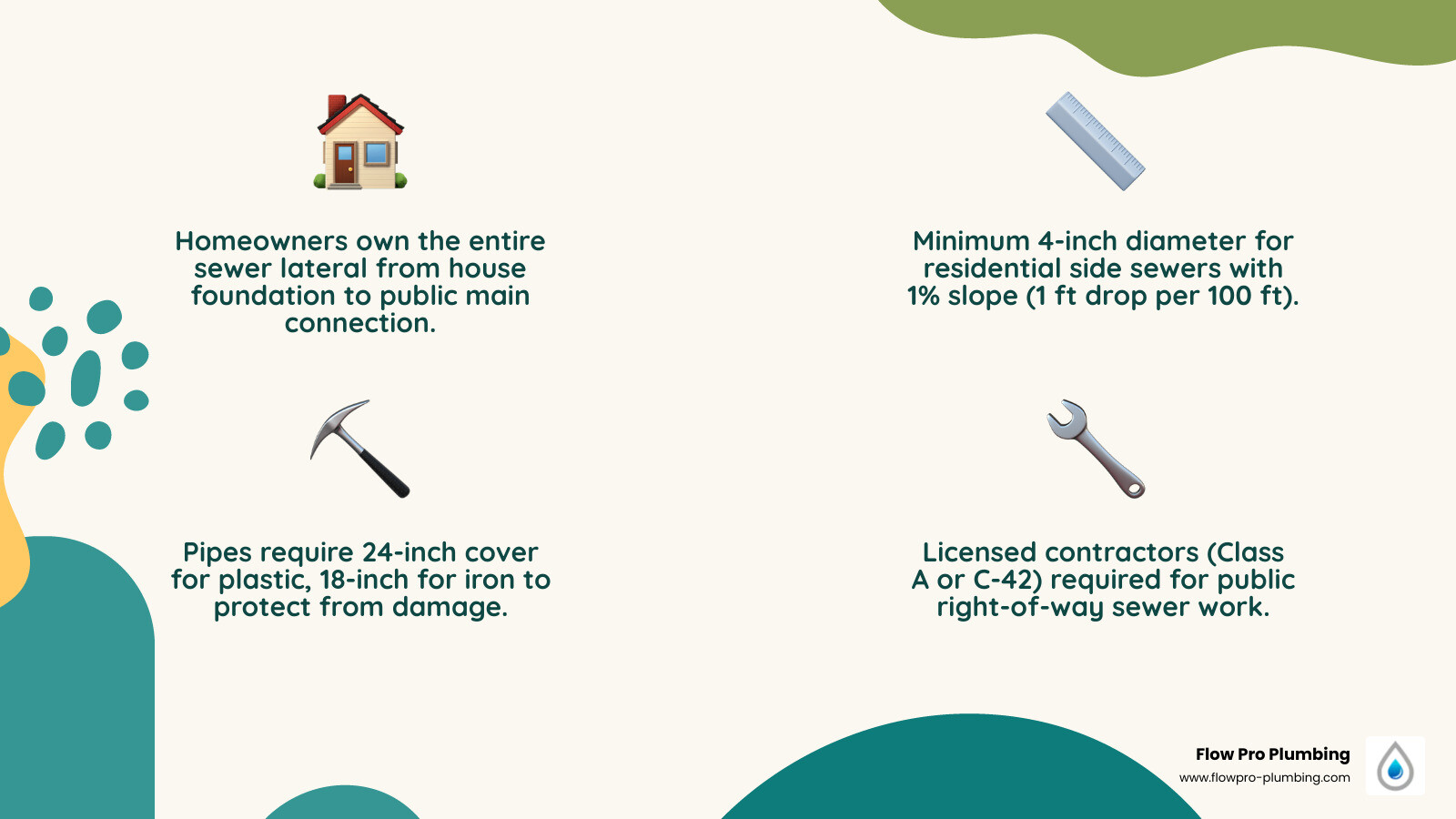
- You own your sewer lateral — the pipe from your home all the way to the connection point at the public main, including the connection itself
- Minimum pipe size for residential side sewers is 4 inches; public mains are at least 8 inches
- Minimum slope is 1% (1 foot per 100 feet) for 4-inch pipes to maintain proper flow
- Minimum cover depth is 24 inches for plastic pipe and 18 inches for iron pipe
- Permits are required for new connections and any work in the public right-of-way
- Licensed contractors (CSLB Class A or C-42) must be used for sewer work in public rights-of-way
- Regional ordinances — such as EBMUD in the East Bay — require inspections before property sales, after remodels over $100,000, or when changing water meter size
- Backwater valves may be required if your building pad sits lower than the upstream manhole
- Prohibited discharges include grease, wipes, and hazardous materials
These rules vary by city and district, but the pattern is consistent across California: the public agency maintains the main line, and you are responsible for everything on your side.
Many homeowners are genuinely surprised to learn just how much of the sewer system falls under their responsibility — including sections that run beneath public streets. A lateral that has “worked fine for years” may still be leaking groundwater into the system or quietly failing inspection criteria, creating liability you may not know about until you go to sell your home.
I’m Jesse Delgado, owner of Flow Pro Plumbing in Brentwood, California, with over a decade of licensed plumbing experience helping East Bay homeowners navigate exactly these kinds of issues — including california sewer line regulations for homeowners that often catch people off guard. In the sections below, I’ll walk you through everything you need to know to stay compliant, avoid costly surprises, and keep your sewer lateral in solid shape.
Understanding California Sewer Line Regulations for Homeowners
When we talk about california sewer line regulations for homeowners, the most important term to learn is the “private sewer lateral” (PSL). This is the pipe that carries wastewater from your home’s foundation to the public sewer main. In most of our service areas, like Antioch, Pittsburg, and Walnut Creek, the property owner is responsible for this entire line.
Upper vs. Lower Segments
Many jurisdictions divide the lateral into two parts:
- The Upper Lateral: The portion running from your home to the property line (usually the curb or sidewalk).
- The Lower Lateral: The portion extending from the property line to the actual connection at the public main in the street.
Even though the lower lateral sits under a public street, California law and local ordinances typically place the burden of maintenance on the homeowner. If a tree root in the middle of the street clogs your specific connection, it is usually your responsibility to fix it. This is why understanding your Sewer Line Repair Guide is so vital; the liability doesn’t stop at your grass.
Public Sewer Mains and District Boundaries
The public sewer main is the large “collector” pipe (usually at least 8 inches in diameter) that the city or sanitation district maintains. To determine if you are in a specific district, you can check your property tax bill or use a parcel report tool. In areas like Brentwood and Oakley, being within a district means you must follow their specific technical standards for any work performed. If you are doing work that touches the public right-of-way, you will likely need an encroachment permit from the city to legally dig in the street.
Technical Standards for Sewer Lateral Installation and Repair
When we perform a Sewer Video Inspection, we are looking to see if the pipe meets the strict technical standards set by the California Plumbing Code (CPC) and local district amendments. If a pipe is failing, the repair must meet modern specs.
Approved Pipe Materials
Not all pipes are created equal. In the old days, vitrified clay was king, but it’s prone to cracking and root intrusion. Today, the most common approved materials include:
- Schedule 40 PVC: Durable plastic often used for new installations.
- ABS DWV: Another common plastic pipe used for drainage, waste, and vent.
- Ductile Iron: Required in specific scenarios, such as when the pipe has very shallow cover (less than 18 inches) or is buried very deep (over 20 feet) to handle the weight of the soil.
For joining pipes of different materials—like connecting a new plastic pipe to an old cast iron stub—specific rubber couplings (often called Ferncos or Calder couplings) are used to ensure a watertight seal. We provide Essential Sewer Repair Services to ensure these connections are made correctly the first time.
Minimum Pipe Size
For a single-family residence, the minimum pipe size for a side sewer is 4 inches. If a building is larger or has more than 150 “fixture units” (a technical way of measuring how many sinks, toilets, and tubs are in the house), the requirement jumps to a 6-inch pipe.
Minimum Slope and Depth Requirements
Gravity is what makes your sewer work. If the pipe is too flat, solids settle and cause clogs. If it’s too steep, the water outruns the solids.
- The 1% Rule: For 4-inch side sewers, the minimum slope is 1% (1 foot of drop for every 100 feet of pipe).
- Velocity: The system is designed so that water moves at a minimum of 2 feet per second when flowing, which provides a “scouring” action to keep the pipe clean.
- Cover Depth: To protect pipes from being crushed by vehicles or lawn equipment, plastic pipes must have at least 24 inches of cover (soil on top). Iron pipes, being stronger, only require 18 inches.
In cities like Pittsburg, we often utilize Trenchless Sewer Line Replacement in Pittsburg to meet these depth and slope requirements without destroying a homeowner’s entire driveway.
Cleanouts and Backflow Preventer Regulations
A cleanout is an access point where we can insert a camera or a cleaning tool. California regulations typically require a cleanout within two feet of the house foundation, at every bend greater than 45 degrees, and at least every 90 feet along the line.
Backwater valves (or backflow preventers) are perhaps the most important safety device you’ve never heard of. These are one-way flapper valves. If the public sewer main in the street gets blocked and wastewater starts backing up, the valve slams shut, preventing “the neighbor’s business” from coming up through your downstairs toilet. These are mandatory if your home’s lowest floor is lower than the top of the nearest upstream manhole. To Avoid Common Sewer Problems, ensuring your backwater valve is functional is a top priority.
Compliance Triggers and Regional Ordinances
In the East Bay, california sewer line regulations for homeowners aren’t just about how you build—they are about when you must inspect. Many of our local areas are governed by the Regional Private Sewer Lateral (PSL) Ordinance.
| Trigger Event | Requirement |
|---|---|
| Property Sale | Inspection and “Certificate of Compliance” required before title transfer. |
| Remodel > $100,000 | Mandatory inspection and repair of the lateral to obtain permits. |
| Water Meter Change | Changing the size of your water meter triggers a lateral check. |
| Sewer Backup | Significant blockages may lead the district to mandate a full repair. |
In cities like Concord and Martinez, these triggers ensure that aging infrastructure is slowly replaced. If you are planning a major renovation, don’t forget to factor in the sewer. We often help clients by providing a Sewer Camera Inspection early in the process so they aren’t surprised by a mandatory repair bill right before they finish their dream kitchen.
California Sewer Line Regulations for Homeowners and Septic Conversions
If you are moving from a septic system to a public sewer connection (a common occurrence in more rural parts of Brentwood or Knightsen), the regulations are strict. You cannot simply leave the old septic tank in the ground. You must obtain a Septic Tank Destruction Permit, which usually involves pumping the tank empty, breaking the bottom so it doesn’t hold water, and filling it with sand or gravel. You’ll also need an Outside Service Agreement if your property wasn’t originally part of the sewer district. Our team handles Trenchless Sewer Line in Martinez for these types of complex transitions.
Maintenance and Inspection Protocols
Maintenance isn’t just a suggestion; in many California counties, it’s the law. County codes often state that all house laterals must be maintained in a “safe and sanitary condition.”
The 48-Hour Rule and Trench Inspections
If you are having a new sewer line installed or a major repair done, the city or district inspector must see the work before it’s covered up. This is called a trench inspection. In many jurisdictions, you must provide 48-hour notice to schedule an inspector. They want to see the “bedding” (the material the pipe sits on, like pea gravel) and confirm the slope is correct.
Prohibited Wastes
The sewer system is not a trash can. Discharging the following into the public sewer is strictly prohibited:
- Fats, Oils, and Grease (FOG): These solidify and cause “fatbergs.”
- Stormwater: You cannot connect your roof downspouts or yard drains to the sewer line. This causes “Infiltration and Inflow” (I&I), which can overwhelm treatment plants during rainstorms by as much as 2,000%.
- Wipes and “Flushables”: Even if the box says flushable, they don’t break down and are a leading cause of lateral clogs.
Professional Requirements
You can’t just have a “handyman” dig up the street. For any work performed in the public right-of-way, California requires a contractor with a Class A (General Engineering) or C-42 (Sanitation System) license. These professionals carry the necessary bonding and insurance to work in the street. At Flow Pro Plumbing, we specialize in the Benefits of Trenchless Sewer Repair, which allows us to fix pipes with minimal digging, often saving the homeowner from massive restoration costs for sidewalks and roads.
Frequently Asked Questions about California Sewer Regulations
Who is responsible for repairing a broken sewer lateral?
In almost all California jurisdictions, the property owner is responsible for the maintenance and repair of the sewer lateral from the house all the way to the connection at the public main. This includes the “upper lateral” on your property and the “lower lateral” under the sidewalk and street.
When is a backwater valve required on a sewer line?
A backwater valve is required by the California Plumbing Code whenever a plumbing fixture (like a toilet or floor drain) is located at an elevation lower than the manhole cover of the next upstream manhole in the public sewer system. This protects your home from sewage backups caused by main line blockages.
What materials are approved for residential sewer pipes?
Modern approved materials include Schedule 40 PVC, ABS, and Ductile Iron. While older homes may still have vitrified clay or cast iron, these are usually replaced with PVC or ABS during repairs. Rubber couplings are only permitted for joining different types of pipe and must be installed according to specific joint integrity standards.
Conclusion
Navigating california sewer line regulations for homeowners can feel like a maze of permits, pipe sizes, and hidden liabilities. However, staying informed is the best way to protect your property and your wallet. Whether you are selling a home in Walnut Creek or planning a remodel in Brentwood, understanding your responsibility for that underground pipe is essential.
At Flow Pro Plumbing, we pride ourselves on being the local experts who make these complex regulations simple. From Sewer Video Inspections Prevent Plumbing Issues to full-scale Trenchless Sewer Line Replacement in Concord, we have the experience and the licensed team to handle the job.
Don’t wait for a backup to think about your sewer. Keeping Up with Sewer System Services in Your Home is the key to a stress-free household. If you need a professional eye on your lateral or help navigating a compliance certificate, reach out to us for Professional Sewer Repair in Brentwood. We serve Brentwood, Oakley, Antioch, and the surrounding communities with the “unsurpassed workmanship” our reputation is built on.