
What You Need to Know About California Water Heater Code Requirements
California water heater code requirements cover a broad set of rules that every homeowner and installer must follow — from pulling permits before work begins to seismic bracing, venting, energy efficiency, and safe installation locations. Here is a quick overview of what the codes require:
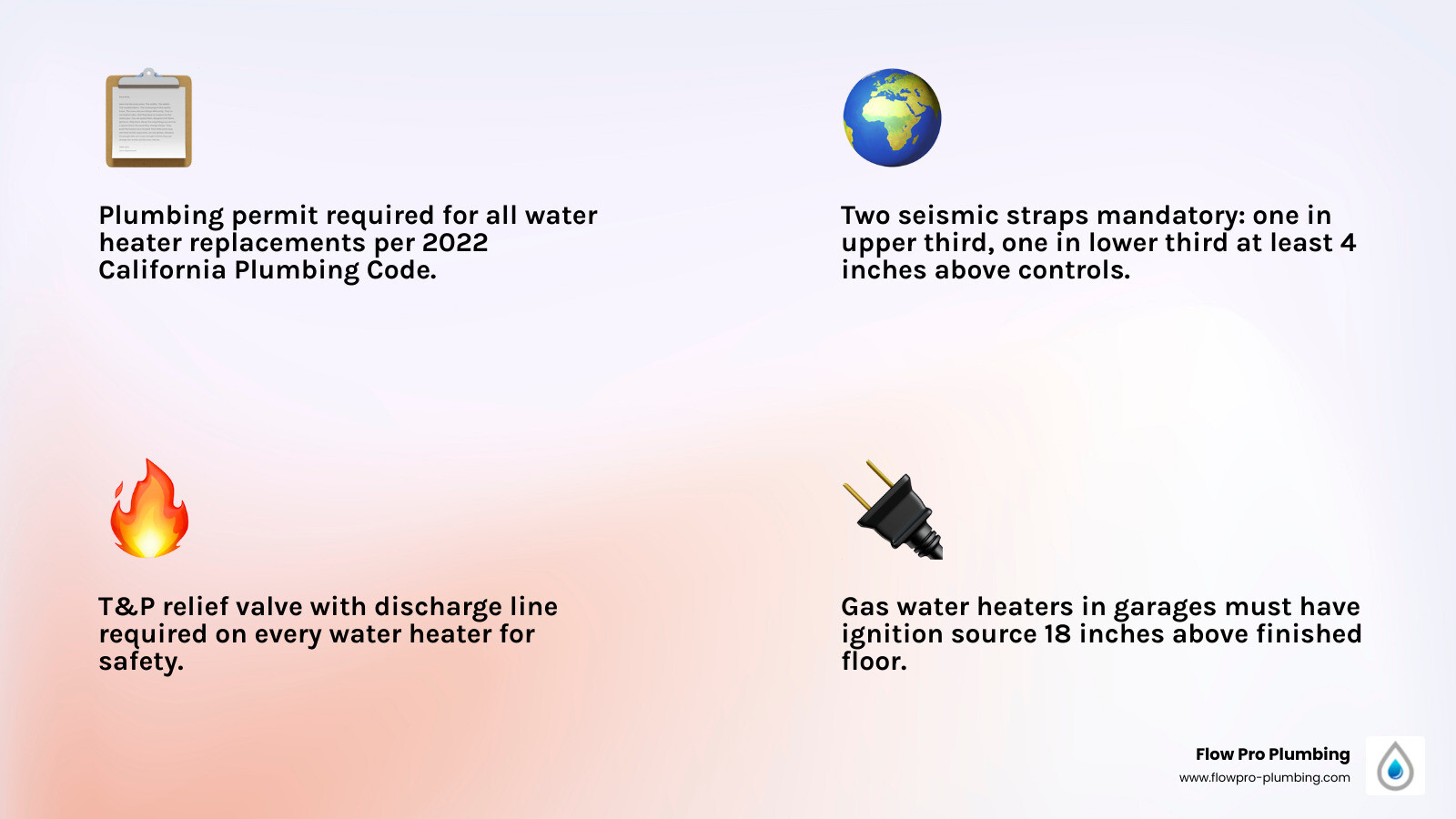
- Permits: A plumbing permit is required for all new installations and replacements, followed by a final inspection.
- Seismic bracing: Two earthquake straps are mandatory — one in the upper third and one in the lower third of the tank, with the lower strap at least 4 inches above the controls.
- T&P relief valve: A temperature and pressure relief valve with a proper discharge line is required on every water heater.
- Garage elevation: Gas water heaters in garages must have their ignition source at least 18 inches above the finished floor.
- Energy efficiency: All new and replacement water heaters must meet Title 24 Part 6 and Title 20 appliance standards.
- Pipe insulation: Hot water pipes must be insulated to a thickness equal to the pipe diameter for pipes 2 inches or smaller.
- Venting: Gas water heaters require Type B double-wall venting or Category III/IV venting with specific clearances and termination heights.
- Tankless systems: Units over 6,800 BTU/hr require isolation valves on both the inlet and outlet, plus hose bibbs for flushing.
- New construction: Gas and propane systems must include electric-ready infrastructure, including a 120V/20A receptacle within 3 feet of the unit.
California’s rules are among the strictest in the country. That is because the state has to account for earthquake risk, air quality regulations, and some of the most aggressive energy efficiency standards in the nation. A water heater that looks fine and works fine can still fail an inspection if key safety components — like seismic straps or a properly terminated T&P discharge line — are missing or installed incorrectly.
These codes pull from multiple overlapping regulations: the California Plumbing Code (CPC), California Building Code (CBC), California Electrical Code (CEC), and Title 24 Part 6 energy standards. Local jurisdictions can add even more requirements on top of those. Knowing which rules apply to your home and your specific installation is not always straightforward.
I’m Jesse Delgado, owner of Flow Pro Plumbing in Brentwood, California, and holder of a C-36 plumbing license with over a decade of experience navigating california water heater code requirements for homeowners across the East Bay. Growing up in a family of plumbers and working across residential, new construction, and commercial settings gave me a ground-level understanding of what compliance actually looks like in the field.
Mandatory Permits and Inspection Processes
One of the biggest misconceptions we hear at Flow Pro Plumbing is that you only need a permit for a “new” installation. In reality, the 2022 California Plumbing Code is very clear: a plumbing permit is required for the replacement of any existing water heater. Whether you are in Brentwood, Oakley, or Walnut Creek, your local building department oversees this process to ensure your home remains safe and up to code.
Applying for a permit is more than just a bureaucratic hurdle; it is your safety net. When we perform a Water Heater Repair and Installation, the permit triggers a final inspection by a city or county official. This inspector verifies that the unit is strapped correctly, the gas lines are leak-free, and the venting won’t back-draft carbon monoxide into your living space.
During the inspection, the official will look for:
- Proper seismic bracing (strapping).
- Correct T&P relief valve discharge routing.
- Adequate combustion air for gas units.
- Compliance with Title 24 energy standards, including pipe insulation.
Documentation is key for homeowners. If you ever decide to sell your home in Antioch or Concord, a home inspector will check for these permits. An unpermitted water heater can hold up a real estate transaction or even lead to insurance claim denials if a leak occurs. If you’ve ever wondered How Long for Water Heater to Heat Up, a code-compliant installation ensures the system is sized and vented correctly so it performs efficiently from day one.
Essential California Water Heater Code Requirements for Safety
Safety is the heartbeat of the California Plumbing Code. Because our region is prone to seismic activity, the state has developed some of the most rigorous safety standards in the world. These rules are designed to prevent fires, explosions, and water damage during and after an emergency.
Beyond the tank itself, safety components like sediment traps and shut-off valves are mandatory. A sediment trap (sometimes called a “dirt leg”) must be installed on the gas line downstream of the shut-off valve. This small piece of pipe catches debris and moisture before it can enter the water heater’s sensitive control valve. Speaking of valves, a full-port gas shut-off valve and a dedicated cold-water shut-off valve must be accessible so you can quickly kill the power or water supply in an emergency.
Seismic Bracing and California Water Heater Code Requirements
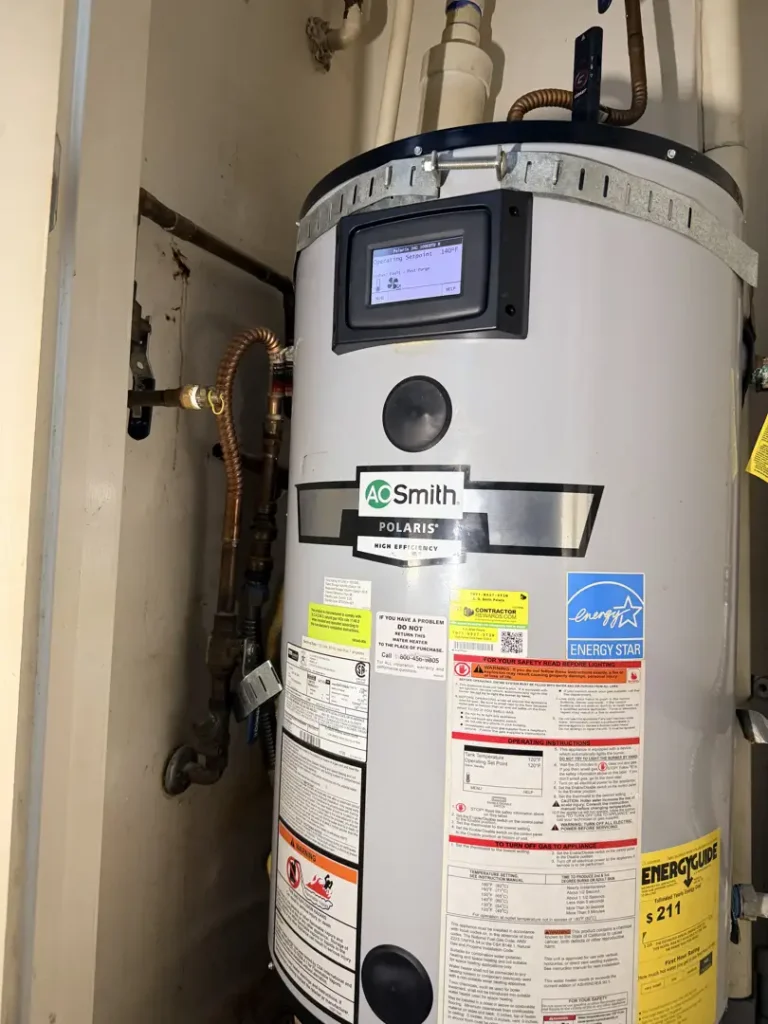
In California, it isn’t a matter of if the ground will shake, but when. Per Health and Safety Code Section 19211, all water heaters must be anchored or strapped to resist horizontal displacement caused by earthquake motion.
The california water heater code requirements for seismic bracing are specific:
- Two Straps Minimum: You must have at least two straps—one in the upper one-third of the tank and one in the lower one-third.
- Lower Strap Placement: The bottom strap must be placed at least 4 inches above the water heater’s control valves to ensure the strap doesn’t interfere with the equipment’s operation.
- Wall Anchoring: These straps must be secured to the structural framing of the house (the studs), not just the drywall.
- Stability: The goal is to prevent the tank from tipping over, which could rupture gas lines and lead to devastating fires.
Temperature and Pressure (T&P) Relief Valve Standards
Every water heater is essentially a pressurized vessel. If the thermostat fails and the water continues to heat indefinitely, the tank could literally explode. The Temperature and Pressure (T&P) relief valve is the “fail-safe” that prevents this. It is designed to open and release water if the internal temperature reaches 210°F or the pressure exceeds 150 psi.
The discharge line connected to this valve has its own set of strict rules:
- Material: It must be made of approved materials like galvanized steel, hard-drawn copper, or CPVC.
- Termination: The line must run to the exterior of the building and terminate between 6 and 24 inches above the finished grade. It must point downward.
- No Threads: The end of the pipe cannot be threaded. This prevents anyone from accidentally capping the pipe, which would disable the safety feature.
- No Traps: The line must drain by gravity; it cannot have any “traps” or upward bends where water could sit and freeze or corrode.
Knowing How to Flush a Water Heater is a great maintenance habit, but you should also manually test your T&P valve once a year to ensure it isn’t stuck.
Installation Locations and Garage Safety Rules
Where you put your water heater matters just as much as how you install it. In our service areas like Discovery Bay and Pittsburg, many water heaters live in the garage. This presents a unique risk: flammable vapors. Gasoline or chemical fumes tend to settle near the floor. If a gas water heater’s pilot light or burner is too low, it could ignite those vapors.
To prevent this, the “18-inch rule” is a cornerstone of the california water heater code requirements. The ignition source (the pilot light or spark igniter) must be elevated at least 18 inches above the garage floor. Typically, this means the unit sits on an approved water heater stand.
Note: Some modern units are Flammable Vapor Ignition Resistant (FVIR). While some jurisdictions allow these to be placed on the floor, many local East Bay inspectors still prefer or require the 18-inch elevation for added safety.
Other location-specific rules include:
- Bollards/Protection: If the water heater is in a location where a vehicle could hit it, you must install a steel bollard or “crash post” to protect the unit.
- Attic Installations: If the unit is in an attic, there must be a clear passageway at least 22 inches wide and 30 inches high leading to the appliance. The unit must sit in a watertight drip pan (at least 1.5 inches deep) with a drain line that leads to the house exterior.
- Closet Access: Water heaters installed in closets must have enough “combustion air” (oxygen) to burn gas safely. This usually requires two openings—one high and one low—leading to a larger space or the outdoors.
Regular maintenance is vital regardless of location. Learning How Often to Drain Your Water Heater can help prevent the sediment buildup that often leads to premature tank failure in attic or closet installations.
Energy Efficiency and Title 24 Standards
California’s Title 24, Part 6 (The Energy Code) is designed to reduce the state’s energy consumption. For homeowners, this means that any new or replacement water heater must meet high-efficiency standards.
One of the most visible requirements is pipe insulation. You are required to insulate all “accessible” hot water pipes. For new construction, this applies to the entire hot water distribution system. For replacements, you must insulate the first 8 feet of both the cold and hot water lines (or more if they are accessible). The insulation thickness must generally match the diameter of the pipe for sizes up to 2 inches.
| Feature | Standard Storage Tank | Tankless Water Heater |
|---|---|---|
| Efficiency (UEF) | Lower (Standby loss occurs) | Higher (Heats on demand) |
| Space Required | 20-30 sq. ft. | Minimal (Wall-mounted) |
| Lifespan | 8-12 Years | 20+ Years |
| Title 24 Compliance | Requires HERS or Pipe Insul. | Generally Prescriptive |
If you are looking to maximize efficiency, Here’s Why You Should Upgrade to a Tankless Water Heater. These units often make Title 24 compliance much simpler because they don’t suffer from the “standby” heat loss that traditional tanks do.
Venting and California Water Heater Code Requirements for Gas Units
Proper venting is a life-or-death matter. Gas water heaters produce carbon monoxide, which must be safely exhausted outside.
- Type B Vents: Most standard gas water heaters use Type B double-wall metal vents. These require at least a 1-inch clearance from combustible materials (like wood studs or insulation).
- Termination: The vent must terminate at least 5 feet above the highest connected appliance and at least 1 foot above the roofline.
- Slope: Horizontal vent runs must slope upward toward the exterior at a minimum of 1/4 inch per foot.
- Tankless Venting: High-efficiency tankless units often use Category III or IV stainless steel or specialized PVC/CPVC venting, as the exhaust is cooler and more acidic. Always follow our Tankless Water Heater Installation Guide for specific venting specs.
Recirculation Systems and California Water Heater Code Requirements
Tired of waiting for hot water at the kitchen sink? Recirculation systems are the answer, but they have their own codes. To save energy, California requires “demand-based” controls for many new systems. This means the pump shouldn’t run 24/7. Instead, it should be triggered by a button, a motion sensor, or a smart timer.
These systems must also include:
- Air Release Valves: To prevent air locks in the plumbing.
- Check Valves: To prevent cold water from “short-circuiting” into the hot water lines.
- Insulation: All recirculating loops must be fully insulated.
If your system isn’t working right, you might notice your Water Heater Pilot Light Won’t Stay Lit, which can sometimes be linked to pressure imbalances in complex recirculating systems.
Specialized Rules for Tankless and Electric-Ready Systems
Tankless water heaters are the gold standard for modern California homes, but they require a different installation approach than the old tanks we grew up with.
Isolation Valves are Mandatory: Per the CPC, any instantaneous (tankless) water heater with an input of more than 6,800 BTU/hr must have isolation valves installed on both the cold water inlet and the hot water outlet. These valves must also include hose bibbs (service ports). Why? Because tankless units require periodic descaling. These ports allow us to circulate a cleaning solution through the heat exchanger without disconnecting the entire unit. For more on this, check out our Tankless Water Heater Maintenance Guide.
Electric-Ready Infrastructure: As California moves toward electrification, new construction rules (and some major remodels) require “electric-ready” setups. Even if you install a gas water heater today, you must provide the infrastructure for a future Heat Pump Water Heater (HPWH). This includes:
- A dedicated 125V/20A electrical receptacle within 3 feet of the water heater.
- A reserved space at least 2.5 feet wide, 2.5 feet deep, and 7 feet tall.
- A condensate drain line for the future heat pump.
If you are curious about making the switch, you can Explore Tankless Water Heaters or read about the Benefits of a Tankless Water Heater to see if it’s the right fit for your home. Proper Tankless Water Heater Installation requires upgrading gas lines to handle the higher BTU demand (often 150,000 to 199,000 BTU/hr), so professional assessment is a must.
Frequently Asked Questions about California Water Heater Codes
Do I need a permit to replace my water heater in California?
Yes. Whether you are doing a “like-for-like” replacement or upgrading to a new system, a plumbing permit is required by state law. This ensures that the new unit meets current safety standards, specifically regarding seismic strapping and venting.
What is the 18-inch rule for water heaters in garages?
This rule requires the ignition source of a gas water heater to be at least 18 inches above the garage floor. This prevents the pilot light or burner from igniting flammable vapors (like gasoline) that may have settled on the floor.
Are expansion tanks required in California?
Expansion tanks are required if you have a “closed-loop” plumbing system. This usually happens if you have a pressure-reducing valve (PRV) or a backflow preventer installed. When water heats up, it expands. In a closed system, that extra volume has nowhere to go, which can stress your pipes and water heater. An expansion tank gives that extra water a safe place to move.
Conclusion
Navigating california water heater code requirements can feel like a full-time job, but these rules exist for a very good reason: to keep your family safe and your home efficient. From the seismic straps that protect us during an earthquake to the Title 24 standards that lower our energy bills, every line of the code serves a purpose.
At Flow Pro Plumbing, we take pride in being the Brentwood plumbing experts that homeowners trust for code-compliant, high-quality installations. We serve our neighbors in Oakley, Antioch, Walnut Creek, and throughout the surrounding communities with a commitment to unsurpassed workmanship. We don’t just “install” water heaters; we ensure they are fully integrated into your home safely and legally.
Don’t risk your safety or your home’s value with a “handyman” special that skips the permits and the straps. Schedule your water heater service with Flow Pro Plumbing today and rest easy knowing your hot water is in professional hands.