
Your Guide to Lower Energy Bills and Endless Hot Water
High efficiency water heaters can cut your energy bills by up to 50% compared to standard models while delivering reliable hot water. Here are the top types to consider:
- Tankless (On-Demand) – Heats water only when needed, eliminating standby losses, with a 20+ year lifespan.
- Heat Pump (Hybrid) – Uses ambient air heat, making it 2-4x more efficient than standard electric models.
- Condensing Gas – Captures exhaust heat with a second heat exchanger for maximum gas efficiency.
Water heating accounts for roughly 18% of your home’s energy use. If you’re still running an older tank-style unit, you’re likely paying far more than necessary every month. Today’s high-efficiency models use advanced technology to slash energy waste, delivering better performance and real savings on your utility bills.
However, efficiency ratings can be confusing. Thermal efficiency measures how much input energy converts to heat, while operational efficiency accounts for real-world factors like standby heat loss from a tank. That second number has a bigger impact on your wallet.
Traditional tank heaters can lose significant efficiency through standby and purging losses. Modern high-efficiency models eliminate or drastically reduce these losses through smarter engineering.
I’m Jesse Delgado, owner of Flow Pro Plumbing in Brentwood, California. I’ve worked in plumbing since childhood, helping hundreds of East Bay homeowners upgrade to high efficiency water heater systems that match their household needs and budget. The right choice depends on your home’s infrastructure, hot water demand, and long-term goals.
Understanding Water Heater Efficiency: What the Numbers Really Mean
When shopping for a high efficiency water heater, you’ll encounter different efficiency ratings. Understanding the difference between thermal and operational efficiency is key to lowering your monthly bills and avoiding a costly mistake.
Thermal Efficiency Explained
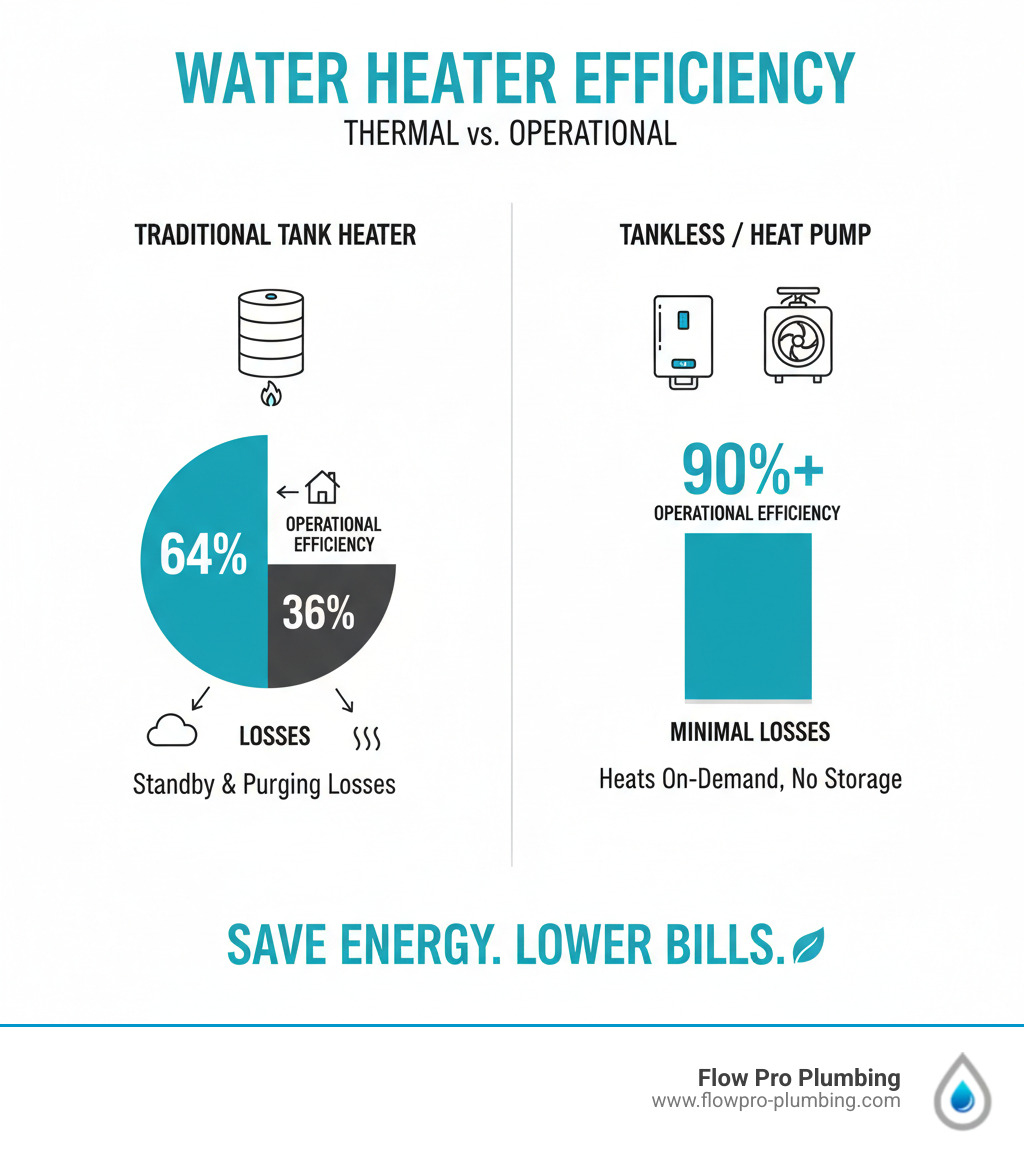
Thermal efficiency measures the percentage of energy that a water heater converts directly into hot water. For example, with 96% thermal efficiency, 96 cents of every dollar spent on energy heats the water, while 4% is lost during the process. It’s a basic measure of how well the unit does its primary job, but it doesn’t tell the whole story.
Operational Efficiency: The Metric That Impacts Your Wallet
Operational efficiency is the more practical metric, as it measures the energy delivered at your fixtures, like your shower or sink. It accounts for all energy losses that occur between heating the water and using it.
For traditional tank-style heaters, the biggest energy drain is standby loss. A tank heats 40-50 gallons of water and then works to keep it hot 24/7. Heat constantly radiates from the tank, forcing the unit to fire up repeatedly to reheat water that has already been heated. You’re paying to heat the same water multiple times.
Another factor is purging losses, which is energy that escapes up the flue with exhaust gases. Combined, these losses can be significant. A traditional heater with 96% thermal efficiency might only have 64% operational efficiency once standby losses are factored in. This gap is why operational efficiency is a better indicator of your actual costs.
When comparing high efficiency water heater options, look beyond the thermal efficiency number. Focus on ratings that account for real-world performance, like the Uniform Energy Factor (UEF). Models that minimize standby losses, such as tankless and heat pump units, have an operational efficiency that is much closer to their thermal rating.
You can dive deeper into how these ratings work at the Department of Energy’s guide to water heater efficiency ratings.
The Top High Efficiency Water Heater Technologies
Now that we understand the difference between thermal and operational efficiency, let’s explore the leading high efficiency water heater technologies. Each type minimizes energy waste in a unique way, offering a solution for your home’s specific needs.
Tankless (On-Demand) Water Heaters
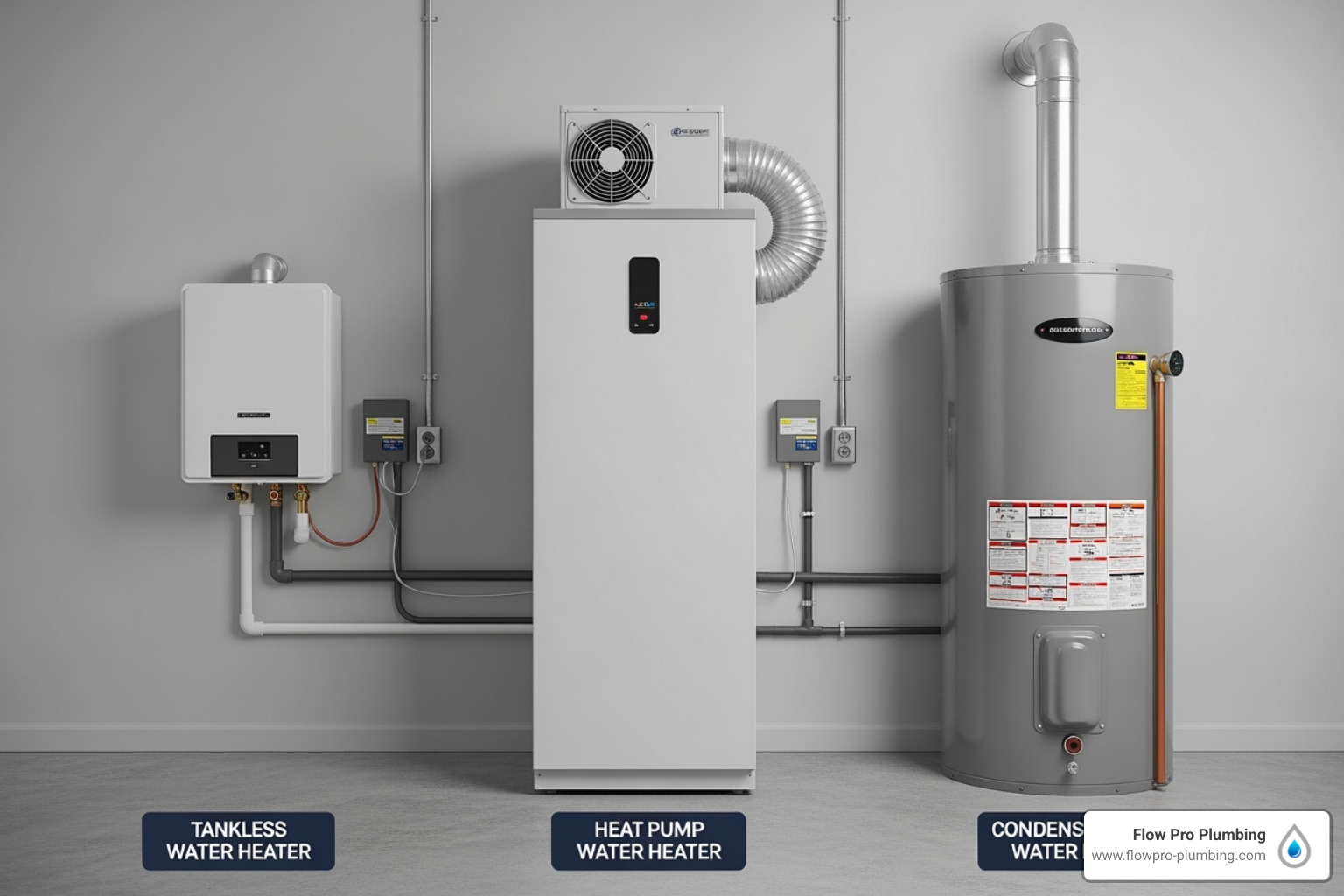
Tankless water heaters provide hot water on demand, eliminating the need for a storage tank. When you turn on a tap, cold water flows through the unit and is instantly heated by a powerful gas burner or electric element. This process stops when the tap is turned off, completely eliminating the standby losses common with traditional tanks. As a result, the operational efficiency of a tankless high efficiency water heater is very close to its thermal efficiency.
These units are also compact, mounting on a wall to free up floor space. They are rated by gallons-per-minute (GPM), indicating how much hot water they can supply continuously. A properly sized system can easily handle multiple simultaneous uses, like showers and appliances.
If you’re curious about how these systems work, I’ve written a detailed guide: Explore Tankless Water Heaters.
Key Benefits of a Tankless High Efficiency Water Heater
- Continuous hot water: A properly sized system provides an endless supply, so you never have to worry about running out.
- Significant energy savings: By eliminating standby losses, these units keep operational efficiency high and lower your utility bills.
- Longer lifespan: Tankless models often last 20 years or more, double the lifespan of many tank heaters, offering a better return on investment.
- Space-saving design: Their compact size allows for flexible installation in closets, attics, or on walls, reclaiming valuable floor space.
For a deeper look at these benefits, check out: Benefits of a Tankless Water Heater.
Heat Pump (Hybrid) Water Heaters
The most efficient way to heat water with electricity is to move heat, not create it. A heat pump water heater works like a refrigerator in reverse, pulling heat from the surrounding air and transferring it to the water in its storage tank.
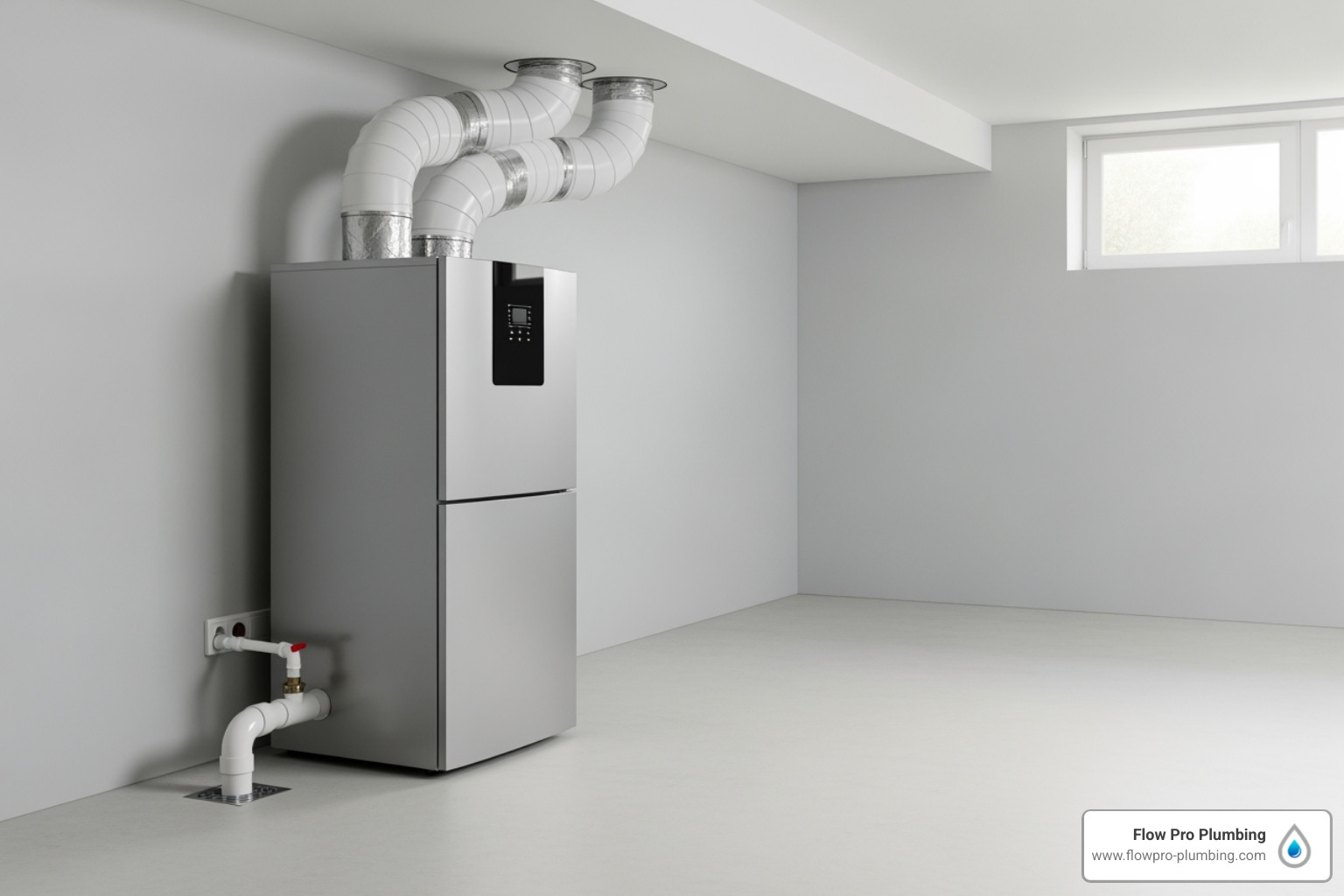
Because they move heat, these systems are two to four times more efficient than conventional electric water heaters. Most are “hybrid” models that include backup electric heating elements to ensure hot water is always available during high-demand periods or in colder temperatures.
Installation requires adequate space for airflow (typically 700 cubic feet) and a drain for condensation. They perform best in areas that remain above 38°F, such as a garage or basement. The federal government also offers tax credits for eligible models, which can reduce upfront costs. You can learn more here: Learn about tax credits for energy efficiency.
Why Choose a Heat Pump Water Heater?
- High efficiency: They are 2-4 times more efficient than standard electric models, saving a typical family of four around $600 per year.
- Dehumidifying effect: The unit cools and dehumidifies the surrounding air, a welcome bonus for damp basements or garages.
- Smart controls: Many models offer smartphone apps for remote monitoring, temperature adjustments, and vacation mode.
- Environmental benefits: Using less energy reduces your home’s carbon footprint and improves indoor air quality by avoiding in-home combustion.
Condensing Gas Water Heaters
For homes with natural gas, condensing water heaters are the most efficient tank-style option. They capture waste heat from exhaust gases that traditional models vent outside. A second heat exchanger uses this captured heat to preheat incoming cold water, boosting efficiency.
This process cools the exhaust gases enough for water vapor to condense, releasing additional heat. The result is a high efficiency water heater with a Uniform Energy Factor (UEF) of 0.90 or higher, leading to lower gas bills. Installation requires specific venting materials (like PVC) and a drain for the condensate, which a professional plumber can easily manage.
At Flow Pro Plumbing, we handle all types of Complete Gas Water Heater Installation in the East Bay area.
Key Features to Consider When Choosing Your Water Heater
Beyond technology type, several key features and ratings will help you choose a high efficiency water heater that matches your household’s needs.
| Feature | Tankless (On-Demand) | Heat Pump (Hybrid) | Condensing Gas |
|---|---|---|---|
| Energy Source | Gas or Electric | Electric | Gas |
| Efficiency Metric | GPM, UEF | UEF | UEF |
| Space Needs | Compact, wall-mounted | Larger tank, space for airflow | Larger tank |
| Hot Water Delivery | Continuous, on-demand | Stored, very efficient reheat | Stored, efficient reheat |
| Standby Losses | None | Minimal | Minimal |
| Lifespan | 20+ years | 13-15 years | 10-12 years |
Sizing: First-Hour Rating vs. Gallons-Per-Minute
Correctly sizing your water heater is critical to meet your home’s peak demand. The two key measurements are First-Hour Rating (FHR) for tank models and Gallons-Per-Minute (GPM) for tankless models.
First-Hour Rating (FHR), found on the EnergyGuide label of tank-style heaters (including heat pump and condensing gas), tells you how many gallons of hot water the unit can deliver in one hour. This number should match your household’s busiest hour of hot water use.
Gallons-Per-Minute (GPM) measures the continuous flow rate of a tankless water heater. To determine your required GPM, add up the flow rates of all fixtures you might use simultaneously. Typical fixture demands are:
- Shower: 2.0 – 2.5 GPM
- Kitchen Faucet: 1.5 – 2.5 GPM
- Bathroom Faucet: 0.5 – 1.5 GPM
- Dishwasher/Washing Machine: 1.0 – 2.5 GPM (intermittent)
For example, two simultaneous showers (2.5 GPM each) and a running dishwasher (2.0 GPM) would require a tankless unit that can handle at least 7.0 GPM.
Understanding Efficiency Ratings: UEF and ENERGY STAR®
The Uniform Energy Factor (UEF) is the most important number for comparing efficiency across different models and brands. A higher UEF means greater efficiency and lower operating costs. For instance, a heat pump water heater can have a UEF of 3.5 or higher, while a standard electric model is typically below 1.0.
Also, look for the ENERGY STAR® label. Products with this certification meet strict energy efficiency guidelines set by the U.S. EPA, ensuring they are among the most efficient in their class. You can Find ENERGY STAR certified products on their website to compare models and check for rebates.
Additional Smart Features and Warranties
Modern high efficiency water heater models often include smart features for added convenience and energy optimization. Look for WiFi connectivity for remote control via a smartphone app, vacation mode to reduce energy use while you’re away, and leak detection with auto shut-off to prevent water damage.
A long warranty is a strong indicator of a product’s quality and durability. Warranties typically range from 3 to 15 years. A longer warranty often suggests better build quality, including thicker insulation, larger heating elements, and more robust components.
Frequently Asked Questions about High-Efficiency Models
When considering an upgrade to a high efficiency water heater, homeowners across Contra Costa County often have similar questions. Here are answers to the most common concerns.
How much can I really save by switching to a high efficiency water heater?
Savings can be substantial, though the exact amount depends on your old unit, your family’s water usage, and the new model you choose. The key is improving operational efficiency by eliminating standby losses. A traditional tank constantly reheats water, wasting energy. By switching to a tankless or heat pump model, you stop paying to heat water you aren’t using.
An ENERGY STAR certified heat pump water heater can save a family of four around $600 annually compared to a standard electric tank. While the upfront investment is higher, most homeowners see a payback in just a few years, followed by years of monthly savings.
What maintenance does a high efficiency water heater require?
All high-efficiency models require some maintenance to perform optimally. The tasks vary by type but are crucial for protecting your investment and extending the unit’s lifespan.
- Tankless water heaters should be periodically descaled (flushed with a solution) to remove mineral buildup, especially in areas with hard water.
- Heat pump water heaters have an air filter that needs regular cleaning or replacement to ensure efficient airflow.
- Condensing gas water heaters have a tank that should be flushed annually to remove sediment, and the anode rod needs periodic inspection.
Regular professional maintenance helps catch small issues before they become major problems.
Can I replace my old tank water heater with any high-efficiency type?
It depends on your home’s infrastructure, but an upgrade is usually possible with some modifications. A professional assessment is the best way to determine your options.
- If you have a gas tank water heater, switching to a gas tankless or condensing model is often straightforward. However, these units may require a larger gas line and different venting materials (like PVC pipe).
- If you have an electric tank water heater, a heat pump model is a natural fit. Most require a 240-volt circuit, which your old unit likely already has. The main considerations are providing adequate space for airflow and a drain for condensation.
We can assess your home’s setup and guide you through any necessary modifications for a proper installation. For more information, see our guide on Water Heater Repair and Installation.
Upgrade Your Home with an Expert Installation
Now that you understand the benefits of a high efficiency water heater, the next step is choosing and installing the right system for your home. Even the best water heater will underperform if it’s improperly sized or installed. Professional expertise is crucial to ensure you get the savings and performance you expect, while avoiding costly future repairs.
At Flow Pro Plumbing, we help families throughout Contra Costa County upgrade to high efficiency water heater systems that match their unique needs. Whether you’re in Brentwood, Oakley, Antioch, Findy Bay, Pittsburg, Bay Point, Concord, Byron, Bethel Island, Clayton, Walnut Creek, Pleasant Hill, or Knightsen, we provide careful, expert installation.
We’ll evaluate your home, discuss your family’s hot water habits, and recommend the system that makes the most sense for your situation and budget—whether it’s a tankless, heat pump, or condensing gas model.
I built Flow Pro Plumbing on a foundation of quality workmanship and honest service. Our team takes pride in doing the job right the first time, respecting your home, and ensuring you understand your new system. We’re not just installing equipment; we’re helping you make a smart investment that will provide savings and peace of mind for years to come.
Don’t let an outdated water heater drain your wallet. The technology has improved dramatically, and the savings are real.
Ready to make the switch to a high efficiency water heater? Contact us for your professional water heater installation in Brentwood and let’s bring reliable, energy-efficient hot water to your home!