
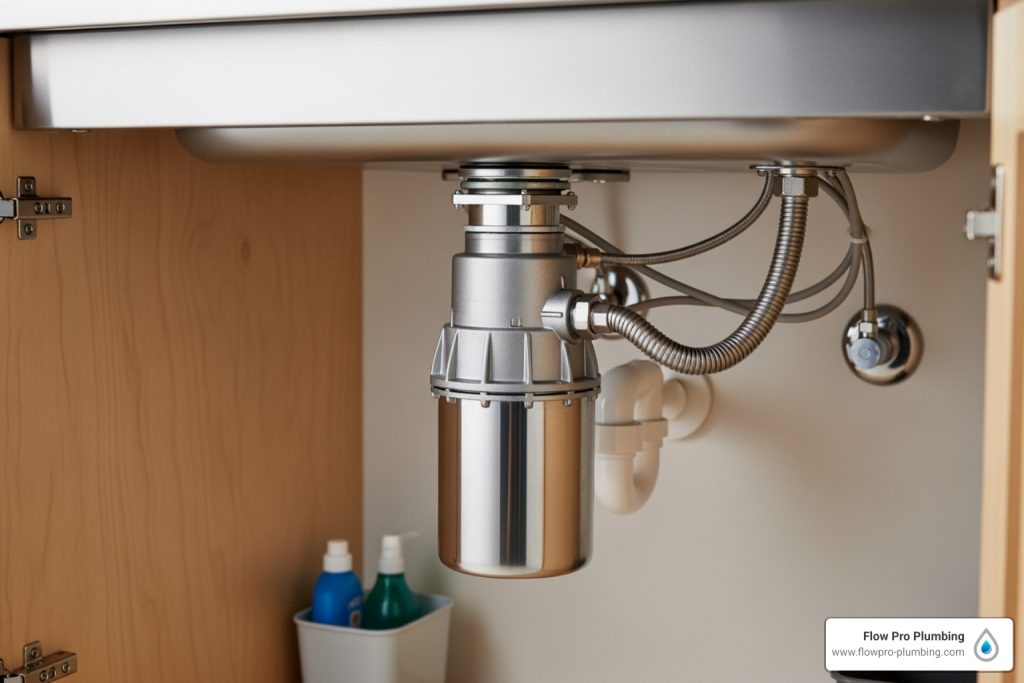
Understanding Garbage Disposal Blade Replacement
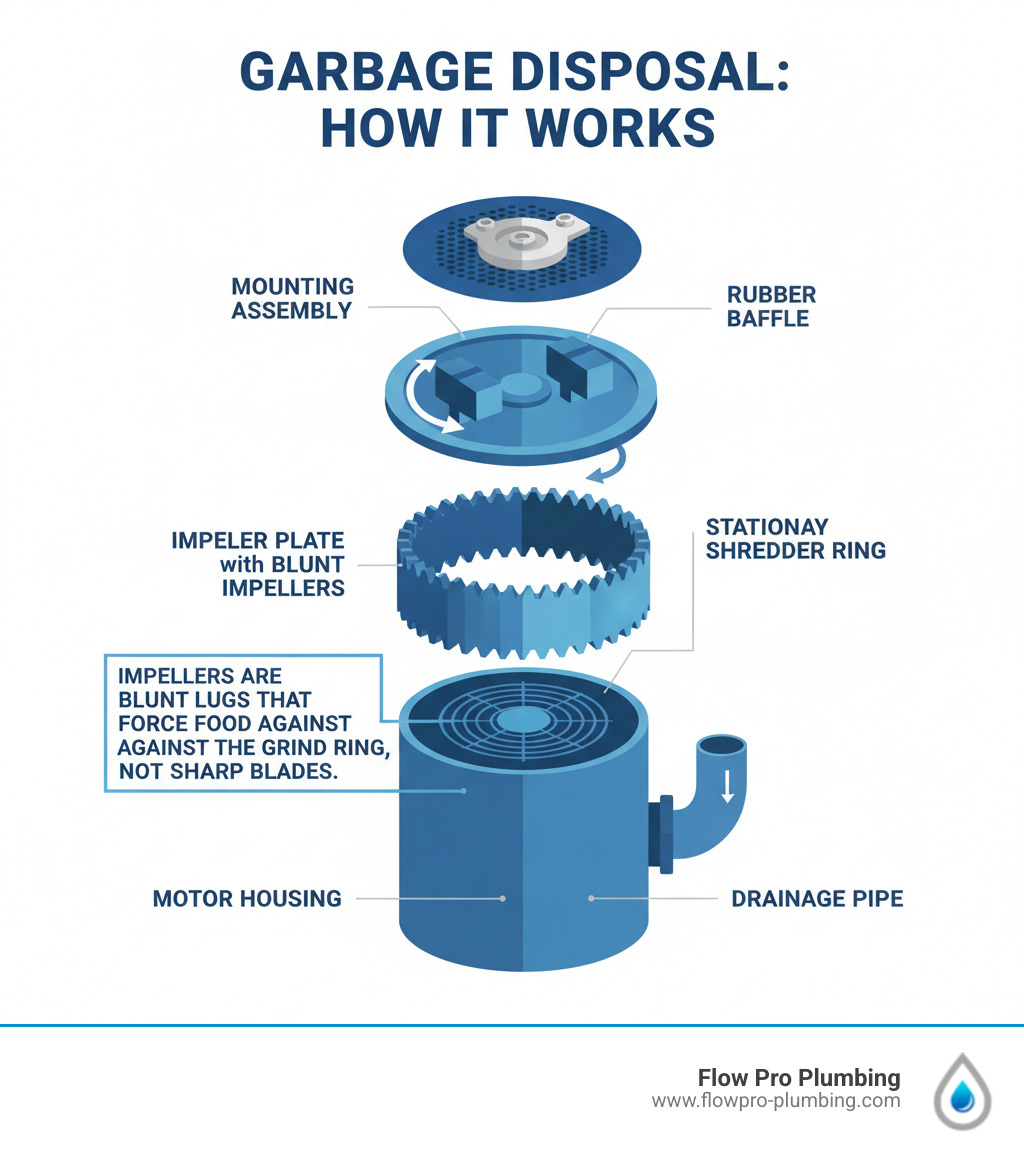
When your disposal grinds poorly, garbage disposal blade replacement seems like the obvious fix. However, here’s a key insight from my plumbing experience: most garbage disposals don’t have replaceable blades. Instead, they use blunt metal impellers (lugs) that are permanently attached to the unit.
Quick Answer: Can You Replace Garbage Disposal Blades?
- No Sharp Blades: Disposals use blunt impellers, not blades.
- Impellers are Permanent: They are riveted to the unit and not designed for replacement.
- Impeller Failure = Unit Replacement: When impellers wear out, the entire disposal must be replaced.
- DIY Fixes: You can free stuck impellers, but you can’t replace them on most models.
Most homeowners are actually dealing with stuck impellers, jams, or a worn-out unit that needs full replacement. The good news is that you can often fix a jam or replace the entire disposal yourself in just a couple of hours.
As Jesse Delgado, owner of Flow Pro Plumbing, I’ve helped countless East Bay Area homeowners with disposal issues. The reality is that “blade replacement” almost always means replacing the entire unit. My team is trained to educate customers on disposal maintenance so they can make informed decisions.
Similar topics to Garbage disposal blade replacement:
Before You Begin: Signs, Tools, and Safety
Before you start working, it’s important to understand what’s really happening under your sink. When most people think they need a garbage disposal blade replacement, they’re actually seeing the warning signs of a disposal reaching the end of its life. Catching these issues early helps you plan ahead and avoid an emergency.
Signs Your Impellers Need Replacing
Even the toughest units show their age. Here’s what to watch for:
-
Slow draining or inefficient grinding: If food waste isn’t breaking down, it will create a sluggish drain that backs up. This happens when worn impellers can no longer push food against the shredder ring effectively.
-
Unusual humming or grinding sounds: Loud rattling, clanking, or a motor that hums without grinding indicates a problem. A hum with no action often means the impellers are completely stuck. If you’re dealing with a Garbage Disposal Humming Not Working situation, investigate right away.
-
Frequent resets: If the reset button keeps tripping, the motor is likely overheating. This is usually caused by the strain of grinding with worn-out impellers or fighting a jam.
-
Persistent odors: Lingering smells that cleaning can’t fix are often a sign that food particles are trapped in the grinding chamber because the impellers aren’t doing their job.
-
Visible corrosion: If you look inside your disposal (with the power off!) and see rust on the impellers or chamber, the unit is past its prime. The Effects of corrosion on metal weaken the components and make them less effective.
Most disposals last 10-15 years. If yours is approaching that age and showing these signs, replacing the entire unit is smarter than attempting a repair. Good Maintenance Tips for Garbage Disposals can extend its life, but nothing lasts forever.
Safety First!
Working with electricity and water under a sink requires caution. Follow these non-negotiable safety steps.
-
Turn off the power: Go to your circuit breaker and flip off the breaker for your kitchen. If the disposal has a plug, unplug it. Test the disposal’s wall switch to confirm the power is off.
-
Shut off the water supply: Close both the hot and cold water shut-off valves under the sink by turning them clockwise.
-
Wear protective gear: Safety goggles will protect your eyes from debris, and work gloves will keep your hands safe from grime and sharp edges.
[LIST] of Tools and Materials for Garbage Disposal Blade Replacement
Since this job involves replacing the entire unit, gathering these tools beforehand will make the process smoother:
- New Garbage Disposal Unit
- Screwdriver Set (Phillips and flathead)
- Plumber’s Wrench or Adjustable Wrench
- Bucket
- Safety Gloves
- Safety Goggles
- Flashlight or Headlamp
- Allen Wrench (often included with new disposals)
- Plumber’s Putty
- Pliers
- Non-Contact Voltage Tester (for extra safety)
- Wood Block or Broom Handle

Your Step-by-Step Guide to Garbage Disposal Blade Replacement
Now that you’re prepared, let’s walk through the replacement process. When we talk about garbage disposal blade replacement, we’re actually replacing the entire unit. This guide will help you get it done in a couple of hours.
Step 1: Disconnect Power and Plumbing
Safety is the priority. First, turn off the circuit breaker for the kitchen and unplug the disposal. Use a non-contact voltage tester to confirm the power is off. Next, shut off the water supply valves under the sink.
Place a bucket under the P-trap (the curved drain pipe) to catch water. Use a plumber’s wrench to disconnect the P-trap from the disposal and the wall drain. If you have a dishwasher, use a screwdriver or pliers to loosen the clamp and disconnect the dishwasher hose from the disposal.
Step 2: Remove the Garbage Disposal Unit
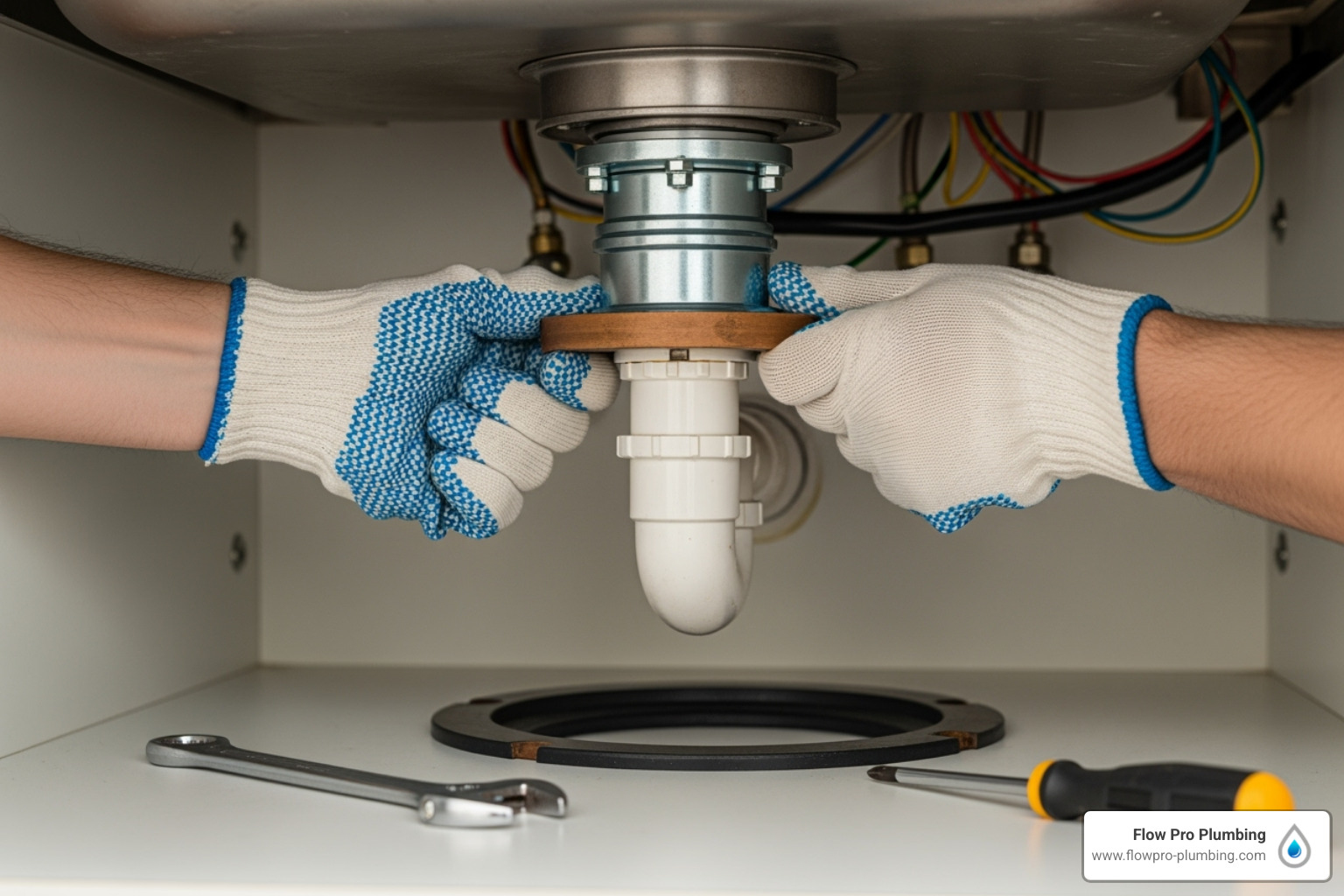
Garbage disposals are heavy, so support the unit from below with a block or sturdy box. This prevents it from falling when you release it.
Look at the metal mounting ring connecting the disposal to the sink. Insert a flathead screwdriver into one of the ring’s tabs and turn the ring counter-clockwise to release the unit. It may require some force.
Carefully lower the disposal. If it’s hardwired, open the electrical plate on the bottom, take a photo of the wiring for reference, and disconnect the wires. Set the old unit aside.
Step 3: The Process for Accessing and Removing Old Garbage Disposal Blades
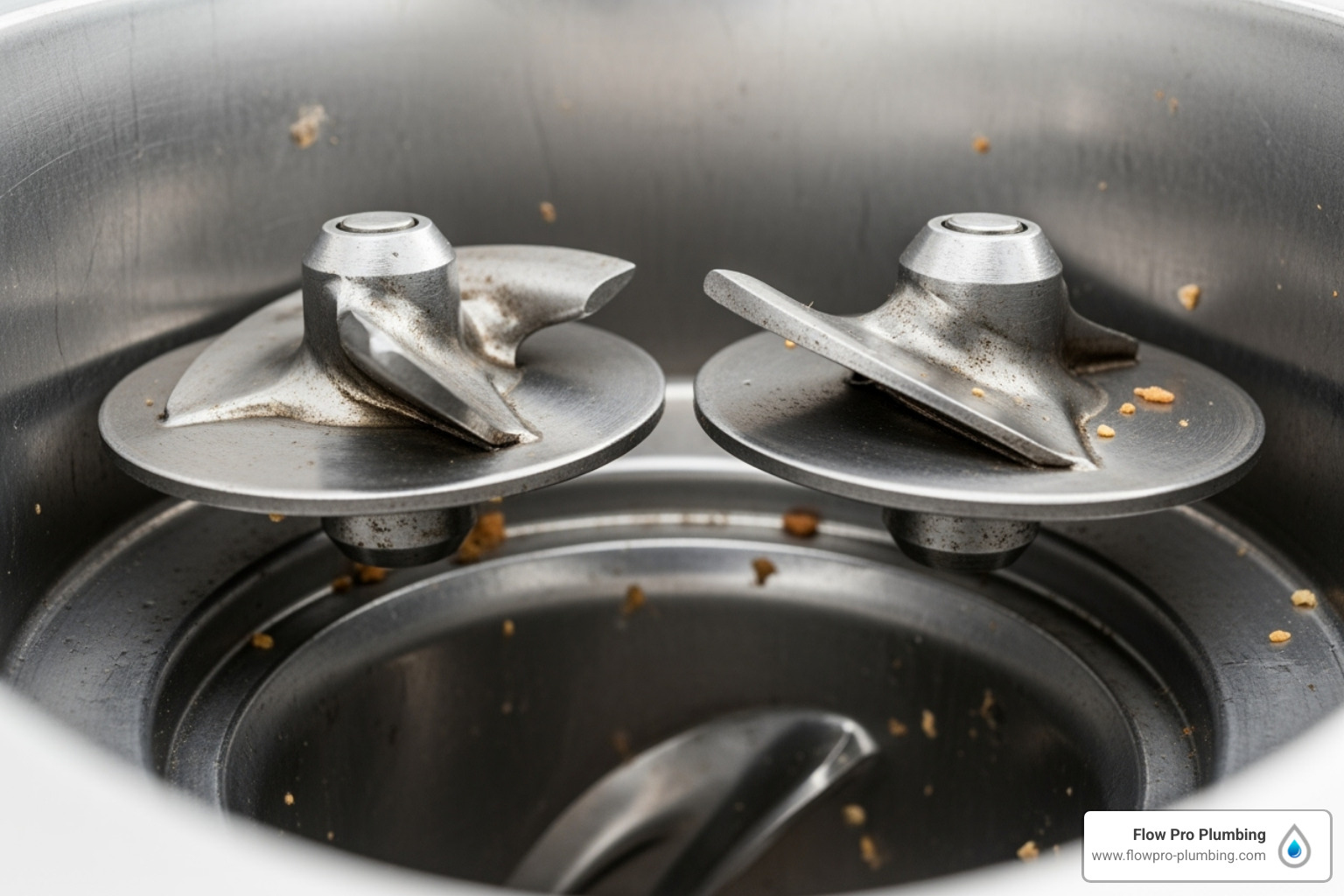
With the old unit removed, look inside the grinding chamber. You’ll see the two blunt metal impellers that are often mistaken for blades. Try to move them with a wooden spoon. If they are frozen, excessively loose, or severely corroded, you’ve confirmed the need for replacement.
Check for any foreign objects like bones or utensils that may have caused a jam. While removing an object can sometimes fix a jam, at this stage, replacement is the goal.
This inspection confirms why garbage disposal blade replacement means full unit replacement. The impellers are permanently attached and not designed to be serviced.
Step 4: Install New Impellers and Reassemble
Now, let’s install the new disposal. Start by cleaning the sink drain opening and removing old plumber’s putty. Apply a rope of new putty to the underside of the new sink flange and press it firmly into the drain opening.
From underneath, install the new mounting assembly. Slide the gasket, backup flange, and mounting ring onto the flange, then secure it with the snap ring. Tighten the three mounting screws evenly until the assembly is snug.
Important: If you have a dishwasher, you must knock out the drain plug on the new disposal. Use a screwdriver and hammer to tap it out from the side inlet, then reach inside the disposal and remove the plastic plug.
Next, connect the electrical wiring. For hardwired models, connect the wires (black to black, white to white, and ground to the green screw) and secure them with wire nuts. For plug-in models, attach the power cord.
Finally, lift the new disposal into place, aligning its tabs with the mounting ring. Twist the disposal clockwise until it locks firmly into place.
Step 5: Reconnect and Test for Leaks
We’re almost done. Reconnect the discharge tube to the P-trap and the P-trap to the wall drain, tightening the slip nuts with a wrench. Reconnect the dishwasher hose and secure the clamp.
Turn the water supply back on. Run water into the sink for several minutes and use a flashlight to inspect every connection for leaks. If you see a drip, gently tighten the connection. If a leak persists, you may need to re-seat the connection.
Once you’re sure everything is dry, restore power at the circuit breaker or by plugging the unit in. With water running, turn on the disposal to test it. It should run smoothly. If you still have drainage issues, you may need to Fix Clogged Sink problems further down the line.
Congratulations! You’ve successfully replaced your garbage disposal.
DIY vs. Calling a Professional: When to Get Expert Help
While DIY projects are rewarding, it’s wise to know when to call for backup. There’s no shame in calling a professional; in fact, it often protects your home from costly mistakes. Here are some situations where expert help is the smartest choice.
-
Complex electrical issues: If you’re uncomfortable with wiring or suspect a serious electrical problem, don’t risk it. Mixing water and electricity is dangerous, and a wrong connection can lead to injury or fire.
-
Severe corrosion or cracks: If the disposal’s housing is cracked or leaking from the body of the unit itself, it’s internally damaged and needs professional replacement.
-
The unit is over 10-15 years old: The average lifespan of a disposal is 10-15 years. For an aging unit, replacement is often more cost-effective than repeated repairs.
-
Persistent leaks: If you’ve done the job but one stubborn connection keeps dripping, a plumber can quickly diagnose and fix the issue.
-
Lack of proper tools or time: Your time is valuable. If you don’t have the right tools or simply don’t want to deal with the hassle, our team is here to handle the job efficiently.
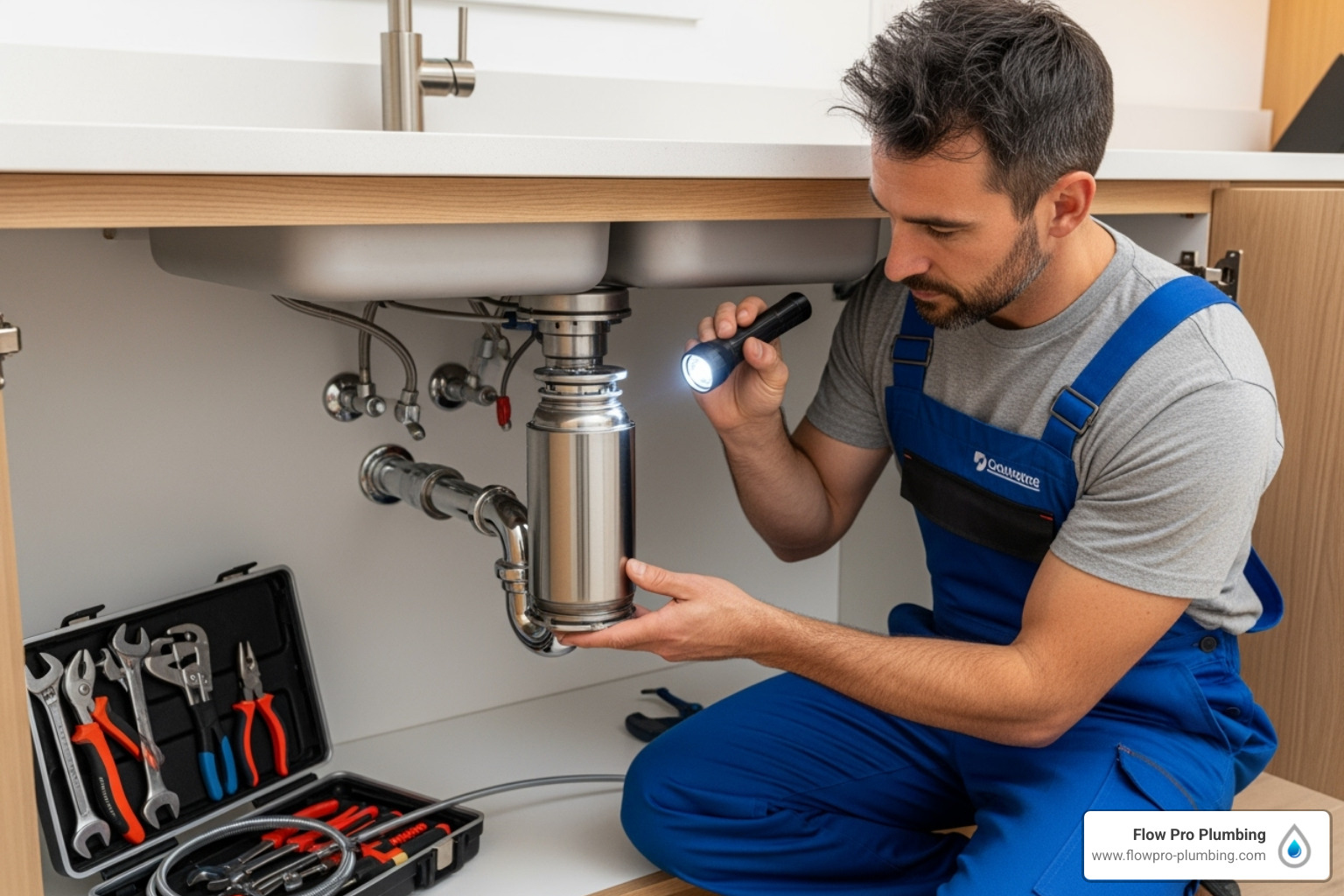
We serve the entire East Bay Area, including Brentwood, Oakley, Antioch, Pittsburg, Concord, and Walnut Creek. Our reputation is built on superior service and quality workmanship. If you’re in the Antioch area, learn more from our Garbage Disposals Antioch Guide.
Whether you tackle this project yourself or call us, what matters is that it’s done safely and correctly. We’re always here when you need us.
Frequently Asked Questions about Disposal Impellers
Homeowners often have the same questions about garbage disposals. Let’s clear up the confusion about those mysterious “blades.”
Do garbage disposals have sharp blades?
No, and this surprises most people. Garbage disposals do not have sharp blades like a blender. They use blunt metal lugs called impellers. These impellers use centrifugal force to fling food waste against a stationary, serrated grind ring built into the chamber wall. The ring does the actual pulverizing, not the impellers.
How do I know which replacement blades are compatible with my disposal?
Since impellers aren’t sold as separate parts for most disposals, this question is really about finding a compatible replacement unit. To do this, find your garbage disposal’s model number, which is usually on a sticker on the unit’s side or bottom. Use this number to search for a new disposal that will fit your existing mounting system and plumbing connections. If the impellers are worn or damaged, a full unit replacement is the correct solution.
Can I just sharpen my old garbage disposal blades?
Not really. The idea of “sharpening” impellers by grinding ice cubes or small bones is a myth. This practice only cleans the impellers and grind ring by dislodging caked-on food debris, which can temporarily improve performance. However, it cannot repair impellers that are physically worn down, corroded, or damaged from years of use. In those cases, replacing the entire garbage disposal unit is the only effective solution to restore proper performance.
Restore Your Kitchen’s Flow and Function
You now know that garbage disposal blade replacement isn’t about blades at all, but about hardworking impellers that usually require replacing the entire unit. With this knowledge, you can confidently troubleshoot your disposal issues.
Replacing a worn-out disposal brings immediate benefits: improved grinding efficiency, which helps prevent future clogs, and quieter, smoother operation. Your kitchen will thank you!
Throughout this process, safety is paramount. Always disconnect the power at the breaker and shut off the water supply before you begin.
If this project seems too complex, or if you run into issues you can’t solve, that’s what we’re here for. For complex repairs or full unit installations in Antioch and throughout the East Bay—including Brentwood, Oakley, Pittsburg, and Concord—the expert team at Flow Pro Plumbing is just a phone call away. We bring years of experience to get the job done right the first time.
Don’t let a faulty disposal disrupt your kitchen. Whether you DIY or need our professional touch, we’re here to ensure your plumbing flows smoothly.
Contact us for professional plumbing services in Antioch, CA